Blood as an emotional bond
The RadleysBlood as an emotional bond describes the intimacy and knowledge that vampire blood can carry between people, beyond its roles in craving and conversion. Its clearest expression comes when Rowan Radley saves Eve Copeland with his blood: the exchange brings her back to life as a vampire and gives their relationship a depth neither ordinary familiarity nor spoken declaration could provide. Elsewhere, Rowan’s experience of drinking Helen Radley’s blood changes how he understands her concealment of the past, joining emotional attachment to family identity and responsibility.
Blood, Abstention, and Conversion
The concept operates within a world where blood has both a physical force and a relational consequence. When Rowan asks whether his father was converted, Peter Radley explains that he was born a vampire, as members of the Radley family have been for generations; Helen, by contrast, was converted. The distinction makes blood exchange more than a general marker of vampire identity: conversion can establish a particular connection between the person who gives blood and the person changed by it.
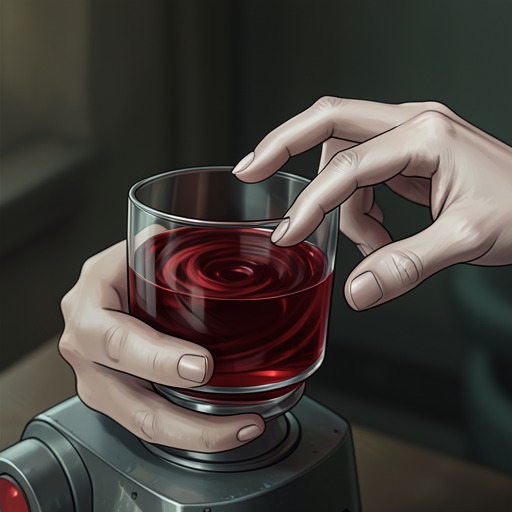
That connection is not presented as an uncomplicated benefit. The second edition of The Abstainer’s Handbook warns that blood magnifies cravings rather than satisfying them, and its discussion of abstention also identifies suicidal depression as a common burden. Rowan encounters these tensions in his own life. After finding the handbook’s note on suicide, he later holds a bottle of vampire blood and considers whether he can take only a small amount. When he drinks, he feels immediate relief from worry and physical discomfort. The episode makes blood’s short-term power evident, but the handbook’s warning frames that relief as intensification rather than resolution. Blood can change a person’s state; the emotional bond it creates is part of a broader and potentially destabilizing force.
Blood and Rowan’s Family Understanding
Rowan’s contact with blood also alters how he interprets his family. Will Radley finds a shoebox containing a letter and a photograph of Rowan as a young child, objects that connect the hidden past to Rowan’s parentage. Later, after tasting Helen’s blood, Rowan no longer feels the same anger about what she concealed. He understands her secrecy as an attempt to protect him, and this empathy changes what he chooses to do with the evidence.
The shift is practical as well as emotional. Rowan takes the letters Helen sent to Will in the early and mid-1990s, along with the childhood photographs, and burns them. He does so to preserve the family’s secret and, in his words as conveyed by the narration, to make Peter his father again. The act does not erase the history the objects contain; it shows Rowan deciding that his newly enlarged understanding of Helen matters more than exposing that history. Blood therefore joins knowledge to obligation: what Rowan learns through it changes how he treats his mother and what he is willing to conceal for the family.
Rowan and Eve: Blood as Intimacy and Protection
The bond reaches its fullest expression when Eve is dying and asks for Rowan’s blood. Helen explains to Jared Copeland that giving Eve blood will make her a vampire and that she is likely to feel strongly toward the person whose blood converts her. Eve’s choice is not simply a response to Rowan’s wish to save her. She recognizes that he wants to keep her alive, but also understands that he hopes her survival might save him from his own despair. Even in this crisis, the decision about whose blood to use belongs to Eve.
Rowan cuts his palm and gives her his blood. As she recovers, Eve experiences the exchange as a form of intimate knowledge: she does not acquire a store of everyday facts about Rowan, but feels that she knows him at a deeper level. That knowledge becomes love, understood as reciprocal rather than one-sided. The bond also carries a promise of mutual protection. Blood here does not merely mark a transformation performed upon Eve; it makes Rowan and Eve’s connection part of the transformed life she chooses to accept.
Meaning and Limits of the Bond
The book places this affirmative bond beside blood’s capacity to intensify appetite and to bring immediate relief. Rowan’s drinking from a bottle and his later experience of Helen’s blood are not identical in consequence: one is associated with cravings and a brief lifting of distress, while the other produces empathy that reshapes his response to family history. The distinction cautions against treating every encounter with blood as inherently loving or morally clarifying. Its effects depend on the relationship and circumstances in which it is encountered.
In Eve’s conversion, blood becomes a medium for attachment, but the scene also preserves her agency: she chooses Rowan’s blood after understanding what conversion entails. In Rowan’s response to Helen, the bond does not make the family past disappear; it enables him to act with greater sympathy toward the person who kept it hidden. Blood as an emotional bond thus links intimacy with consequence. It can establish a new relationship, deepen an existing one, or change what a person believes they owe to family, while remaining inseparable from the risks and cravings associated with vampire life.