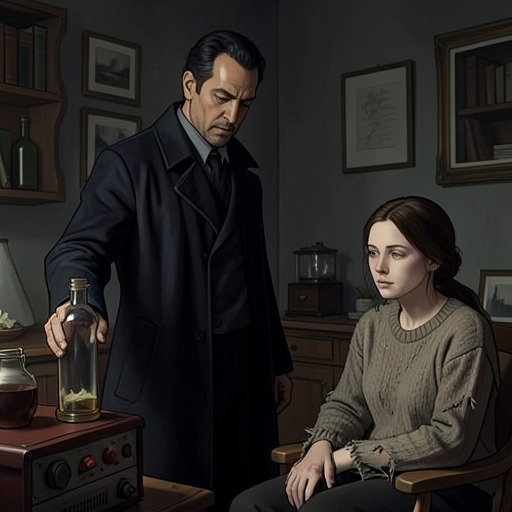
Lorna Felt’s blood sample
The RadleysLorna Felt’s blood sample is a set of three vials sent in a padded envelope to the hospital, but its decisive significance lies in what it becomes for Peter Radley: a clinical specimen that draws him back to drinking after nearly twenty years of abstinence. Its passage from the mail pile to his room, and then from a drawer to his lips, gives the object a precise narrative arc. At each step, medical handling and private craving occupy the same space, until the doctor’s professional language can no longer hold the temptation at a distance.
Origin and Identification
Peter notices the brown padded envelope among mail to be sent to the hospital while at work in his surgery. Before opening it, he is already drawn to it by smell; his attention sharpens and his heart quickens. The response arrives before confirmation, as though the sample is recognizable to him in a way ordinary specimens are not.
He carries the envelope into his room and checks the time: five minutes remain before his next patient. Inside are three plastic vials and a pale blue NHS form. The form identifies the blood as Lorna Felt’s, confirming what Peter’s nose had already told him. This combination of administrative paperwork and bodily recognition establishes the object’s double character. It is documented patient material, but for Peter it has a personal force that the form can name without diminishing.
Clinical Distance and Growing Temptation
Peter initially attempts to preserve the distinction between doctor and consumer. He tells himself that blood is a mixture of plasma, proteins, and red and white cells, and tries to look at the vials as a doctor should. He also thinks of his son and daughter. Those thoughts help him put the three vials back and try to reseal the envelope, an effort that fails when it peels open again as he sits down.
The envelope’s opening marks a shift from controlled handling to sustained attention. Peter experiences its dark gap as carrying both fear and pleasure, possibilities he cannot separate. Although he manages to return the sample at first, he does not remove it from his immediate surroundings: he puts the envelope in a drawer. The effort at restraint therefore leaves the object accessible, and his clinical explanation remains in direct competition with the attraction he has already felt.
When another patient leaves, Peter takes the envelope back out, removes the vials, and unscrews their caps. At this point he no longer accepts the medical terms he used to steady himself. The sample has become, in his understanding, a means of escape. He associates its smell with an imagined scene of himself and Lorna standing together in a field at night, and his desire to taste the blood rises until he sees no space between himself and the pleasure he wants. The shift is not simply from thought to action: his attempt to define the blood medically has been displaced by an intensely personal association with its owner.
Consumption and Immediate Aftermath
Peter recognizes that he is unlikely to resist, and the three vials become three successive acts of consumption. He drinks them one after another, abandoning the rule he had tried to maintain against drinking a patient’s blood. The speed and completeness of the act contrast with the earlier handling of the envelope: he had returned the vials, considered his children, and tried to restore the seal, but none of those measures prevents him from consuming the entire sample.
Afterward, Peter keeps his head back and pats his stomach. He notices that the layer of fat that has accumulated over the years may be receding, a bodily change he registers immediately after drinking. He then speaks to himself as though introducing music on a late-night radio programme, expressing affection for live jazz. The abrupt, buoyant performance is part of the aftermath: his attention has moved from the medical specimen and his failed restraint to a newly energized self-presentation.
Significance Within the Story
The sample makes Peter’s abstinence concrete by testing it against a particular person’s blood, in the setting of his own surgery. His knowledge as a doctor helps him identify and classify the vials, but it cannot make them emotionally neutral. The paperwork verifies their source; his attempted return to clinical thought cannot cancel the attraction; and the drawer that temporarily hides the envelope becomes only a brief pause before he retrieves it.
The episode also gives physical form to a principle printed in The Abstainer’s Handbook (second edition): blood does not satisfy craving but magnifies it. Peter’s experience follows the pressure of that warning rather than a simple movement from hunger to resolution. The sample’s arrival triggers recognition and desire, his effort at restraint keeps the vials close, and drinking them is followed by a marked change in how he feels and behaves. The object’s importance rests in this reversal: what enters the surgery as patient material exposes the limit of Peter’s practiced separation between medical knowledge and his own dependence.