Peter Radley
The RadleysPeter Radley is a doctor and the father of Rowan Radley and Clara Radley, married to Helen Radley. A vampire who has abstained from blood for seventeen years, he tries to hold family life together through routine, medical reassurance, and a commitment to doing what he believes is right. His renewed taste of blood exposes the cost of that commitment, but his later choices show that temptation does not settle the question of who he intends to be.
Identity and Family Life
Peter’s professional life is grounded in ordinary medical work. On one day, he sees his fourteenth patient and tries to keep his attention on the examination rather than on what the task requires of him. At the same time, he is preoccupied with Clara’s refusal to eat meat and searches for a way to persuade her to change her diet. His concern for her emerges through practical, sometimes uncomfortable circumstances rather than grand declarations: he wants to protect his daughter, but initially approaches the problem as a doctor seeking a remedy.
His medical outlook includes a clear understanding that reassurance can itself have therapeutic force. Peter knows that a patient’s confidence and expectations can affect how treatment works, and he recalls research showing that the apparent effects of a medicine can vary with its presentation. That knowledge makes him attentive to the power of explanation, but it also sits uneasily beside the family secret he must eventually explain. In Clara’s case, the truth cannot be reduced to a reassuring medical story.
Peter’s role as a husband is similarly bound to daily practices. Helen values routine as a form of therapy, and Peter recognizes her determination to keep the family’s Sunday dinner proceeding normally. On that afternoon, he studies the cooked lamb on his plate while the familiar meal continues around him. The scene places ordinary domestic repetition beside the family’s extraordinary condition: routine offers a way to carry on, but it cannot make the underlying facts disappear.
The Family’s Disclosure
When Clara’s condition becomes impossible to explain away, Helen begins by telling her that she was provoked and that the hunger she is experiencing is connected to an inherited condition. Peter interrupts the attempt to soften the explanation. Looking directly at Clara, he tells her plainly that the family are vampires. His intervention marks a shift from medical language and gradual preparation to direct acknowledgment. He takes responsibility for naming what the household has concealed.
Peter also gives Rowan an account of the family’s past relationship with blood. He says that he tried to avoid drinking it, seeking supplies through other means, including at a hospital. He recalls that the police never officially acknowledged vampires, though special units existed, and that people were known to disappear and be killed. He admits that fresh human blood was the most compelling and that cravings could become powerful, bringing an intoxicating sense of energy. He does not present those experiences as a justification. Instead, he tells Rowan that the family’s abstinent way of life is better, even though it leaves them feeling unwell much of the time and may mean they die younger. His account frames abstention as a moral decision with a physical cost, not as effortless self-control.
Rowan asks whether Peter was converted into a vampire. The question shows that the family’s disclosure opens further uncertainties about identity and inheritance; the available account records the question, but does not establish Peter’s answer. For Peter, the revelation is therefore not a single explanation that resolves everything. It begins a more difficult conversation about the origins, consequences, and limits of the family’s condition.
Abstention, Temptation, and Return
After seventeen years without tasting blood, Peter licks his hands and feels his body transform. Strength returns, aches recede, and he experiences the change as a release from prolonged discomfort. The intensity of that response gives concrete force to the conflict he has described to Rowan: abstention is a sustained deprivation, while blood offers immediate physical reward. The scene does not erase Peter’s reasons for refusing it; rather, it shows why those reasons are continually tested.
Later, Peter drinks Lorna Felt’s blood. The exhilaration does not last. Once it fades, he is left with temptation stripped of its pleasurable gloss, and he becomes alarmed by what the experience means. He retrieves The Abstainer’s Handbook from Rowan’s room without asking and turns to the text as a source of guidance. The detail matters: in a moment of private uncertainty, Peter reaches for the family’s rules, even though he has taken the book from his son’s space without permission.
Peter sits in his car watching couples enter the Fox and Crown. Their ordinary pleasures—cultural events, walks in the country, and evenings of music—become an image of the unremarkable human life he wishes he could inhabit. He longs to have been born human and to be free of wanting more. That longing complicates his earlier defense of abstention: he believes it is better to be good, yet the discipline does not extinguish desire or make him feel at home in his own condition.
He thinks he sees Rowan’s forlorn face through the car window and worries that his son may have seen him. The possibility changes his response. What had been a pleasurable temptation becomes a solid sense of duty; Peter starts the engine and heads home. The scene ties his return to his relationship with Rowan without confirming whether Rowan was actually outside. Peter acts on what he fears his son might have witnessed, and on the responsibility that fear awakens.
Marriage, Blood, and Moral Choice
Peter’s relationship with Helen carries a history older than the family’s current crisis. At one point, Helen thinks she hears him whisper a single word under his breath, perhaps a reference to jazz; the uncertainty of what she hears preserves the small, private texture of their shared life. Their marriage also appears in the routines Peter recognizes and in the moments when he must decide whether to remain beside her through difficult truths.
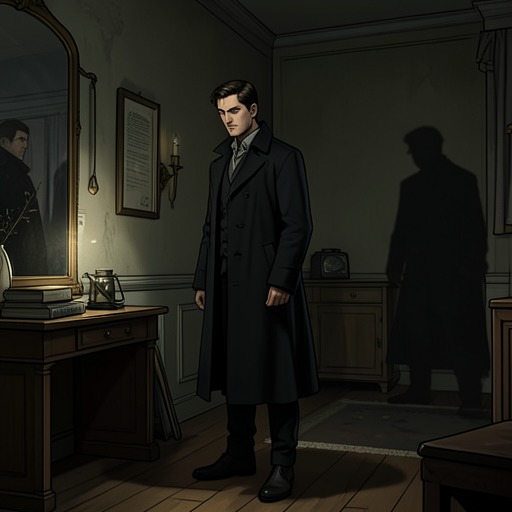
After the violence at the pond, Peter returns wearing his coat and carrying his car keys. Rowan watches him approach; Peter’s attention settles on the pond, and his face freezes as he understands what has happened. He repeats an expression of shock in a barely audible voice. The moment gives his return a different weight from the earlier drive home: this time he is confronted with an irreversible consequence, and the scene registers his recognition before it explains his feelings further.
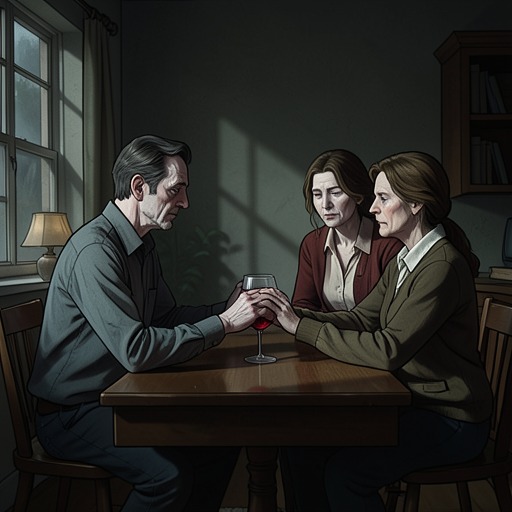
At home, Peter and Helen eventually drink blood together from wine glasses they bought from Heal’s before the previous Christmas. They choose the familiar vessels of a civilized domestic ritual for an act bound to their vampiric nature. Peter asks for reassurance that Helen loves him, admitting that he needs to know. His vulnerability contrasts with the self-possession of the doctor who understands confidence and reassurance as forms of medicine.
He argues that people believe what they want to believe, and that facts can be ignored when they conflict with a preferred account. He applies that observation to the world’s refusal to believe in vampires, but also to the story he wants to believe about his marriage: that he and Helen have loved each other beneath what has come between them. He acknowledges that blood may be influencing his feelings, yet still chooses to believe in their relationship. His smile recalls the one that first attracted Helen, and his flirtation restores a note of intimacy without undoing the damage or uncertainty that preceded it.
Narrative Significance
Peter’s arc places ethical commitment beside bodily need without pretending that either cancels the other. He knows the history of craving, recognizes the pleasure blood brings, and experiences that pleasure again after seventeen years; he also judges abstention to be better and turns back toward his family when temptation threatens to define him. His choices are neither presented as effortless nor reduced to a simple victory over appetite.
The novel also uses Peter’s professional knowledge to sharpen the contrast between explanation and truth. He understands how reassurance can help, but when Clara needs an account of her condition, he abandons a tentative medical preamble and names the family’s reality. Later, he himself seeks reassurance from Helen, making the doctor who knows its value a husband who needs to receive it. His scenes connect blood to physical dependence, family disclosure, moral responsibility, and marital intimacy: the same substance that revives and tempts him can also become part of a shared act through which he and Helen choose to affirm their bond.