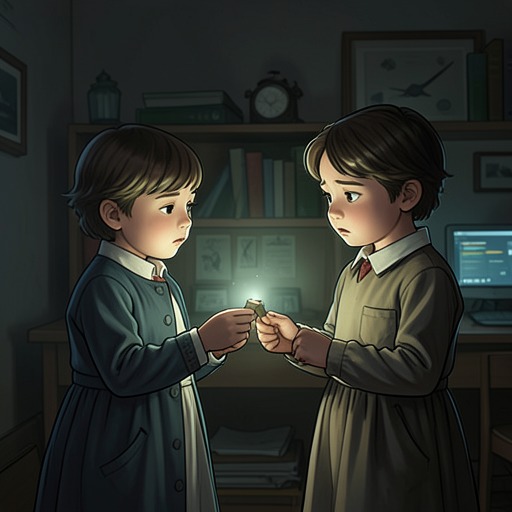
Rowan Radley and Clara Radley's sibling bond
The RadleysRowan Radley and Clara Radley share a sibling bond that functions as their closest friendship and a rare refuge from the pressures around them. Rowan is protective of Clara and unusually candid with her; Clara, in turn, notices when his feelings are hurt and offers to make sacrifices for him. Their relationship is not without friction. As their family’s hidden nature comes to light, they argue over what their parents have done and what it means, making their closeness a place both for comfort and for difficult moral disagreement.
Identity and Early Bond
Rowan regards Clara as more than his sister: she is the only friend he has, and the only person with whom he can be himself. That confidence distinguishes their relationship from the judgments and teasing they face at school. Clara is nearly two years younger than Rowan, but the difference in age does not prevent her from understanding his emotional stakes or speaking directly to him about them.
Their ease with one another includes teasing. When Clara defends veganism, Rowan winds her up with an argument about the living organisms in potatoes and soup. He soon recognizes that he has gone too far. Rather than continue the joke, he quietly points out that she looks unusually pale. His shift from provocation to concern captures a recurring feature of their intimacy: he can needle her because they are close, but he also watches for signs that she is unwell. Clara dismisses the nausea as a result of the early summer weather, while Rowan is suffering too; neither is entirely separate from the other’s discomfort.
School, Vulnerability, and Loyalty
At school, their closeness is tested by the attention of bullies and by Rowan’s feelings for Eve Copeland. When Rowan fears that Eve is looking at him, he wishes he could escape the moment. As he opens his eyes, Clara and Eve are talking, while Clara grips the seat rail and appears ill. Rowan worries not only about her immediate discomfort but also that Toby Felt and Harper will turn their attention toward her. The scene makes his protectiveness practical: his concern is bound up with his knowledge of how readily the boys make other people targets.
Clara also becomes a source of reassurance when she herself is struggling. After leaving a difficult moment at school, she is relieved to find Rowan waiting in the corridor and is pleased to see the one person she feels able to face. Toby Felt prods Rowan with a tennis racquet and makes a taunt about his relationship with his sister. Rowan says nothing; Clara, though weak, dismisses Toby as an idiot and remarks that she does not understand what Eve sees in him. She then notices that her words have upset Rowan and wishes she had not said them. Their exchange shows that the support runs both ways: Rowan’s concern for Clara is matched by Clara’s attentiveness to his embarrassment and disappointment.
When Rowan tries to conceal his feelings for Eve, Clara offers him more than sympathy. As they walk to their next lesson, she says she will stop being friends with Eve if that is what he wants. Rowan refuses the offer and insists that his crush was only mild. The moment reveals the cost Clara is willing to consider on her brother’s behalf, but also Rowan’s reluctance to make her choose between her friendship and his feelings. Their bond is protective without being wholly possessive: Clara offers, and Rowan tells her not to give up a friendship for him.
A Family Revelation and New Tensions
The relationship enters a different phase when Rowan and Clara learn the truth about their family. During the explanation, Clara asks what has happened to her. She sits in a green dressing gown her parents bought when she was twelve or thirteen, but she appears changed and less frightened than before, checking her eyesight by lowering and raising her glasses. Her question is personal and immediate; the revelation is not merely information about the family but something she must understand as having happened to her.
Rowan responds by seeking clarification about their parents’ origins. He asks whether his father was converted into a vampire, then learns that Peter Radley was born one and that the Radley family has been associated with vampires for centuries. Rowan follows up by asking whether their mother was converted. The questions place the siblings within a shared family history while also distinguishing the paths by which their parents came to it. Clara’s question about herself and Rowan’s questions about their parents show them trying to make sense of the same upheaval from different directions.
Conflict and Shared Moral Ground
After the revelation, their ordinary breakfast-table routine becomes a setting for disagreement. Clara complains about the family’s habit of leaving Radio Four on when nobody listens, interpreting it as an effort to demonstrate middle-class normality. Rowan responds sharply, telling her to stop. When she asks whether he feels anything and points out that he hated Harper, Rowan rejects the idea that dislike could justify wiping out a village. His anger is not simply directed at Clara’s remark: he challenges the principle he hears in it, asking whether violence would be granted whenever someone requested it.
The exchange matters because it shows that sibling closeness does not make them morally interchangeable. Rowan sees Clara as acting unlike herself and is exhausted, yet anger revives him; Clara, meanwhile, studies him as though he is the one whose behavior has become strange. Their parents try to calm them, but the siblings remain caught in the argument. The evidence does not resolve this disagreement. It presents the bond as strong enough to sustain direct confrontation, not as a guarantee that either sibling will persuade the other.
Significance of the Bond
Across these scenes, Rowan and Clara repeatedly serve as each other’s first point of recognition. Rowan is the person Clara seeks when she feels unable to deal with anyone else, and Clara is the person who sees past his attempts to minimize his feelings. They are both vulnerable to outside scrutiny, whether from school bullies or from the disruption of their family’s secret, and their closeness offers practical care as well as emotional understanding.
The relationship’s movement from teasing and school confidences to questions about transformation and conflict over violence gives the bond more than one register. Its loyalty appears in small gestures: Rowan notices Clara’s pallor and fears the bullies will target her; Clara notices that her comment has hurt him and offers to surrender a friendship for his sake. Later, their arguments show that the same intimacy can expose differences rather than smooth them away. Their sibling bond is therefore a central measure of how family love operates in the story: it can shelter, challenge, and remain present even when the siblings do not see events in the same way.