Vampire Conversion by Blood Exchange
The RadleysVampire Conversion by Blood Exchange is the process by which a human becomes a vampire through a reciprocal exchange of blood. In the account Will Radley gives the Radley family, one person drinks the other’s blood and the exchange is then returned; conversion is not merely a way to feed, but a serious commitment that creates a lasting emotional bond. The process joins bodily change to attachment, so that the person who saves or transforms someone may also become the focus of feelings that neither participant can simply dismiss.
Definition and Process
Will distinguishes conversion from killing for blood: a vampire need not kill a person in order to taste their blood, because conversion is another possibility. The distinction matters. Ordinary feeding takes blood; conversion changes the person who receives it. The exchange is two-way, rather than a one-sided act, and Will presents it as a consequential decision rather than a casual alternative to feeding.
The resulting bond is central to his explanation. The newly converted person will crave and love the convertor for as long as they live, even when they understand that loving that person is harmful or unwelcome. Rowan Radley presses on the implication, asking whether the converted person would feel love even without liking the convertor. Will confirms that this is how the arrangement works. The bond is therefore not described as an emotion freely chosen after the transformation: it is a consequence of the exchange, capable of overriding a person’s considered judgment.
Conversion also has consequences for the person who initiates it. Will recalls that rapidly giving blood after having tasted someone else’s can weaken the convertor emotionally and create an attachment almost as serious as the converted person’s. The relationship is consequently reciprocal in more than its physical procedure. Both participants may be affected, although the attachment is described as especially powerful for the newly converted person.
Attachment, Risk, and Irreversibility
The Abstainer’s Handbook treats contact with a convertor as a serious emotional hazard. Its warning advises converted people not to seek contact again, because feelings toward the person whose blood caused the transformation may be difficult to resist and meeting that person could provoke an overwhelming emotional response. The warning frames conversion as an event whose consequences persist beyond the exchange itself: distance may be necessary, but the attachment remains a force to be reckoned with.
Will’s exchange with Helen Radley gives that danger a personal history. A photograph marked Paris, 1992, shows Helen with the man she recognizes as her convertor. She cannot bring herself to destroy the photograph or stop looking at it, despite wishing it did not exist. The image connects the conversion bond to a remembered past that remains emotionally present. Helen’s continuing response does not erase what she knows about the relationship; it shows the difficulty of separating knowledge from the attachment associated with conversion.
Later, Will refers to having converted Helen before Peter Radley did. When Helen challenges the idea that this makes her feel more for Will, he answers that a person cannot be converted twice. His remark makes the prior transformation sound irreversible: the relationship created by conversion cannot be displaced by a later choice or repeated exchange. In the story, that history complicates Helen’s present family life and Will’s return, because an old bond remains consequential even when the people involved have other commitments.
Conversion and Other Forms of Blood Use
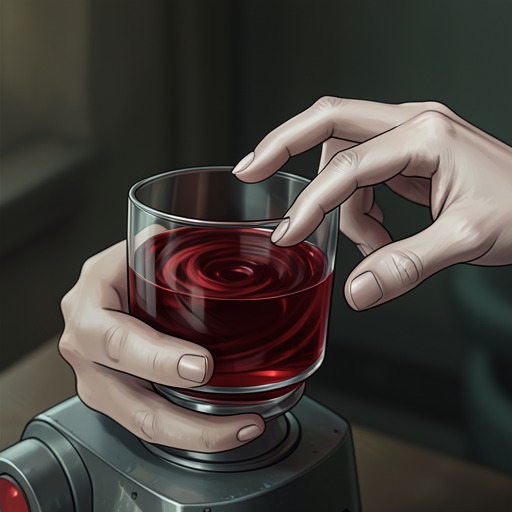
The novel distinguishes conversion from drinking vampire blood for its immediate effects. Rowan, holding a bottle of vampire blood, considers taking only a small sip, then drinks it while thinking of the boy who bullied him. The blood briefly eases his worries and physical discomfort. That episode presents ingestion as a tempting response to distress, but it is not conversion: Rowan drinks from a bottle, and no reciprocal exchange with a convertor takes place.
The distinction also clarifies the danger attached to blood. The Abstainer’s Handbook warns that blood does not settle cravings but magnifies them, while its guidance on conversion focuses on the emotional consequences of the relationship between the two people. These are connected but distinct risks. Consuming blood can intensify desire; exchanging blood to convert someone creates a lasting bond. The account of vampire blood’s heightened quality after conversion further places the transformed person within a larger economy of appetite, without making ordinary consumption equivalent to the act that changes someone’s nature.
The Radleys’ family history supplies another contrast. Peter explains that he has always been a vampire and that the Radleys have been vampires for generations; Helen, by contrast, was converted. The distinction separates inherited vampire identity from a human life altered through a particular relationship. Conversion is thus not simply a general condition shared by all vampires, but a route into vampirism with its own personal history and emotional obligations.
Relationships and Consequences
The process becomes most clearly consequential when it intersects with love and family. Peter had serious feelings for Helen and considered telling her the truth about vampires, hoping she might voluntarily accept conversion. Will initially regards the idea with skepticism, partly because he understands that conversion would bind the participants emotionally and affect him as well as Helen. The possibility is not presented as a neutral medical or practical decision: it has consequences for existing relationships before the exchange even occurs.
The contrast between Peter’s hopes and Will’s later place in Helen’s past shows how conversion can reorganize intimacy. Helen’s relationship with Peter does not make the earlier bond with Will disappear, and Will’s reference to having converted her turns that history into a point of conflict. The exchange can create attachment, but the evidence does not make that attachment a guarantee of a safe or harmonious relationship. Instead, the bond may persist alongside regret, disagreement, and competing commitments.
Eve Copeland’s conversion brings the process into a different relationship. When Eve is gravely endangered, Rowan wants Peter to give her blood to save her. Helen warns Jared Copeland that using blood to convert Eve will make her a vampire and that Eve is likely to develop powerful feelings toward whoever supplies the blood. Eve chooses Rowan’s blood. As Rowan bleeds into her mouth, she awakens and recognizes him through a profound sense of connection. The scene makes the exchange both a means of saving her life and the beginning of a bond whose emotional consequences Eve understands are part of the decision.
Narrative Significance
Across these relationships, conversion binds transformation to questions of agency. The converted person’s attachment may be powerful enough to conflict with what they know or want, as the handbook’s warning and Helen’s history make clear. Yet Eve’s choice also shows that a person facing the possibility of death can knowingly choose whose blood will save her. The process does not have one uncomplicated meaning: it can impose an enduring emotional consequence, but it can also be accepted as an act of trust and rescue.
Conversion further complicates the boundary between kinship and chosen relationship. The Radleys’ inherited vampirism, Helen’s history as Will’s convert, and Eve’s choice of Rowan’s blood place different origins of vampire identity beside one another. Blood carries biological consequence, emotional attachment, and personal history at once. The exchange changes what a person is, but it also changes how that person is bound to someone else—and those bonds continue to shape the story long after the moment of conversion.