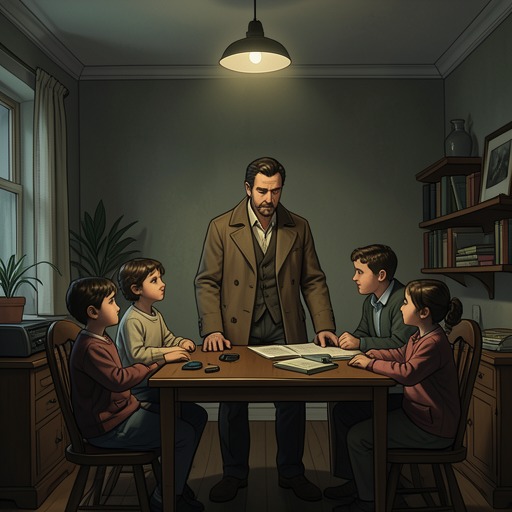
Will coerces Helen into leaving with him
The RadleysWill Radley coerces Helen Radley into leaving with him through Blood-Minding Influence, turning their illicit affair into an exercise of supernatural control. Set in London two weeks before Helen’s wedding to Peter Radley, the episode moves from Will’s professed adoration to Helen’s resistance, then to his deliberate use of power to make her go with him. Its decisive significance lies in that reversal: the language of love accompanies an action that overrides Helen’s choice.
Circumstances and Background
Two weeks before the wedding, Will is back in London and sleeping in a camper van he has stolen in Camden. He has returned despite knowing Peter is out, and the narration presents his visit as something he could not stop himself from making. The detail places the encounter within a continuing affair, not a sudden meeting between strangers: elsewhere, the account notes that Will and Helen had been together in the van on the night before Paris. The affair’s history gives the scene emotional context, but it does not make the coercion that follows a mutual decision.
Will’s family position sharpens the breach. Helen is Peter’s partner, and Will is Peter’s brother. Will acknowledges this complication even as he tells Helen that he adores her. The episode therefore binds private desire to a direct betrayal of family ties: he is not only pursuing Helen against the terms of her coming marriage, but doing so while fully aware of his relationship to Peter.
The Coercion
At first, Will’s approach is expressed as affection. But the narration makes clear that he understands love in selfish terms: morality, in his view, weakens it, while his own desire gives him reason to take what he wants. He begins using Blood-Minding Influence while maintaining the shared gaze. The supernatural power is not incidental to the scene; it is the means by which he tries to make Helen’s response conform to his intention.
Helen leaves the room and walks into the hallway. Will follows. He is described as not wanting to use his power again, yet doing so with all his strength. Her movement away from him establishes resistance, and his renewed control prevents that resistance from ending the encounter. At the door, Will sees that he has only one more chance. He concentrates on Helen’s blood, recalls Jean Genet’s association of betrayal with ecstasy, and directs a stream of words at her intended to break down her sense of self. The scene links his desire to a consciously destructive act: he seeks not to persuade Helen as an equal, but to alter her capacity to refuse.
Will then holds out his hand. Helen takes it, and he invites her outside. The action’s outward appearance is simple—two people leaving together—but the account has shown the pressure that precedes it. Her taking his hand is therefore not presented as uncomplicated consent or as proof that his appeal has succeeded on its merits. It is the immediate result of a confrontation in which Will repeatedly applies Blood-Minding Influence after she has tried to leave.
Desire, Power, and Betrayal
The episode distinguishes Will’s understanding of love from a relationship grounded in mutual choice. He calls his feeling adoration, but his reasoning makes possession central: he believes he has the means to obtain Helen and uses them when she resists. His apparent hesitation does not prevent the coercion; instead, it underscores that he knows he is crossing a boundary and proceeds anyway. The gap between his professed love and his conduct is the scene’s central conflict.
The appeal to Genet gives the betrayal an explicit frame within Will’s thinking. He treats betrayal as a source of ecstasy, and the narration connects that idea to the satisfaction he takes in damaging another person’s happiness. This is not a romantic reconciliation beat: the language of intense feeling is set against the practical violation of Helen’s agency and Will’s betrayal of Peter. The scene allows desire to be forceful without presenting force as proof of love.
Consequences and Narrative Significance
The immediate outcome is that Helen leaves the room with Will, after resisting and attempting to walk away. The supplied account establishes that result, but does not by itself specify the full course of what follows them outside. Its emphasis remains on the decision’s coercive conditions and on Will’s responsibility for creating them.
Placed shortly before the wedding, the episode exposes a fracture in the family and in the promise of ordinary married life. It also makes Blood-Minding Influence more than an abstract vampire ability: in Will’s hands, it becomes a tool for converting private desire into another person’s apparent compliance. The scene’s lasting tension comes from that mismatch between what is visible—Helen taking his hand—and what the narration has disclosed about how he made that gesture possible.