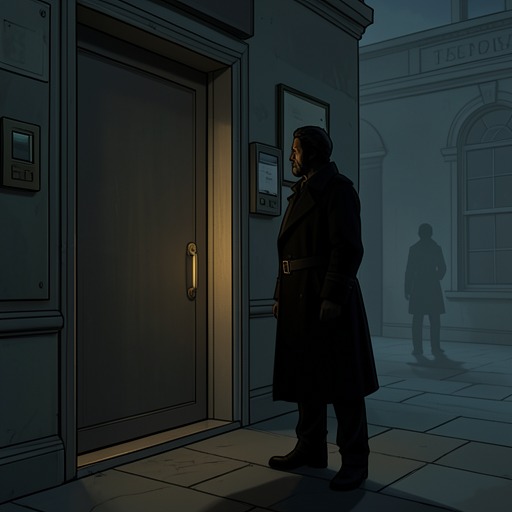
Will’s removal from the Sheridan Society list
The RadleysWill Radley’s removal from the Sheridan Society’s list of untouchables is an institutional break with practical consequences: the Society’s customary protection no longer applies to him, even as the killings that prompted the decision have intensified pressure from the police. The call informing Alison Glenny of his removal also overturns the expectation that Will’s connections will keep him safe. His standing has changed from a protected Society member to someone its own overseer says nobody cares to defend.
The Society’s protection and its limits
The list protects practicing vampires who kill from police action. The arrangement is not a declaration that their conduct is acceptable; it is a way of preserving the Society’s access to the police and the trust on which communication with the wider vampire community depends. The police, in turn, have historically avoided official trials and convictions in vampire-related deaths. The result is an uneasy accommodation in which some vampires remain beyond ordinary enforcement, while the Society helps maintain channels between the community and authorities.
That protection has conditions. A killing is treated as legitimate within the system only when it avoids public exposure, leaves no body to be found, and involves a victim unlikely to attract public sympathy or generate questions. The account identifies people in socially vulnerable circumstances as targets considered less likely to provoke scrutiny, while victims with stronger connections to public attention or the police are excluded. The rules therefore do more than regulate violence: they sort victims according to the likelihood that their deaths will disturb the arrangement. The list shields its members, but the surrounding code is designed to keep that shield from becoming visible or politically costly.
Why Will loses his place
Will had belonged to the Sheridan Society for a long time, but he had not followed its restrictions. He would not reshape his appetites to fit a framework approved by the police and accepted by Society leaders. His recent killings were especially careless, adding to the pressure on the organization. The account links his removal not to a single isolated incident but to the collision between an established pattern of disregard and the increased exposure created by those latest acts.
The distinction matters. The Society’s arrangement depends on secrecy and on the perception that its members can keep violence from becoming a public crisis. Will’s actions challenge both requirements. His removal marks the point at which the Society’s interest in preserving its relationship with the police outweighs the protection it had offered him as a member. That decision does not establish that the Society has abandoned its broader system; rather, it shows that inclusion on the list is conditional and can be withdrawn when a member’s behavior threatens the bargain itself.
The call to Alison Glenny
The removal was communicated fifteen days before the main present of the narrative. Alison Glenny, deputy commissioner of Greater Manchester Police, was briefing a recruit from the Unnamed Predator Unit when she received a call from Otto Child. She recognized the caller by his familiar, cold, tired whisper. Otto was closely placed within the Society: his sister, Isobel Child, was popular among its members, and he oversaw the list.
Alison initially understood Will to be a friend of Otto’s, or at least a friend of Isobel’s. Otto rejected that assumption and told her that Will was no friend of his; he then made the point more starkly, saying that nobody cared about Will anymore. Alison registered bitterness in his voice and was surprised by the degree of contempt it conveyed. The exchange makes the removal more than an administrative update: the person responsible for the list personally disclaims loyalty to Will, closing off the very relationship Alison had thought might explain his continued protection.
Consequences and significance
Before the call, many Society members believed Will would remain protected because Isobel cared for him and Otto controlled the list. His removal overturns that expectation. Whatever protection had seemed to follow from his association with Isobel no longer secures his place, and the account presents him as exposed to the consequences of a system that had previously kept vampire-related deaths from reaching public trial or conviction. It does not state that his removal immediately results in a prosecution; its immediate consequence is the withdrawal of the institutional shelter members had expected him to retain.
The broader history clarifies the stakes without making the Society’s protection seem secure or benevolent. Earlier attempts at a zero-tolerance policy, including the disappearance of vampires at the hands of specially trained officers, increased conversion rates and raised the prospect of an extensive, highly visible conflict. The Society’s negotiated approach arose in that context, but its accommodation depends on restraint and concealment. Will’s exclusion reveals the limit of that compromise: the Society may protect members from outside intervention, yet it can also revoke that status when their conduct threatens the system. The call leaves Alison with a changed understanding of Will’s position and the Society’s willingness to stand behind him.