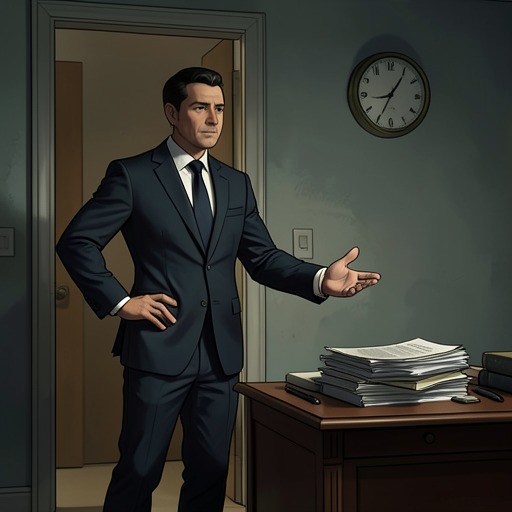
Brodnax & Speer merges into Tinley Britt and Rudy is fired
The RainmakerThe merger of Brodnax and Speer into Tinley Britt becomes an abrupt severing of employment and expectation: the established firm’s partners sell out, its associates are dismissed, and Rudy Baylor loses the job he had secured before he could begin it. The episode turns a corporate transaction into a personal humiliation, exposing how little protection a hiring promise offers when a more powerful firm wants the clients behind it.
Rumors and the imbalance between firms
At law school, Rudy first hears about the merger from classmates who have already learned that Brodnax and Speer is joining Tinley Britt. He had interviewed with the smaller firm, agreed to terms two months earlier, and understood that he would be its only new recruit from his graduating class. No one had told him of a planned merger. His classmates’ knowing questions make the news feel less like a formal announcement than a public revelation of something everyone else seems to know.
The firms stand at radically different scales. Brodnax and Speer has fifteen lawyers and a practice heavily devoted to defending car-accident cases. Tinley Britt has roughly 120 lawyers, substantial corporate and government clients, and an office in Washington. Its polished, elite reputation makes Rudy fear that the merger will leave no place for him. That fear is sharpened by the city’s crowded legal market: his classmates have spent the past year looking for work, and he sees little prospect of another opening.
The associates are dismissed
Rudy goes to Brodnax and Speer’s offices in the Powers Building to find out what has happened. In the lobby he encounters Richard Spain, an associate who had once welcomed him during an interview visit. Spain is dazed and red-eyed. He explains that Loyd Beck called the associates into a conference room, told them the partners had agreed to sell the firm to Tinley Britt, and gave them an hour to clear their desks and leave. The decision has already been carried out by the time Rudy arrives; a uniformed security guard stands at reception.
Spain says the sale was about acquiring clients: Tinley Britt wanted the smaller firm’s business, and buying the partners was the way to obtain it. The associates, in that calculation, were expendable. Spain’s own case makes the imbalance concrete. After six years at the firm, billing 2,500 hours in the previous year and bringing in $375,000 in fees, he had been paid $80,000; he was nevertheless dismissed with no more than an hour to pack. His account makes clear that loyalty and hard work did not translate into security once the transaction was arranged.
Rudy learns that his name had come up in the partners’ meeting because he was the only incoming associate. Beck had reportedly been trying to reach him with the news. Rudy’s position is therefore not an exception to the layoffs but part of the same decision: he has lost his first job before it starts.
The dismissal letter and Rudy’s response
Upstairs, the security guard blocks Rudy from the office and hands him an envelope bearing his name in red ink. The brief letter from Beck confirms that the merger was sudden and unexpected, offers a gentle explanation, and wishes him well. Its restrained tone contrasts with the bluntness of the outcome: the firm that had praised Rudy’s grades, writing, interviews, and fit has withdrawn the position without giving him a chance to enter it.
Inside the office, Rudy tosses the letter onto the floor. As he leaves, he spits on a bronze bust of the elder Brodnax; the pedestal rocks, and the bust’s head falls and crashes into a glass wall. A guard shouts and rushes after him, but Rudy runs down the stairs and gets out. The burst of anger gives physical form to the humiliation, while the abandoned bust turns the firm’s distinguished name into an object Rudy can reject, if only in that moment.
Immediate aftermath and significance
Near seven o’clock, Rudy stops at a convenience store and buys a cheap six-pack of beer with the little money left in his pocket. He recalls how recently Beck had told him that the firm’s lawyers unanimously thought he would fit in and that his future there looked bright. Now the partners have taken the deal, the associates are gone, and the promise of a beginning has collapsed into unemployment. Rudy drinks in his car and drives through Memphis as the hours pass.
The episode establishes a pattern of vulnerability that shapes Rudy’s early career: entry into the profession depends not only on qualifications but also on decisions made by powerful firms pursuing financial advantage. It also marks a sharp reversal in his prospects. A job that seemed to offer a secure foothold disappears through a merger he did not know was coming, leaving him with no warning, no position, and little money.