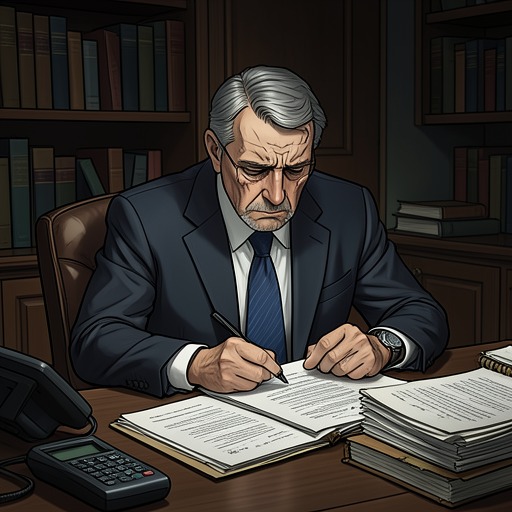
Great Benefit conceals evidence and is sanctioned by Kipler
The RainmakerGreat Benefit’s concealment of witnesses and a key document turns a routine deposition trip into a test of whether a small plaintiff’s case can force a powerful insurer to obey court orders. When Rudy Baylor finds that three scheduled witnesses are unavailable and the claim file lacks the Stupid Letter, Judge Tyrone Kipler responds by shifting control of the discovery process toward Baylor and ordering Great Benefit to pay for the wasted journey to Cleveland.
Background and Stakes
The confrontation arises from the Black family’s bad-faith case against Great Benefit. The company’s claim file matters because it records how the insurer handled Donny Ray Black’s request for coverage of a bone marrow transplant. In this kind of case, the sequence of letters, decisions, and internal communications can show whether a denial was an isolated mistake or part of a broader practice. Rudy is entitled to the file, and Judge Kipler has ordered that it be available at the start of the depositions.
The depositions are also supposed to give Rudy access to six witnesses he selected. Under Kipler’s order, they must be available at nine in the morning, remain on call until Rudy releases them, and be questioned in the order he chooses. Rudy arrives in Cleveland expecting to begin with Jackie Lemancyzk, a claims handler, rather than Jack Underhall, Great Benefit’s corporate designee—the witness the defense lawyers would prefer to present first. Starting with the claims handler and obtaining the underlying file would let Rudy follow the claim’s history instead of accepting the company’s preferred overview.
The Cleveland Confrontation
The defense team has spread papers across the table when its lawyer, T. Pierce, proposes beginning with Underhall. Rudy declines and asks first for Jackie and the claim file. Pierce then tells him Jackie no longer works for Great Benefit. She resigned late the previous week, after the parties had appeared in court on Thursday. Asked about another listed witness, junior claims examiner Tony Krick, Pierce says he has been downsized.
Rudy asks about the remaining names. Senior claims examiner Richard Pellrod and Vice President of Claims Everett Lufkin are present; Underhall is also available. Russell Krokit, the senior claims supervisor associated with the Stupid Letter, has left for another company. Great Benefit describes the departures as routine changes in staffing, but the timing alarms Rudy: three of the six witnesses named in the court order are suddenly gone. He tells the defense that the coincidence is striking and begins recording what he will need to do next.
The claim file arrives as a stack nearly five inches thick, neatly copied and bound with rubber bands. After an hour reviewing it, Rudy spots a conspicuous omission: the Stupid Letter is not there. Its absence is especially significant because Dot Black had produced a copy during her deposition. Rudy had stamped that copy three times with the word COPY, while retaining the original in his own files. That marking lets him distinguish the copy already shown to the defense from the original document; the original’s presence in his possession does not explain why the insurer’s file lacks the letter.
Kipler’s Response and Sanctions
Rudy calls Kipler from a separate room, with Pierce on the other phone. He reports that Jackie, Tony, and Russell are no longer employed by Great Benefit, and that the Stupid Letter is missing from the file. Pierce says he has not checked everything. Kipler asks Pierce to leave the room, then tells Rudy that the missing witnesses and document have given the court grounds to change the deposition arrangements. Rudy is to question Underhall, press him about the three departures, obtain the underwriting file, and return to Memphis; Kipler will hold a hearing later that week.
Underhall’s deposition lasts three hours. He produces two resignation letters and maintains that the departures had nothing to do with the lawsuit. Questions about Great Benefit’s ownership, corporate affiliations, products, markets, divisions, and personnel yield a complicated account that Rudy finds largely unhelpful. The deposition ends earlier than he had expected, but he leaves with additional documents and the prospect that the company’s witnesses will have to appear on his own ground.
At the hearing, Kipler orders a new round of depositions at the court in Memphis, scheduled for the following week. Great Benefit must produce Pellrod, Lufkin, Vice President of Underwriting Kermit Aldy, Vice President of Administration Bradford Barnes, and chief executive M. Wilfred Keeley. They must travel at the company’s expense, remain available at the plaintiff’s discretion, and be ready for three days of questioning. Kipler also requires neatly copied, chronological documents before the depositions and warns that failure to comply will bring severe sanctions.
Kipler separately orders Great Benefit to reimburse Rudy for the Cleveland trip. The calculation includes the coach airfare he reports, an allowance for food and lodging, time valued at two hundred dollars an hour, and a court reporter’s fee. Rudy admits internally that his actual food and lodging cost less than the amount he claims in court; Kipler sets the sanction at $2,410, payable within five days, with the sum doubling for every day of nonpayment after that deadline. When Leo F. Drummond objects, Kipler rejects the effort to dispute the expense calculation and makes clear that the company must pay.
Consequences in the Case
The order changes the practical balance of discovery. Great Benefit’s lawyers had expected to conduct the Cleveland sessions on their terms, with the corporate designee first and the plaintiff’s questioning constrained by the witnesses and records made available. Instead, Kipler places the next depositions near Rudy and his judge, gives Rudy control over when the witnesses are released, and makes Great Benefit bear the associated costs. The sanction is modest beside the resources of an insurer, but it recognizes that a plaintiff’s wasted time and travel have a value the defense cannot simply dismiss.
The missing letter also gains force beyond the discovery hearing. At trial, Dot reads the Stupid Letter and the earlier denial letters to the jury, while Jackie’s testimony describes Great Benefit’s initial denials of claims during 1991. Rudy later presents the concealed-document issue alongside the claims history and the evidence of the insurer’s denial practices. The Cleveland episode thus helps establish the pattern of resistance the jury will encounter: first the records are delayed, then a central letter is absent, and the court must intervene to compel access and impose a penalty.
Significance
The episode makes procedure part of the conflict rather than a neutral backdrop. A court order specifies who must appear, when the file must be ready, and who controls the depositions; the defense’s explanations do not erase the immediate effect of three absent witnesses and an incomplete record. Kipler’s response gives those rules practical force, while Rudy’s insistence on the claim file and his careful marking of the letter’s copy make it harder for the document to disappear without question. The resulting sanctions do not themselves resolve the Black family’s claim, but they alter who controls the next stage of the case and help bring the insurer’s internal conduct into public view.