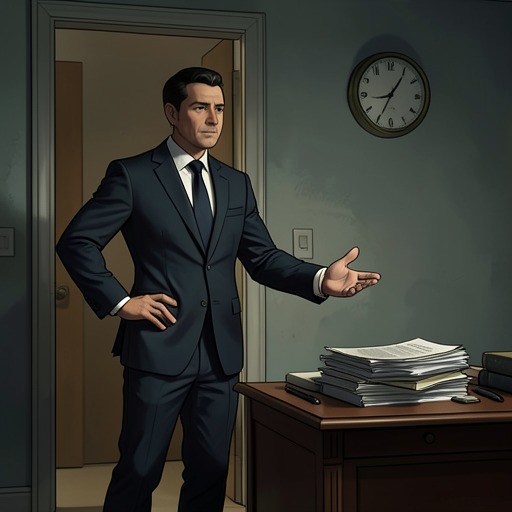
Great Benefit’s bankruptcy
The RainmakerGreat Benefit’s bankruptcy follows the Black family’s courtroom victory but unsettles what that victory can deliver. After a jury awards $50 million, Great Benefit Life Insurance Company seeks bankruptcy protection in federal court in Cleveland. Reports indicate that its parent, PinnConn, had suffered heavy foreign-currency trading losses and moved subsidiary cash overseas. The award stands, but the company’s apparent insolvency leaves payment uncertain and spreads the consequences far beyond the family that brought the case.
The Claim and the Trial
The financial collapse arrives after a trial built around a more immediate question: whether Great Benefit Life Insurance Company had wrongfully denied coverage for Donny Ray Black’s bone marrow transplant. In opening statements, Leo F. Drummond argues that the policy did not cover the procedure and presents the family’s demand for additional damages as excessive. Rudy Baylor objects when Drummond calls the claim greed; Judge Kipler sustains the objection. The exchange establishes an early contrast between the defense’s effort to define the dispute as a matter of policy language and the plaintiff’s presentation of a denial with human consequences.
Dot Black’s testimony gives that dispute its documentary history. She describes trying to find help for her dying son, contacting Great Benefit Life Insurance Company and public officials, approaching hospitals, and seeking donations from friends and neighbors. She reads the company’s first seven denial letters, whose explanations shift among claims handling, underwriting, alleged preexisting conditions, household eligibility, and assertions about transplant coverage. The final letter, known in the trial as the Stupid Letter, is read aloud twice. The jurors’ visible reaction makes the insurer’s paperwork central evidence rather than background administration.
Rudy Baylor also exposes the removal of Section U from an underwriting manual. When executive Kermit Aldy first describes the section’s checks and balances, Rudy produces the complete manual, showing that the section was absent from the copy supplied to him. Aldy confirms that it had been removed. His account and the document give the jury a basis for understanding the company’s internal process as more than a series of isolated mistakes.
The plaintiffs’ case also makes the injury visible through Donny Ray Black’s recorded deposition. The edited video runs for thirty-one minutes; jurors watch closely, and Dot cries as it ends. In his closing argument, Rudy connects the medical evidence, the denial history, and the company’s claims data, presenting the 1991 denials as a planned experiment intended to generate cash. He emphasizes that the defense has not contradicted Dr. Kord’s testimony that a transplant was not simply an experimental treatment. The argument’s structure joins company records to the consequences for one family, helping explain how the jury reaches a substantial verdict.
The Filing and Its Financial Background
At five o’clock on Tuesday, lawyers for Great Benefit Life Insurance Company file for protection under the bankruptcy code in federal court in Cleveland. The news reaches Rudy Baylor and Deck Shifflet while Rudy is occupied with the separate crisis surrounding Kelly Riker. They sit in silence as they take in what the filing may mean for the fee they had expected from the Black case. Their small firm had relied on that case as a prospect of financial stability; its ordinary income and pending matters appear inadequate to sustain it for long.
The filing also throws earlier estimates into doubt. Great Benefit Life Insurance Company’s recent balance sheet appeared strong enough to persuade a jury that it could afford a large award, while M. Wilfred Keeley had estimated that the company held $100 million in cash. Max Leuberg had cautioned Rudy not to trust an insurer’s own figures, since companies make their own accounting rules. Those estimates now sound less like dependable measures of available money than figures whose meaning depends on what has happened to the company’s funds.
Peter Corsa, a lawyer in Cleveland, tells Rudy that the legal and financial communities are trying to understand the collapse. According to the developing account, PinnConn sustained heavy losses in foreign-currency trading and then drew on the reserves of subsidiaries, including Great Benefit Life Insurance Company. The money was reportedly siphoned away and sent to Europe. Corsa warns that the situation is evolving and could take months to untangle; a local U.S. Attorney has promised indictments, but the prospect of criminal proceedings does not itself restore money to claimants.
Investigation and Wider Fallout
The bankruptcy filing follows an earlier escalation in official scrutiny. The Federal Bureau of Investigation, working with the Ohio Attorney General and the Ohio Department of Insurance, raids the corporate offices and removes records. Most employees are sent home for two days, while computer analysts in accounting remain. By the time the filing becomes public, newspaper reporting also says PinnConn has defaulted on bonds and laid off many employees. The raid and the layoffs widen the story from a contested insurance claim to a crisis involving the parent company and its records, workers, and subsidiaries.
A later report describes grand juries beginning work and lawsuits arriving in large numbers against PinnConn and its subsidiaries, especially Great Benefit Life Insurance Company. M. Wilfred Keeley is detained at JFK airport while waiting to board a flight to Heathrow with his wife; they cannot provide the name of a hotel where they plan to stay. The account says the companies were looted over the preceding two months: cash first covered bad investments, then was preserved and wired to havens around the world. The money, the report concludes, is gone. The account conveys the scale of the suspected transfers, though the unfolding investigation has not yet resolved every detail.
The Verdict’s Uncertain Value
The bankruptcy does not erase the jury’s finding or the importance of the evidence presented at trial, but it sharply changes the practical meaning of winning. For Dot Black and Buddy Black, a verdict of $50 million cannot straightforwardly promise compensation if the insurer’s assets have been depleted. Rudy and Deck likewise realize that their anticipated fee may not materialize. The possibility of a large award had made the case a financial turning point for their firm; insolvency turns that expectation into a liability they cannot yet measure.
The consequences extend to people who did not bring the suit. Other policyholders with legitimate claims, Great Benefit employees and agents, and Jackie Lemancyzk may all be affected by the collapse. Even Leo F. Drummond, who represented the insurer, expects not to be paid for the trial. The case thus ends its courtroom phase with a verdict but no secure financial resolution. Its central irony is that evidence strong enough to persuade a jury does not guarantee that the defeated company will still possess the money needed to satisfy the judgment. The bankruptcy makes the distance between legal accountability and actual recovery the Black family’s next uncertainty.