Great Benefit's Section U claims manual
The RainmakerGreat Benefit's Section U claims manual turns a routine corporate handbook into evidence of a deliberate system for delaying and denying insurance claims. Its procedures directed claims handlers to issue initial denials and route files through underwriting, while its counterpart manual supplied the other half of the process. When Rudy Baylor found that the copy Great Benefit had produced in discovery lacked Section U, the manual became both a record of how the scheme worked and proof that crucial material had been withheld.
Identity and Design
The claims manual is one of two operational handbooks that Rudy examines while investigating Great Benefit's treatment of the Black family's claim. Cooper Jackson describes a process in which claims handlers deny an incoming claim, obtain the insured's medical records for the preceding five years, and send a further letter stating that the claim remains under review. The file then goes to underwriting, which sends instructions back to claims not to pay until further notice. Correspondence accumulates between departments, even though both work for the same company, and the policyholder receives communications from each.
Jackson's account presents this separation as functional rather than accidental: claims and underwriting rarely know what the other department is doing. Meanwhile, insured people face a succession of letters and delays, and many eventually give up. The procedure's complexity makes responsibility hard to locate while leaving the person seeking payment to contend with the consequences. Jackson estimates that only about one in twenty-five policyholders consults a lawyer, a low likelihood that helps explain why the system can operate to the company's advantage.
The physical manuals make that account testable. Jackson leaves Rudy with organized storage boxes and points him to the manuals. Rudy goes directly to the dark-green volumes, one for claims and one for underwriting. At first, they look much like the copies he has obtained in discovery: their procedures are arranged by section, with an outline at the front and a glossary at the back. The decisive difference is at the end of the claims manual. Its Section U is absent from Rudy's copy but present in Jackson's. The underwriting manual contains a corresponding section, completing the instructions that Jackson has described.
How the Procedure Worked
Section U makes the denial process more than a vague pattern of delay. The claims manual instructs handlers to deny every claim within three days of receipt. Subsequent review is allowed for some claims, and the required paperwork identifies claims that may be inexpensive, valid, and payable. Claims with a potential value above five thousand dollars are to be sent to underwriting with a denial letter stating that the matter is subject to review.
Other provisions show how the process responds to the policyholder. A section supplies coded signals for recording a strong reaction from an insured. If someone threatens to consult a lawyer or sue, the file is referred to a supervisor; if the insured appears unlikely to resist, the denial can stand. The manual thus records a system that distinguishes between claims not simply by their merits but also by the likelihood that a claimant will challenge the decision.
A later provision directs a handler to prepare a check for the claim amount and send it, with the file, to underwriting, while instructing that the check not be mailed until further word from claims. The corresponding instruction never arrives. The two departments' procedures therefore produce a loop: each step appears documented, but the transfer of responsibility prevents payment. The paperwork gives the process an administrative form while leaving the insured without the promised result.
The manual's instructions also illuminate Great Benefit's broader 1991 policy. Jackie Lemancyzk testifies that claims were initially denied as a matter of policy and that claims exceeding one thousand dollars were subject to a twelve-month experiment, regardless of their legitimacy. Smaller claims could also remain unpaid when an arguable reason for denial could be found. She says the experiment was intended to compare the money saved with the cost of quick settlements and that it generated about forty million dollars in additional funds. Her account connects the manual's working rules to an enterprise-wide financial incentive rather than an isolated error by an individual handler.
The Missing Section in Court
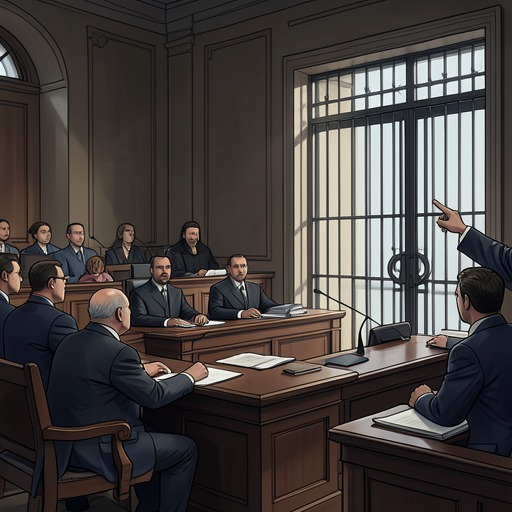
The manual's evidentiary force depends on the contrast between the versions. During trial, Rudy questions Everett Lufkin, Great Benefit's vice president of claims, about the claims manual produced in discovery. Lufkin describes it as complete and confirms that he selected the copy sent to Rudy. Rudy asks him to locate Section U. Lufkin cannot find it. Rudy then presents Jackson's copy, which has the same stated revision date, January 1, 1991, but includes the missing section.
Lufkin acknowledges the difference but does not identify who removed the section. He calls its absence an oversight and says he does not know who did it. The exchange exposes a gap between the company's assurance that its production was complete and the actual document in evidence. It does not establish that Lufkin personally removed the material; rather, the missing pages make the company's handling of the manual and the credibility of its discovery responses central questions for the jury.
With the complete manual before him, Rudy has Lufkin read and explain its provisions. He repeatedly characterizes the procedures as a scheme, and Judge Kipler permits the line of questioning to continue over objections. Lufkin cannot explain who drafted Section U or answer basic questions about the number of policies, claims, and denials Great Benefit had in 1991. The claims manual thus serves not only as a description of company procedure but as a standard against which the witness's testimony and the company's conduct can be measured.
Jackie also connects the Black file to the general procedure. She testifies that she handled the initial claim and sent a denial because all claims were initially denied under the policy then in force. After the words acute leukemia appeared in the file, her work was monitored by a supervisor. She says the company knew that the policy did not exclude bone marrow transplants and that the medical records showed Donny Ray Black needed the treatment. Her testimony places a particular claim inside the machinery described by the manuals and links the administrative process to a serious human consequence.
Significance as Evidence
In his closing argument, Rudy pairs testimony about the manuals with Great Benefit's own figures, presenting the 1991 policies, claims, and denials on a chalkboard. The manual's procedural detail gives that statistical picture a mechanism: it shows how an initial denial, internal referrals, coded reactions, and suspended checks could turn a company policy into a repeatable practice. The discrepancy between the produced copy and the complete version also makes concealment part of the trial, not merely the underlying denial.
The manual's importance lies in the way its bureaucratic form cuts both ways. Its sections and documentation requirements appear to organize careful claim review, yet Section U directs actions that systematically delay or prevent payment. At trial, the same written instructions that could create a protective paper trail become a traceable account of the process. By placing the missing section beside the version Great Benefit produced, Rudy makes the difference visible and gives the jury concrete grounds to assess both the denial scheme and the company's credibility.