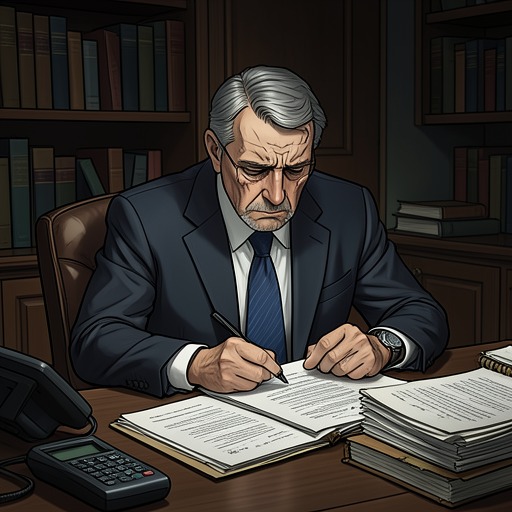
Harvey Hale
The RainmakerHarvey Hale is the judge assigned to the Black family’s lawsuit against Great Benefit Life Insurance Company, and his old ties to defense counsel make the hearing on the company’s motion to dismiss feel less like a neutral beginning than a coordinated test of the young lawyer facing him. A former insurance-defense attorney who has spent eleven years on the bench, Hale is both a consequential obstacle and a figure whose death leaves the case unresolved at a crucial moment.
Identity and Background
Before becoming a judge, Hale was a highly regarded insurance-defense lawyer. He shared a room at Yale with Leo F. Drummond while they studied law, about thirty years before the events of the case. After a heart attack, his doctor advised him to change careers; Hale entered public life and was elected to the bench. The shift in profession did not, in Bruiser Stone’s account, erase his old instincts: Hale still seemed to regard a just and fair verdict as one below ten thousand dollars.
The later report of his death identifies him as sixty-two and says he had served as a judge for eleven years. His former professional identity matters because the Black case places a family challenging an insurer before a judge who once represented insurers, while the company’s lead lawyer is Hale’s longtime friend. The novel establishes the connection directly, but Rudy Baylor’s suspicion that the two men have coordinated their courtroom tactics remains his inference rather than a proven arrangement.
The Black Case Hearing
Hale presides over the Black case in Circuit Court Division Eight. When Rudy arrives for the hearing, Bruiser is absent, and the opposing lawyers are already gathered in the courtroom. Hale sits in his robe, watches Rudy approach, and taps his fingers impatiently. Rudy identifies himself as Bruiser’s associate and says he is prepared to argue the motion to dismiss. Hale asks whether he is a lawyer; Rudy explains that he has passed the bar but has not yet taken the oath or received his license. The distinction immediately makes his position more precarious.
Drummond objects to Rudy appearing, then delivers a lengthy argument for Great Benefit. Rudy responds more briefly, setting out why a motion to dismiss should not succeed where the parties dispute the facts. Hale listens skeptically and appears bored. The contrast establishes the imbalance Rudy is confronting: Drummond speaks for a powerful corporate client with a large legal team, while Rudy is a newly qualified advocate left to handle the hearing without Bruiser.
In chambers, Hale tells Rudy that the lawsuit bothers him, that he is not impressed by its merits, and that he is inclined to dismiss it. He suggests the plaintiffs could refile in federal court because he does not want the case clogging his docket. As he speaks, he takes at least a dozen pills from four bottles and arranges them on his desk. He then excuses himself to use the restroom, leaving Rudy waiting with Drummond. The pills and Hale’s later reference to high blood pressure make his health visible in the scene, though the book does not explain what each medication is for.
Settlement Pressure and Rudy’s Suspicions
While Hale is away, Drummond tells Rudy that Great Benefit has authorized a seventy-five-thousand-dollar settlement offer, an amount he describes as the anticipated cost of defending the case through trial. The offer is time-limited and comes with no admission of liability. Drummond presents it as practical: the insurer could avoid litigation expenses, executive appearances, and unwanted publicity, while the Black family could take the money. The conversation follows Hale’s warning that he may dismiss the case, and Rudy reads the sequence as a bad-cop, good-cop routine.
When Hale returns, he says he likes to encourage settlement from the beginning and advises Rudy to take the money. He reacts with apparent surprise when Rudy tells him Drummond has already offered seventy-five thousand dollars, then echoes Drummond’s recommendation that accepting it would be sensible. Rudy is left believing Hale is serious about dismissal and that Drummond is unusually anxious to settle. He suspects the insurer has been caught in serious wrongdoing, but at this point that is Rudy’s interpretation, not a finding established by the hearing.
The episode also shows Hale’s conception of his judicial role. He does not confine himself to deciding the motion: he describes settlement pressure as part of his work and laughs about the prospect of the parties avoiding further legal expense. That intervention, combined with his old association with Drummond and his stated impatience with the case, makes the hearing feel tilted against the plaintiffs before their evidence has been heard.
Death and Consequences
Hale dies of a heart attack at his home, where he falls by the swimming pool. Deck Shifflet tells Rudy the news the following morning. The death comes after the hearing but before Hale has signed an order dismissing the Black case. When Rudy checks the court file, he confirms that no dismissal order was entered, and the suit remains pending. A wreath appears on Hale’s courtroom door, while the case that he had considered removing from his docket survives his death without a ruling against the plaintiffs.
His vacancy also becomes part of a broader argument about representation on the bench. The county is described as roughly half Black and half white, while only seven of its nineteen circuit judges are Black. Tyrone Kipler, a Harvard-educated partner at Marvin Shankle’s firm, had been a leading candidate for an earlier vacancy; after Hale’s death, he is again widely expected to be appointed. Political leaders press for his selection, and Rudy later learns that the appointment appears likely. The change in judges carries immediate significance for the case: the motion Hale was inclined to grant did not end the lawsuit, and the later trial proceeds before Kipler.
Narrative Role
Hale’s brief appearance concentrates several pressures on Rudy at once: his lack of courtroom experience, the insurer’s superior resources, the possibility of losing the case before trial, and the tempting prospect of a settlement. His courthouse authority is made tangible by the contrast between the grand courtroom and the private chambers where he displays the pills and announces his doubts about the suit. The scene then shifts into Drummond’s settlement pitch, leaving Rudy to decide what the offer means while Hale’s absence lends the exchange an unsettlingly theatrical quality.
Hale is not present at the later trial, but the case’s survival after his death gives his unfinished ruling a lasting consequence. The attempted dismissal never becomes an order; instead, the dispute reaches a jury under a successor judge. Hale therefore functions less as a continuing participant than as the first major judicial obstacle in the Black family’s effort to make Great Benefit answer for its denial of Donny Ray’s treatment. The narrative preserves the uncertainty around his conduct: his relationship with Drummond and his settlement advice invite suspicion, but the evidence does not establish that he acted from a secret agreement or improper motive.