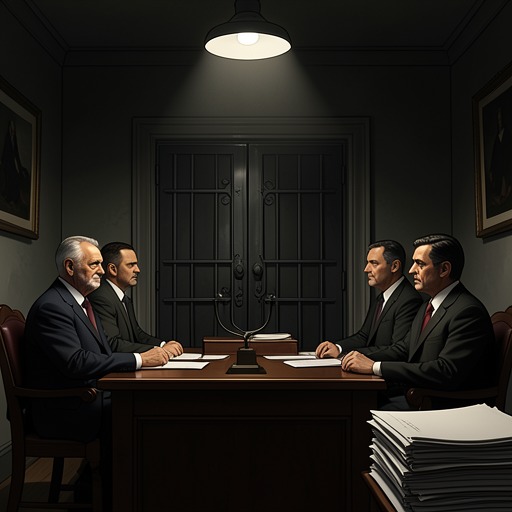
Jack Underhall
The RainmakerJack Underhall, an in-house lawyer for Great Benefit Life Insurance Company, becomes one of the most exposed company figures in Rudy Baylor’s trial against the insurer. His importance lies less in a complete account of his work than in the moments when corporate records and a former employee’s testimony place him under pressure: he is connected to the disappearance of a key claims-manual section, accused of arranging a departing employee’s silence, and later forced to answer for the records his company has not brought to court.
Position Within the Company
Underhall sits behind defense counsel Leo F. Drummond in the courtroom with other Great Benefit representatives. The narrative identifies him as one of the company’s in-house lawyers. When Rudy directs Everett Lufkin to look for Section U in a claims manual supplied during discovery, he deliberately looks toward Underhall. Underhall closes his eyes, lowers his head, and then stares at the floor; Kermit Aldy also reacts visibly. Lufkin finds that the manual he had personally selected and provided to the opposing side has no Section U.
Rudy then produces a second copy, supplied by Cooper Jackson. It bears the same January 1, 1991 revision date, but includes a final section called U. The contrast establishes that the discovery copy is incomplete, while the reactions of Underhall and other company representatives heighten the impression that the omission has caught them unprepared. The scene does not establish who physically removed the section or who directed its removal. It does, however, place Underhall in the courtroom at the moment the discrepancy is exposed, and makes his response part of the evidence the jury observes.
Accusations Concerning Jackie Lemancyzk
The most direct allegations against Underhall come from Jackie Lemancyzk, a former Great Benefit employee who testifies about her departure from the company. She says she was fired on October 3, shortly before she was scheduled to give a deposition concerning the Black claim. The resignation letter in her file says that she left for personal reasons; Jackie testifies that the letter was false and that company representatives, including Underhall, were responsible for the arrangement.
Jackie describes a choice presented to her at a meeting in the office: she could leave as a fired employee without compensation, or sign a resignation letter and receive $10,000 in cash in return for keeping quiet. She says that she was a single mother facing bills, accepted the money, and signed an agreement promising not to discuss her claims files—specifically including the Black file. She also says that Underhall did not let her keep a copy of the agreement. After consulting a lawyer, she came to believe the agreement was illegal, and she testified despite having signed it.
Her account broadens the stakes beyond the claim file. Jackie says she had been wrongfully dismissed and discriminated against, and describes sexual harassment and pressure from senior male employees at the company. She does not accuse Underhall of being one of the men who used workplace power in that way. Rather, she identifies him as one of the people involved in her dismissal and the alleged effort to silence her. The distinction matters: her testimony places him within the alleged company response to her, not among the executives she names in connection with sexual coercion.
Testimony and the Missing Records
After Jackie testifies, Underhall takes the stand for the defense. His account contradicts hers. He characterizes her work performance as poor and says the company offered her the chance to resign so that her record would not be damaged. He denies that her departure had anything to do with her scheduled deposition or the Black claim. His testimony thus presents the resignation letter as a legitimate personnel decision rather than evidence of a concealed effort to prevent damaging testimony.
Rudy asks whether Great Benefit keeps personnel files and whether Jackie had one. Underhall confirms both. He says the file is at the company office in Cleveland, not with him in court, and agrees that it contains evaluations and records of disciplinary actions or transfers. He believes it includes such records concerning Jackie, as well as a copy of her resignation letter. The jury therefore hears that relevant documents exist but cannot inspect them during his testimony; it must rely on Underhall’s description of material held elsewhere by the company.
Rudy then asks about the alleged cash payment and agreement. Underhall denies that the agreement ever existed and says Jackie is lying. Rudy appears to consult a paper and asks questions in a way that makes Underhall fear he may have a copy. The paper is a bluff: Rudy does not produce the agreement, and eventually crumples and discards the meaningless sheet. Underhall, however, has to answer while unsure whether the document will appear. His visible uncertainty gives the exchange its tension, but it does not resolve the contradiction between his denial and Jackie’s detailed account.
Trial Function and Significance
Underhall’s role links two different forms of disputed evidence. The missing Section U is a documentary problem: the manual supplied in discovery does not match the complete version. Jackie’s testimony is a human account of how the company allegedly treated an employee who knew about the Black file. When Underhall denies her account and then cannot produce the personnel file, the defense’s credibility becomes a central issue rather than a matter of policy language alone.
The defense’s attack on Jackie is especially stark because she is not present when Underhall testifies. He challenges her honesty, her work record, and the circumstances of her departure, while she has no opportunity to respond from the witness stand. Rudy’s questions about the absent agreement and the missing personnel file turn that imbalance back toward the company: Underhall is asked to account for records Great Benefit controls, but has not brought them before the jury.
The sequence contributes to Drummond’s decision to end the defense case. The jury has already reacted poorly to other defense testimony, and Underhall’s appearance becomes a near-disaster for the company when his certainty about the nonexistent agreement is tested by Rudy’s bluff. In closing, Rudy refers to Jackie’s testimony alongside the hidden documents and Great Benefit’s claim-denial statistics, asking jurors to understand the Black claim as part of a company scheme rather than an isolated mistake. Underhall is not shown making a final confession or being conclusively proven responsible for every concealment. His significance is instead structural: the company’s account depends on denials and records that remain out of reach, while his courtroom presence makes that gap visible.