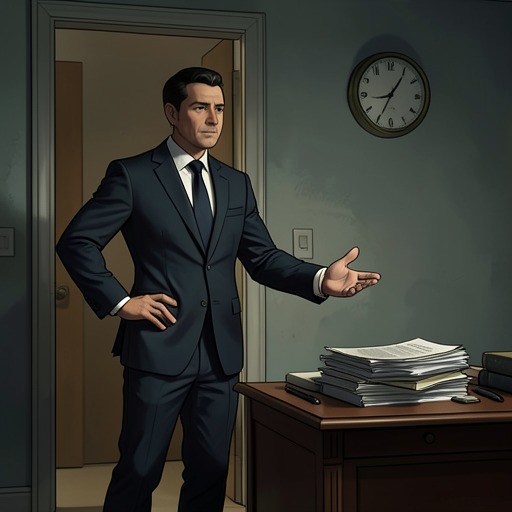
Jonathan Lake
The RainmakerJonathan Lake’s rise from an unemployed law-school graduate to a powerful trial lawyer is a Memphis legend that gives Rudy Baylor a model for starting out on his own. The legend makes Lake’s success look both dramatic and contingent: a motorcycle crash placed him beside an injured stranger, and the resulting case supplied the money with which he built his practice.
The Legend of His Rise
Lake graduated from law school but could not find a job with the established firms in downtown Memphis. About twenty years before Rudy hears the story, he rented office space and opened a practice, prepared to sue on behalf of clients. For several months he struggled to get established. Then he crashed his motorcycle and was taken to St. Peter’s Hospital, the charity hospital.
The bed beside Lake’s was occupied by another motorcycle-crash victim, a man badly injured and burned. The man’s girlfriend had suffered even worse burns and died a few days later. Lake became friends with the man and took on both cases. The driver who had struck their motorcycle by running a stop sign was a senior partner at the third-largest law firm downtown—the same lawyer who had interviewed Lake six months earlier. He had been drunk when he caused the crash.
Lake pursued the cases aggressively. The senior partner had extensive insurance, and the insurer quickly began offering money; everyone involved wanted a prompt settlement. Six months after passing the bar, Lake settled the cases for $2.6 million, paid upfront rather than in long-term installments. According to the legend, the injured biker had promised Lake half of whatever he recovered because Lake was young and just out of school. Lake remembered the promise, the biker honored it, and Lake reportedly left with $1.3 million. The story reaches Rudy as local legend, not as a verified account, but its striking figures give Lake’s later success a vivid origin.
Building a Litigation Enterprise
The settlement money became the foundation of a deliberately expansive practice. Rather than treating his recovery as a private windfall, Lake built an office staffed by secretaries, paralegals, runners, and investigators, then committed himself to the business of litigation. He worked eighteen-hour days, studied hard, trained himself, and became known for suing anyone he believed had done wrong. The account of his rise thus shifts from a lucky break to sustained construction: the money opened a door, but Lake made a firm capable of pursuing cases on a much larger scale.
Two decades later, Lake was still working eighteen hours a day. He was the firm’s sole partner, with no partners sharing ownership and twelve lawyers working under him: seven trial associates and five younger associates. The trial lawyers operated in autonomous units, each with its own staff, while Lake occasionally stepped in to direct the larger strategy. He selected the cases with the greatest potential for large verdicts, including suits against obstetricians over bad-baby cases and asbestos litigation. Associates managed their units and were responsible for generating new business; referrals from other lawyers and people who encountered injured clients supplied almost eighty percent of the firm’s work. An associate’s income depended partly on how much business that lawyer brought in.
The firm’s physical setting made its ambition visible. Its offices occupied a renovated warehouse near Memphis’s medical district, where Lake reportedly spent three million dollars on renovation and decoration. Rudy Baylor sees Persian rugs, hardwood floors, exposed beams, and a library rising across three levels of walkways; the building also contained a gym, sauna, and steam room. The offices were not interchangeable workspaces but a carefully furnished monument to Lake’s success. According to the legend, he earned roughly three million dollars a year, and his conspicuous spending helped keep him in the news and his story alive among law students.
The Firm’s Refusal and Destruction
For Rudy Baylor, Jonathan Lake’s career is more than a Memphis success story: it offers a way to imagine becoming a lawyer after established firms have shut their doors. On graduation day, Rudy goes to Lake’s renovated warehouse office for an interview with Barry X. Lancaster, who is hiring a paralegal. Rudy has researched the firm’s organization and business, and he arrives ready to accept low pay and demanding hours rather than remain unemployed. He also brings a summary of the Black family’s insurance case, offering the case to the firm and asking only for a job and the chance to work on it. Lake himself does not meet Rudy; the prospective employment depends on the firm’s internal rules and Lake’s approval.
Barry initially considers Rudy for the position, but later calls Dot Black and presents himself as her lawyer, leaving her to discover that Rudy is no longer working at the firm. Barry explains to Rudy that Lake has rejected the arrangement: Lake objects to placing a lawyer in a paralegal position, reasoning that such an employee might try to force his way into an associate’s job. Barry says he agrees with the decision and that Lake runs the firm with an iron fist. The ruling closes off Rudy’s hoped-for route into Lake’s world while putting the Black case, and Rudy’s relationship with its clients, in jeopardy.
Rudy drives to the warehouse that night and repeatedly pounds on its locked doors, trying to confront Lake. Though the building is lit, no one comes out; a security guard tells Rudy to leave, and he does. The next morning, police inform him that the Lake firm has burned to the ground and that the guard died after becoming trapped when the roof fell in. They question Rudy because he had been fired and had gone to the office angry, but his account is that he could not enter and left when ordered. The fire destroys the physical setting that had embodied Lake’s wealth and authority, and turns Rudy’s failed attempt to confront him into part of an arson investigation. The novel does not establish Lake’s whereabouts or fate in this episode; it leaves the celebrated firm itself in ruins.
Security, Reputation, and Narrative Role
Lake’s control over the firm extended to access to its building. When Rudy asked for a key, Barry explained that Lake was particular about who could enter, a policy linked to phones being bugged years earlier during a bitter lawsuit against an insurance company. A key might take weeks to obtain, and Lake might require a polygraph. The detail gives the celebrated trial practice a guarded underside: litigation is not only a public contest in court but a source of suspicion managed behind locked doors.
Lake’s story reaches Rudy chiefly as an example to measure himself against, while Lake remains personally out of reach. Rudy imagines beginning in a low-level job and one day becoming the head of a major firm, but Lake’s refusal to hire him exposes the distance between admiring a success story and entering the institution that success built. The later destruction of the warehouse makes that distance physical: the firm that had seemed a durable monument to Lake’s wealth is reduced to ruins, while the surviving account leaves Lake’s own fate unstated. His legend therefore offers no reliable promise that ambition will reproduce his path; it is an inspiring origin story whose extraordinary beginning cannot guarantee its repetition.