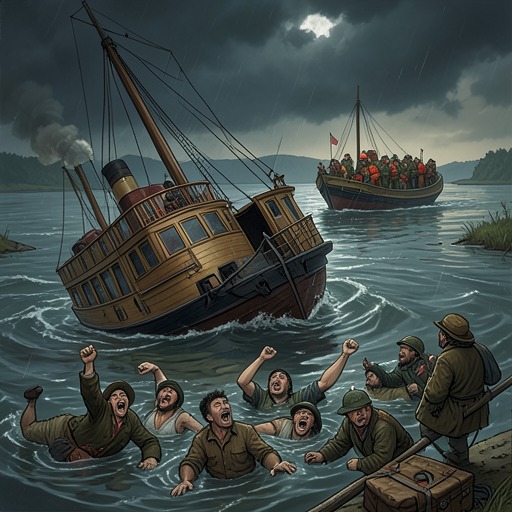
Memphis prom riverboat sinks
The RainmakerThe Memphis prom riverboat sinks after an oil barge breaks free from its tug and strikes a paddle wheeler carrying about three hundred students. The collision turns a high-school celebration into a night of rescue and loss, and then into a test of how lawyers respond to disaster: while Deck Shifflet sees potential business, Rudy Baylor turns away from soliciting the families. The event exposes a sharp divide between grief as a human emergency and grief as a source of legal fees.
The Collision and the Call
The wreck happens shortly after eleven at night. The barge drifts downriver after separating from its tug and hits the paddle wheeler, which is being used for a high-school prom. The boat goes down near Mud Island, close to the bank. The account gives no further explanation for the barge breaking free; the immediate facts are the collision, the sinking, and the large number of young people aboard.
At almost four in the morning, Deck calls Rudy on his car phone, speaking excitedly and telling him to meet at the curb. Deck is less than three blocks away and arrives in a ragged minivan. Rudy has been asleep for less than an hour; he climbs in without having time to brush his teeth. Deck explains that Bruiser Stone has called him about the wreck, and that Bruiser expects to be involved. The urgency of the call is therefore mixed with a prospect Deck openly treats as an opportunity. Rudy, by contrast, asks what they can do and objects to the idea of treating a mass-casualty disaster as a business chance.
Rescue on the Riverbank
As they drive toward downtown Memphis, ambulances pass them and Rudy’s pulse quickens. Riverside Drive is blocked by police cars; fire trucks and ambulances are lined up at the scene, and a helicopter hovers downriver. A crane is visible near the bank. When Rudy and Deck walk past yellow caution tape and join the onlookers, the rescue has already been underway for several hours. Its first urgency has given way to waiting as divers and paramedics search for people in the water.
The account places families and rescue workers in the same public space, but gives them different tasks. Rescuers in wet suits and scuba gear cling to the part of the paddle wheeler still above the surface, while others work from three pontoon boats tied together. Parents, relatives, and friends sit in groups on the cobblestoned bank, many holding blankets or praying. Ministers kneel with families. Students in wet formal clothes sit together, holding hands and watching the water. The stranded hull, the rescue boats, and the waiting crowd make the scale of the disaster visible without turning the scene into a spectacle.
A police lieutenant walks along a gangplank from a floating pier and addresses the gathered families and reporters. He announces that the body of Melanie Dobbins has been identified. Her family’s grief is immediate; people nearby gasp, embrace, and lower themselves together. For the other families, the announcement brings a different, uneasy response: their own feared news has not yet arrived, so hope remains. The account later establishes that twenty-one students survived after being drawn into an air pocket. Meanwhile, another body is being brought from the water. Relief and loss coexist at the riverbank, each new announcement changing what those still waiting can expect.
Solicitation Amid Grief
As the families wait, a second, less visible activity begins. Men with small white business cards edge toward relatives and friends of the dead, trying to offer their services. The men watch one another warily and angle for access to the bereaved; the narrator describes them as competing for a case and a share of any recovery. Deck recognizes what is happening before Rudy does. He gestures toward a place closer to the families, then slips away into the crowd to pursue the potential business.
Rudy refuses to follow. He will not move closer to the grieving families or offer them a card. Instead, he turns his back on the river and runs through downtown Memphis. His response contrasts with Deck’s: both have been brought to the scene through their legal work, but Rudy rejects the idea that the disaster should be approached as a harvest of clients. The decision is not presented as a legal ruling or a solution to the families’ loss; it is a refusal to participate in the solicitation taking place beside it.
Consequence and Narrative Significance
The wreck brings together two kinds of urgency. On the river, rescuers search while families wait for news; on the bank, lawyers compete to turn the consequences into cases. Rudy’s refusal marks a boundary between representing people who need legal help and pursuing them when they are newly bereaved. Deck’s departure makes that boundary concrete: he goes toward the families, while Rudy leaves the scene.
The episode’s movement—from Deck’s predawn call, through the organized rescue and the lieutenant’s announcement, to the lawyers’ approach—shifts the focus from disaster response to the conduct of those who arrive in its aftermath. The later knowledge that twenty-one students survived does not erase the announcement of Melanie Dobbins’s death or the families’ uncertainty at the scene. Instead, the event holds hope and bereavement together, while showing how a tragedy can expose the competing purposes people bring to the same place.