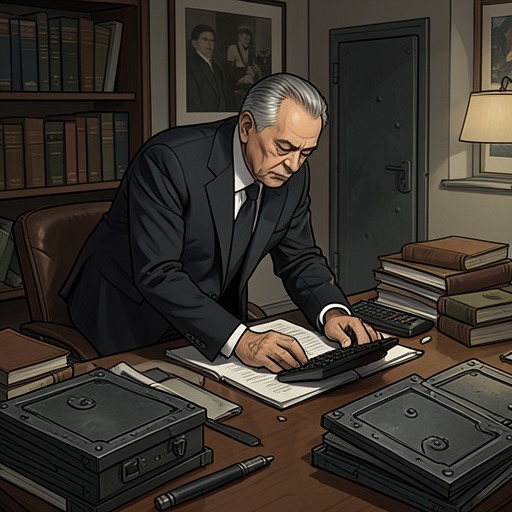
Rudy Baylor joins the Lake firm
The RainmakerRudy Baylor’s recruitment by Jonathan Lake’s firm turns the Black family’s insurance case into the center of a short-lived career breakthrough—and then into the occasion for a humiliating reversal. Offered a paralegal position despite not yet being licensed, Rudy secures an agreement for the firm to represent the Black family, only to learn days later that Lake has vetoed the arrangement. The offer’s withdrawal leaves Rudy without the job he believed he had won and with urgent questions about who will handle his clients’ case.
The case behind the offer
The opportunity begins with Rudy’s work on the Black family’s claim against Great Benefit Life Insurance Company. At law school, Max Leuberg describes debit insurance as inexpensive coverage sold door to door to low-income customers, with agents returning periodically to collect premiums. He explains that insurers routinely deny claims and that only a small fraction of bad-faith denials reach court, in part because the people targeted may be wary of lawyers and the legal system. A lawsuit, he cautions, does not guarantee a large recovery: juries may award legitimate medical expenses but little in punitive damages, especially in Tennessee, where he says verdicts tend to be conservative.
Leuberg nevertheless tells Rudy that the Black matter is a good case and advises him to refer the family to an experienced trial lawyer. Rudy sees an opportunity to bring the file to Jonathan Lake, whose successful Memphis practice has become a model for aspiring lawyers. When Barry X. Lancaster later invites Rudy to meet and bring the complete file, the case is not simply the basis for employment: the firm is considering taking it on. Rudy’s carefully organized materials, memorized names and dates, and ready copies help him present himself as prepared to work on it.
The proposed position and representation
At the meeting, Lancaster records the proposed arrangement on a Dictaphone. The firm will hire Rudy as a paralegal for twelve months at an annual salary of $21,000, paid in twelve equal monthly installments. He will receive no health insurance or other benefits during the first year. At the end of that period, the firm will review the relationship and consider whether to hire him as a lawyer. The distinction matters: Rudy has not yet passed the bar exam, and the offer does not make him an associate or promise that he will become one.
The job also carries a demanding schedule. Rudy is expected to work at least sixty hours a week, starting at eight in the morning and continuing until whenever the work is finished. He accepts without hesitation. He is prepared to study for the bar on his own time, and discloses that he has filed for Chapter 7 bankruptcy. Lancaster tells him the bankruptcy will not affect his paycheck. For Rudy, the position offers more than immediate income: he imagines that a year of hard work could move him toward the legal career he has struggled to begin.
The firm agrees to become counsel of record for the Black family against Great Benefit Life Insurance Company. Rudy will work on the file but receive none of any fees the case may generate. The agreement on representation is significant to him, even though it comes with that financial limitation. He has not yet obtained a signed legal-services contract from the Black family, and Lancaster emphasizes that one will be needed. That missing contract becomes a practical loose end in an arrangement that otherwise seems settled.
After the meeting, Rudy studies the file with Lancaster in the firm’s library. Lancaster asks for documents, dates, and names; Rudy has the materials at hand and makes one copy for the firm and another for himself. He leaves after ten o’clock, pleased that the job gives him a place to start and convinced that his prospects have changed. He plans to share the news with Booker Kane and thank Madeline Skinner, then celebrates at Yogi’s with Prince Thomas. The scene marks the high point of the offer: Rudy is no longer merely hoping that a firm might take the case or give him a chance.
The reversal
The arrangement collapses before Rudy has time to settle into the position. On a Tuesday evening, while Rudy is at Miss Birdie’s house, Dot Black calls. Barry X. Lancaster has contacted her directly, saying that he is her lawyer and asking her and Donny Ray Black to come to his office to sign papers. When Dot asks about Rudy, Lancaster tells her that Rudy is no longer working at the firm. The call makes the change official to the client before Rudy himself has been told.
Rudy is startled and tries to reassure Dot that Lancaster may simply have forgotten to mention him. He promises to call the firm and find out what is happening. Lancaster then confirms that Jonathan Lake will not approve the position. His stated reason is that a lawyer employed as a paralegal might try to force his way into a future associate position; Lake considers that arrangement bad business. Lancaster says he agrees with Lake and tells Rudy that Lake had reprimanded him for proposing the hire. He refuses Rudy’s request to speak with Lake, saying that Lake is too busy and will not change his mind.
Rudy responds with anger, repeatedly accusing Lancaster of betraying him and demanding to know whether Lake is at the office. He drives to the firm’s warehouse, where lights are on and cars are parked outside, but no one comes to the door. He pounds on the front entrance, tries a door on the north side and an emergency exit at the back, then calls up toward Lancaster’s office window. A uniformed security guard finally approaches, asks him to leave, and warns that he will call the police. Rudy shakes off the guard’s hand and walks away without speaking to Lake.
Consequences and significance
That night, Rudy sits in the darkness on the battered sofa Miss Birdie has lent him. He drinks two warm beers, curses, cries, and thinks about revenge; in his anger, he even imagines killing Lake and Lancaster. He believes they have conspired to take his case and is left wondering how to explain the reversal to the Black family. His immediate crisis is therefore both professional and personal: a job he had accepted in good faith has vanished, while the family whose case helped secure it has been contacted by the firm without him.
The episode exposes the difference between being invited into a powerful practice and having secure standing within it. Rudy has a recorded offer, a salary, a schedule, and the prospect of a later review, yet none of those terms prevents Lake from cancelling the arrangement before it has properly begun. His effort and command of the file matter at the meeting, but the final decision rests with the firm’s owner. The stated concern about a paralegal pressing for an associate role explains the veto as Lake’s business judgment; the timing and Lancaster’s direct approach to Dot leave Rudy convinced that the deeper stake is control of the client and case.
The withdrawal also makes the case’s economic and legal stakes visible in a personal form. Leuberg has explained that many policyholders never sue after a denial and that punitive awards are difficult to obtain, making the family’s representation consequential as well as commercially uncertain. Later in the litigation, Jackie Lemancyzk testifies that Great Benefit adopted a one-year policy of initially denying every claim over $1,000 in 1991, including legitimate claims, and that the experiment netted the company about $40 million. That later revelation gives added weight to the file Rudy carried into the Lake firm: it was not just a promising assignment for an inexperienced lawyer but a claim that would become central to exposing a deliberate denial scheme. The offer’s reversal does not end Rudy’s connection to the case; it establishes the precarious circumstances in which he continues to pursue it.