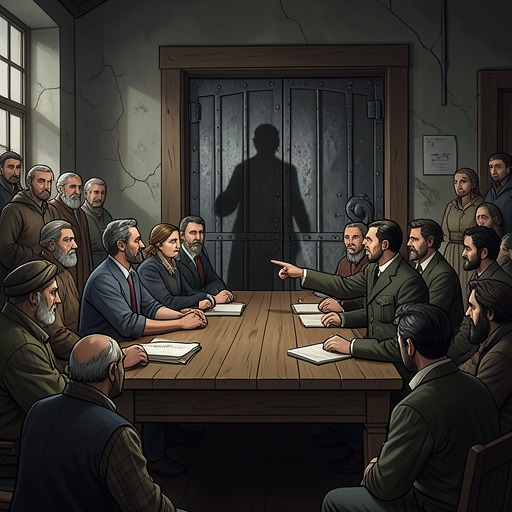
Rudy decides to represent the Black family in their insurance case
The RainmakerRudy decides to represent the Black family in their insurance case after investigating Great Benefit’s refusal to cover Donny Ray Black’s bone marrow transplant. The decision transforms a law-school assignment into a fight over whether an insurer can delay or deny an urgent claim until a family gives up—and whether a novice lawyer can act for that family before he is licensed.
The case Rudy inherits
Before Rudy approaches Dot Black, Max Leuberg explains the economics of debit insurance: inexpensive policies are sold door to door, premiums collected regularly, and claims often denied on whatever grounds the company can find. Leuberg says only about one in thirty bad-faith denials reaches court. In his account, companies count on people with limited resources being wary of lawyers and the legal system. Even when a case is brought, juries may award the medical bills and only a modest additional penalty, leaving a wealthy insurer little reason to change its practices.
That pattern sharpens the stakes for the Black family. Donny Ray is dying, and Rudy understands the dispute to concern a transplant he believes the policy entitles him to receive. Leuberg cautions that Rudy has heard only the family’s side; if their account and the records are accurate, he calls the case good, though not great. He also warns that Tennessee juries are conservative and that a trial could bring a small verdict. His practical advice is to refer the family to an established trial lawyer, contact that lawyer, and write a report for Professor Howard L. Smoot. Rudy instead continues investigating and decides to take responsibility himself.
Dot Black agrees to sue
When Rudy visits Dot, he finds her at home, where Buddy Black spends much of the day sitting in the family’s old Ford Fairlane. Dot describes him as unwell and says he drinks, while Donny Ray spends much of his time in bed. These circumstances are part of the family’s strain, but the immediate question is the claim: Great Benefit first denied it the previous August, soon after Donny Ray’s diagnosis, and Dot kept writing to the company because she expected it to honor a policy for which the family had paid its premiums regularly.
Dot explains that she had never used a lawyer and had hoped Great Benefit would pay for the bills and treatment. Rudy tells her he has spent hours reviewing the records and days researching the law, and advises her to sue promptly. He is candid that the company may stall for months or years, and that filing suit might lead either to a quick settlement or to trial and appeal. Dot answers that Donny Ray may have only months. Her urgency turns the risks from abstract litigation advice into a question of time.
Rudy offers to handle the case on contingency: he will receive a third of any recovery, after Donny Ray’s medical bills are paid, and nothing if there is no recovery. He tells Dot they will sue for millions, while acknowledging that he does not expect to recover that amount. What appeals to her is not a promise of wealth so much as the chance to make Great Benefit answer for its conduct. She tells him to proceed at once.
The professional and ethical risk
Dot’s agreement does not resolve Rudy’s authority to act. He has a legal-services contract in his pocket, but recognizes that he cannot ethically sign an agreement to represent clients until he has passed the bar and been admitted to practice. He therefore does not present the contract or formally sign her up at that meeting. He says he will probably need to associate another lawyer, whose name can go on the filings until he is admitted. Dot appears not to register the complication; her concern is how much the case will cost and how quickly Rudy can get to work.
The moment establishes a tension that continues through the case. Rudy’s knowledge of the records and investment in the family’s claim give him a reason to act, while his unlicensed status sets a boundary he knows he cannot ignore. His choice is thus not simply to accept a promising lawsuit. He commits himself to advancing the Blacks’ interests while facing the practical and ethical limits of his position.
From private claim to corporate evidence
The later proceedings show how much larger the case becomes than the initial dispute over coverage. Cooper Jackson describes a claims process in which a handler denies a claim, requests five years of medical records, and sends the file between claims and underwriting. The insured receives successive letters while the departments issue instructions that leave payment pending. According to Jackson, many people give up before seeking counsel. When Rudy examines Jackson’s manuals, he finds Section U in both the claims and underwriting versions. The sections were missing from the manuals produced to him in discovery; read together, the documents direct the departments to keep a claim unpaid while generating a paper trail that makes the process appear orderly.
At trial, former claims handler Jackie Lemancyzk testifies that, during 1991, Great Benefit adopted a year-long policy of initially denying every claim over one thousand dollars, regardless of its legitimacy. She says the scheme generated about forty million dollars in additional savings and that large claims were generally paid only after an insured hired a lawyer and applied pressure. She also explains that the Black claim was closely monitored after the company recognized that the policy did not exclude bone marrow transplants, even though Donny Ray’s medical records indicated that he would ultimately die without one.
The family’s letters make the consequences legible to the jury: the denials give different reasons, including preexisting conditions, Donny Ray’s status as an adult household member, and claims that bone marrow transplants are excluded or experimental. Dot reads the letters, including the insulting denial known as the Stupid Letter. Donny Ray’s recorded testimony, edited to thirty-one minutes, is later played to the jury. Rudy’s decision has carried the family’s experience from correspondence and medical records into a courtroom where both the denial process and its human cost can be examined.
The decision’s significance
Rudy’s closing argument joins the individual claim to the company’s finances. Using Great Benefit’s figures, he places available cash, reserves, and undistributed surpluses at four hundred and seventy-five million dollars, alongside an admitted net worth of four hundred and fifty million. He argues that punitive damages must be large enough to affect a company of that size. The defense, meanwhile, presents the requested transplant cost as an uncovered expense and frames the family’s demand for additional damages as excessive. Rudy answers that Great Benefit’s conduct and its late willingness to offer money must be judged against what the jury has heard about the denials and the concealed manuals.
These later events do not establish the jury’s verdict in the evidence presented here. They do show what Rudy’s choice set in motion: a case that began with Dot’s decision to trust an inexperienced, not-yet-admitted law student becomes a test of the insurer’s stated reasons, its internal procedures, and the consequences of making desperate policyholders bear the burden of pursuing a claim. The decisive turn is not a guaranteed victory but the family’s passage from waiting for Great Benefit to act to demanding an answer in court.