Angels
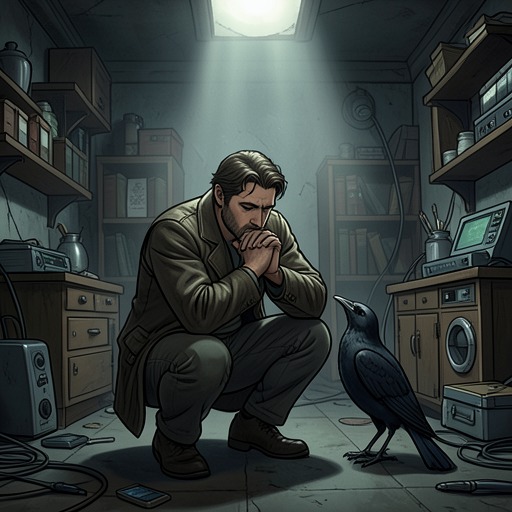
The RavenAngels occupy a decisive but elusive place in the narrator’s grief. They name Lenore as a “rare and radiant maiden,” connect her earthly loss with a sacred order beyond the chamber, and become the imagined agents through whom relief might arrive. Yet their presence never produces consolation: whenever the narrator reaches toward divine mediation, the Raven answers “Nevermore,” turning the language of salvation into another confirmation of irrevocable separation.
Sacred Naming and Lenore
The first appearance of Angels is bound to Lenore’s identity rather than to an independently described celestial scene. The narrator remembers his lost beloved as a rare and radiant maiden whom the Angels name Lenore, a formulation that places her in a realm of sanctity and posthumous recognition. Her name is therefore more than a personal designation: it is presented as something preserved by a heavenly authority even while she is “Nameless here for evermore.” The contrast joins sacred remembrance to earthly absence. Angels can name and recognize her, but that recognition does not return her to the narrator or lessen his sorrow.
The narrator’s grief is already established before the supernatural questioning begins. In bleak December, the dying embers cast ghosts upon the floor, while he eagerly wishes for the morrow and seeks relief from books. His reading cannot provide surcease from sorrow for Lenore, so the Angels’ naming of her carries the burden of a hope that ordinary memory and ordinary objects cannot satisfy. Their sanctifying language makes the loss seem meaningful without making it reversible.
The Vision of Celestial Mediation
Angels become more physically suggestive when the air appears to grow denser and perfumed from an unseen censer swung by Seraphim. The scene introduces an atmosphere of possible visitation: perfume, a censer, and the imagined tinkling footsteps of celestial beings transform the chamber from a private room into a threshold between earthly anguish and sacred intervention. The Angels are not directly seen, however. Their agency is mediated through scent, sound, and the narrator’s perception, leaving open whether the moment is supernatural visitation, visionary experience, or an intensification of grief.
The Raven’s arrival provides a sharp counterpoint to this imagined celestial presence. The bird enters after the shutter is opened and perches above the chamber door with the mien of a lord or lady, while the narrator later treats it as a possible prophet, evil thing, or devil. The chamber consequently holds rival forms of mediation: Angels and Seraphim suggest healing from above, whereas the Raven delivers a repeated answer that closes every avenue of hope. The distinction remains unstable because both the celestial vision and the bird’s speech are filtered through the narrator’s distressed consciousness.
Respite, Forgetting, and the Limits of Heaven
The narrator explicitly interprets the perfumed air as a sign that God has lent him respite and nepenthe through the Angels. He asks to quaff this kindly nepenthe and forget Lenore, imagining sacred powers as capable not merely of blessing the dead but of altering the survivor’s memory. This request reveals the extremity of his condition: he does not ask only for explanation or reunion, but for release from the remembrance that continually reopens the loss.
The hope collapses immediately when the Raven answers “Nevermore.” The reply does not identify the Angels as absent or hostile; instead, it makes their supposed intervention ineffective within the scene. The narrator’s appeal to celestial respite is absorbed into the bird’s mechanism of negation. Sacred vocabulary remains available, but its promised function—forgetting, relief, and emotional release—cannot be secured.
Healing and the Afterlife
The narrator next asks whether there is balm in Gilead, directing his question toward a traditional image of healing while still addressing the Raven as a prophet or evil thing. The appeal extends the Angels’ implied role: if celestial powers can send nepenthe, perhaps a divinely sanctioned balm can heal the wound of grief. The question is urgent and repetitive, and the answer is again “Nevermore.” Healing is thus imagined through sacred language but denied through the poem’s recurring verbal pattern.
The final celestial hope concerns Aidenn. The narrator asks whether, within the distant Aidenn, he will clasp the sainted maiden whom the Angels name Lenore. This is more than a request for Lenore’s continued existence; it is a question about reunion, physical embrace, and the possibility that love can survive death as an encounter. The Angels’ naming gives the hope a sacred frame, while the Raven’s final “Nevermore” denies the anticipated reunion. The poem therefore makes Angels witnesses to a possible afterlife without allowing them to become agents who guarantee it.
Narrative and Thematic Significance
Angels function as figures of promised mediation whose meanings are progressively tested against the narrator’s unrelieved sorrow. They connect Lenore with sanctity, introduce the possibility of divine consolation, and lend theological force to the narrator’s questions about forgetting, healing, and reunion. At the same time, every appeal associated with them meets the same refusal. Their importance lies precisely in this tension: the poem invokes a vocabulary of redemption while dramatizing the narrator’s inability to receive redemption from it.
The ending fixes that failure in a lasting image. The Raven remains seated above the chamber door, its eyes seeming like those of a demon dreaming, while lamplight throws its shadow across the floor and the narrator’s soul remains within that shadow. Against this final persistence, the Angels’ earlier perfume and imagined footsteps recede as a fleeting possibility. They represent a sacred order that can name the lost Lenore and suggest another world, but the poem leaves the narrator confined to the room, the shadow, and the refusal that has become the governing answer to every hope.