Balm of Gilead
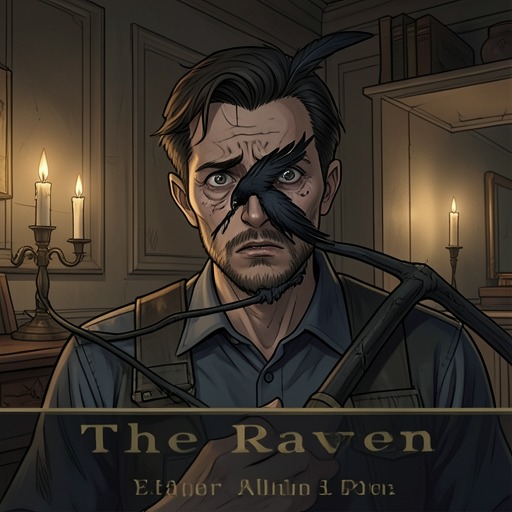
The RavenBalm of Gilead is an imagined remedy that the narrator invokes at the crisis of his grief over Lenore. Rather than appearing as a material object or being obtained through action, it enters the poem as the possibility of healing itself: a sacred answer to suffering that the Raven is asked to confirm and then decisively refuses. The phrase therefore marks the point at which the narrator’s search for relief passes from melancholy speculation into an explicit confrontation with hopelessness.
Definition and Appearance
Balm of Gilead is presented through the narrator’s appeal for a healing substance associated with Gilead. The question is not asked in a calm or informative spirit. He addresses the Raven as a “Prophet!” and as a “thing of evil,” while leaving open the possibility that the bird is either a supernatural tempter or a creature driven ashore by a storm. The balm consequently occupies an uncertain border between religious promise and desperate projection: it is named as though it could exist, but the scene supplies no physical balm, vessel, or act of application.
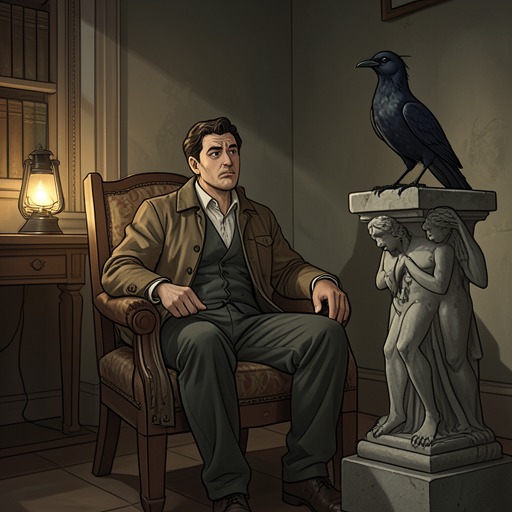
The setting intensifies that uncertainty. The narrator describes himself as desolate and undaunted on an enchanted, horror-haunted home, so that the imagined remedy is sought within a space already marked by isolation and dread. Balm of Gilead is thus less a furnishing of the chamber than a counter-image to it. Against the haunted home, it implies a place of restoration; against the narrator’s sorrow, it implies relief; against the Raven’s ominous presence, it offers the possibility that suffering might still be treated.
Invocation During the Dialogue
The narrator’s appeal comes after the Raven has entered the chamber and established its strange authority by answering the narrator’s first question with “Nevermore.” The bird is a stately Raven from the ancient past, and its grave decorum and ability to discourse plainly have already led the narrator to treat it as more than an ordinary bird. When the narrator asks about Balm of Gilead, he is therefore testing the Raven as an oracle. The question seeks not merely a name or fact but a verdict on whether healing remains available.
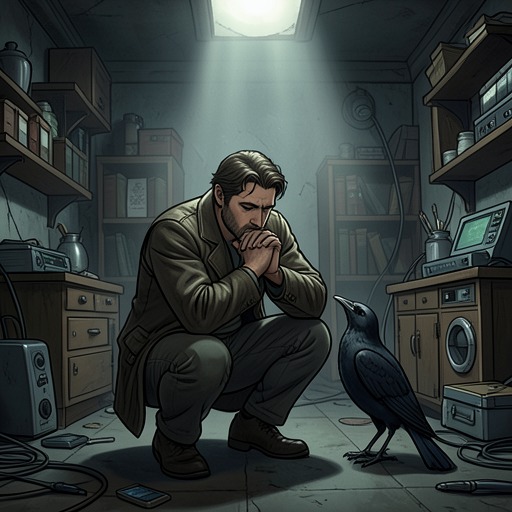
The wording makes the stakes unmistakable. He asks, “Is there—is there balm in Gilead?—tell me—tell me, I implore!” The doubled question and repeated plea enact the pressure of grief: the narrator cannot simply state his need and wait. He presses the question through repetition, as though urgency might force an answer different from the one already programmed into the bird’s speech. Yet the Raven again answers, “Nevermore.” The reply converts a possible remedy into an impossibility. It does not describe the balm, locate it, or explain its absence; its force comes from denying the future the narrator wants.
Religious and Emotional Significance
The invocation places Balm of Gilead beside other sacred or transcendent figures in the narrator’s attempt to find relief. Earlier, the air seems to grow denser and perfumed as if from an unseen censer swung by Seraphim, and the narrator imagines that God has sent angels to lend respite and nepenthe from his memories of Lenore. In that sequence, religious imagery appears to offer a route away from painful remembrance. Balm of Gilead belongs to the same vocabulary of healing, mercy, and release, but its appearance at the later question exposes how fragile that hope is.
The contrast between Balm of Gilead and nepenthe is especially revealing. Nepenthe would permit forgetting, while the balm would answer injury with healing; both imagine a way to make grief bearable. The Raven’s identical refusal closes both possibilities. The narrator is denied not only the means to forget Lenore but also the prospect of spiritual treatment for the wound that remembering has created. The sacred language remains available to him, yet its consoling function no longer succeeds.
Relation to Death and the Afterlife
Balm of Gilead also prepares the narrator’s next and more ultimate question. After asking whether healing exists in the present world, he asks whether the soul laden with sorrow will meet Lenore in distant Aidenn, where the angels name her a sainted maiden. The movement is from remedy to reunion: if the wound cannot be healed here, perhaps death or the afterlife can restore what grief has taken away. The balm therefore functions as a threshold between earthly consolation and hoped-for posthumous recovery.
The Raven’s refusal governs both questions. “Nevermore” answers the request for Balm of Gilead and then shadows the narrator’s hope of clasping Lenore in Aidenn. The object’s significance lies consequently in its failure to appear. It becomes a measure of the distance between the narrator’s religious imagination and the answer he receives: he can formulate the language of healing, angels, and an afterlife, but the repeated response denies access to the relief those images promise.
Symbolic Function and Ending
As a symbol, Balm of Gilead gathers the poem’s conflict between sacred expectation and irreversible loss. It is invoked by a speaker who calls upon prophetic, angelic, and divine frameworks, yet the only response available in the chamber is the Raven’s repeated word. The balm’s imagined efficacy is opposed by the bird’s fixed recurrence, making the object part of a larger structure in which every route out of grief returns to the same negative answer.
That return is reinforced by the Raven’s final stillness. The bird remains perched above the chamber door, its eyes seeming like those of a dreaming demon, while lamplight casts its shadow across the floor. In this concluding image, Balm of Gilead has not relieved the narrator, and no supernatural medicine has displaced the Raven. The hoped-for cure is absorbed into the shadowed chamber as an unanswered possibility, while the Raven’s presence continues to define the narrator’s emotional world.