Fear
The RavenFear is the poem’s central psychological and atmospheric state: it converts grief for Lenore into bodily alarm, interpretive uncertainty, and finally an apparently inescapable dread. The narrator does not encounter fear as a single sudden shock. It develops through stages, beginning with disturbance in a dark chamber, passing through hesitation and attempted self-command, and culminating in the Raven’s ominous permanence and the shadow that overtakes the narrator’s soul.
Origin in Grief and Exhaustion
Fear first emerges from the narrator’s vulnerable condition. He is nearly asleep while pondering over forgotten learning, and he has eagerly wished for the Morrow because he has sought relief from sorrow for the lost Lenore in his books. This exhaustion and bereavement make the chamber psychologically unstable: ordinary sounds can become signs, while the desire for consolation gives every disturbance an emotional weight beyond its physical cause.
The tapping therefore arrives against a background of unresolved loss rather than calm domestic routine. The narrator initially tries to reduce it to a visitor at the chamber door, but the effort is already a form of self-protection. His repeated explanation that it is only a late visitor and “nothing more” attempts to impose a rational boundary on an experience that his grief has made difficult to control.
Fear Before the Threat Is Seen
The strongest early fear is generated by uncertainty. The rustling of the purple curtains thrills the narrator and fills him with “fantastic terrors never felt before,” even though no threatening figure has yet appeared. To still his beating heart, he repeats his explanation about the chamber door; the repetition reveals that reassurance is not succeeding. His fear is physical before it is interpretive, registered in the heart and in the hesitation that precedes action.
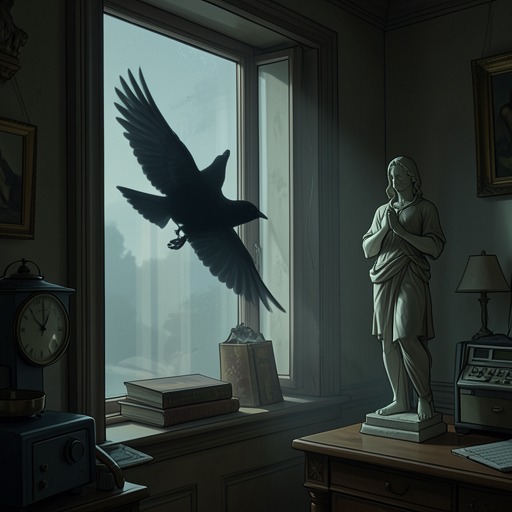
When the door is opened, the expected visitor is absent. The narrator peers deeply into the darkness, wondering, fearing, doubting, and dreaming dreams beyond ordinary human experience. The silence gives no token, and the only word spoken is the whispered name “Lenore?” The empty doorway thus becomes more frightening than a visible intruder would have been: it offers no object that could be judged, resisted, or dismissed, while the beloved dead person’s name makes the unknown inseparable from bereavement.
The Raven and the Escalation of Dread
The fear changes when the shutter is opened and a stately Raven steps into the chamber. The bird’s appearance gives the previously unseen disturbance a body, but its behavior remains unnervingly controlled. It makes no obeisance, pauses neither to ask permission nor to explain itself, and perches above the chamber door on a bust of Pallas. The posture combines the familiar presence of an animal with the authority of a posed figure, making the Raven seem both tangible and resistant to ordinary human expectations.
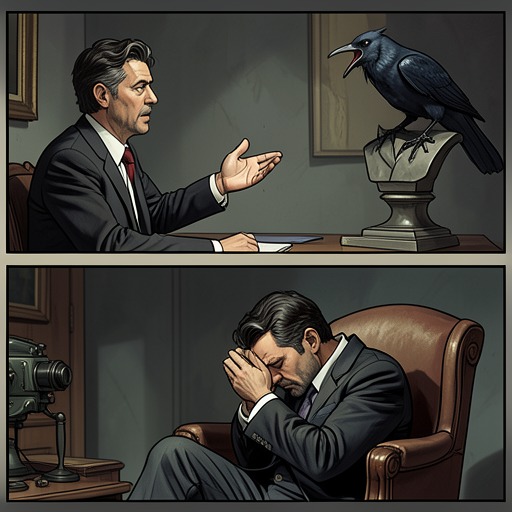
The narrator briefly responds by trying to make the bird amusing. The ebony bird beguiles his sad fancy into smiling through the grave and stern decorum of its countenance. This moment does not dispel fear; it creates a fragile contrast between the narrator’s attempt at social interpretation and the Raven’s impassive presence. The narrator addresses it as a ghastly, grim, ancient bird and asks for its name on the Night’s Plutonian shore. The answer, “Nevermore,” is plain discourse but has little apparent relevance, and that mismatch deepens the disturbance: the Raven can speak, yet its speech does not make the situation intelligible.
The narrator’s response to the Raven also shows fear moving through changing names and explanations. The bird is first treated as an ungainly fowl, then addressed as a possible prophet and as a thing of evil, whether sent by a Tempter or cast ashore by a tempest. These possibilities give the narrator different frameworks for understanding the same presence, but none restores control. The Raven remains an animal with a humanly legible voice and an apparently supernatural significance, a combination that keeps the source of danger unresolved.
Repetition, Consolation, and Failed Control
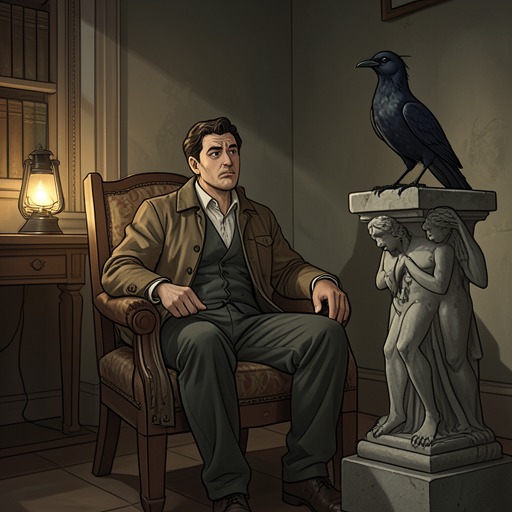
Fear is sustained by the narrator’s repeated attempts to regulate it. He moves from the door to the shutter, from physical inspection to verbal explanation, and finally to deliberate interpretation. Even after the Raven continues to beguile his sad soul into smiling, he wheels a cushioned seat before the bird, the bust, and the door and begins linking one thought to another. The arrangement places him directly before the ominous tableau, as though concentrated reasoning might convert the scene into knowledge.
Instead, the Raven’s repeated answer becomes a mechanism for expanding dread. “Nevermore” first seems like an inherited response with little relevance, but its recurrence invites the narrator to attach increasingly grave questions to it. The word becomes less a reply to what the narrator asks than a fixed limit placed upon what can be hoped for. Fear consequently shifts from anticipation of an external intruder to apprehension that the narrator’s own questions will force a devastating answer.
The appeal for supernatural relief makes this process explicit. The narrator cries that God has lent the Raven, through the Angels, respite and nepenthe from memories of Lenore, and urges the bird to offer the forgetfulness that might release him from lost Lenore. The Raven answers “Nevermore.” Here fear is joined to the collapse of consolation: the possibility of relief is raised in the language of divine intervention only to be denied by the same bleak formula. The emotional threat is not merely that the bird may be evil, but that neither memory nor grief can be escaped through the hope the narrator invokes.
Final Form and Narrative Significance
By the closing image, fear has become a permanent condition rather than a passing reaction. The Raven never flies away; it remains sitting on the pallid bust of Pallas above the chamber door. Its stillness is more disturbing than motion because it turns the encounter into an enduring occupation of the narrator’s space. The position above the door also recalls the original threshold, but the once-uncertain disturbance has now acquired a fixed emblem.
The bird’s eyes have all the seeming of a demon dreaming, while lamplight throws its shadow across the floor. The image preserves the poem’s uncertainty: the Raven may be a literal bird, a supernatural messenger, or a figure shaped by the narrator’s grief and fear. Yet the emotional consequence does not depend on resolving that question. The narrator’s soul is described as emerging from the shadow that lies floating on the floor, and the final spatial image makes fear both external and internal. It belongs to the chamber, to the bird, and to the narrator’s consciousness at once.
Fear therefore governs the poem’s movement from unseen sound to visible presence, from rational explanation to symbolic interpretation, and from temporary alarm to permanent entrapment. Its power lies in delayed revelation and repeated denial: the threat remains uncertain long enough for imagination to enlarge it, then becomes concrete without becoming fully intelligible. The Raven’s continued presence gives that uncertainty a lasting form, while “Nevermore” fixes the narrator’s dread to the impossibility of recovering Lenore or escaping the sorrow that summons the encounter.