Gilead
The RavenGilead is a religiously charged place-name invoked by the narrator as the possible source of a balm for his grief. It never becomes a visited location or a developed setting; instead, it functions as an imagined territory of healing, introduced within a desperate question whose negative answer intensifies the poem’s movement from mourning toward despair.
Invocation as a Search for Healing
The reference to Gilead occurs after the narrator has already tried to manage sorrow through reading and after he has begun treating the Raven as a possible supernatural speaker. He asks whether there is balm in Gilead while addressing the bird as a prophet and as a possible evil thing, leaving its nature uncertain between bird and devil. The geographical name therefore carries more than ordinary medicine: it represents the hope that a sacred remedy might exist for the memories of Lenore.
The question is framed as an urgent appeal rather than as detached theological inquiry. The narrator describes himself as desolate on an enchanted, horror-haunted home and asks the Raven to tell him truly whether such healing is available. Gilead is thus placed in opposition to the chamber: it suggests a distant sphere of spiritual restoration, while the room remains the immediate enclosure of grief, supernatural uncertainty, and repeated interrogation.
Biblical and Religious Resonance
Gilead’s force comes from its association with healing imagery, which the narrator gathers into the single phrase, “Is there balm in Gilead?” The surrounding language enlarges that association through references to Heaven, God, Angels, Seraphim, Nepenthe, and Aidenn. Yet the poem does not allow these sacred or mythic terms to provide secure consolation. Religious vocabulary appears as a series of possible routes toward relief, but each route is tested against the concrete fact of Lenore’s absence.
The reference also stands beside the narrator’s earlier image of a Raven wandering from the “Nightly shore,” a phrase that places the bird within a mythic geography of darkness. Gilead consequently forms a counter-location to the Raven’s night-bound origin: one name implies healing and sacred remedy, while the other evokes an ominous borderland from which the bird has arrived. The contrast sharpens the narrator’s attempt to determine whether the visitor brings revelation, temptation, or merely an accidental answer learned from human speech.
The Raven’s Refusal
The Raven answers the question with “Nevermore.” Because the response is identical to the word previously given when the narrator asked the bird’s name, it offers no explanation of Gilead and no distinction between medicine, miracle, and impossibility. Its repetition converts the narrator’s theological appeal into another instance of final negation. The sacred place-name promises the possibility of cure, but the answer denies that possibility without clarifying whether the denial comes from supernatural knowledge or from the bird’s memorized vocabulary.
This refusal is especially destructive because it follows the narrator’s request that the bird tell him truly. The appeal to Gilead is not simply a request for comfort; it is an attempt to make the Raven certify whether grief can be healed. The answer instead confirms the narrator’s growing conviction that no remedy lies ahead. Gilead remains a name associated with cure, but within the poem it becomes the place from which cure cannot be obtained.
Relation to Lenore and the Poem’s Ending
Gilead is part of a sequence in which the narrator repeatedly translates mourning into religious questions. Before invoking it, he has remembered Lenore as the rare and radiant maiden named by the Angels and has imagined reading as a possible means of obtaining relief from sorrow. After the question about Gilead fails, he proceeds toward a still more distant hope: whether, within Aidenn, he will clasp Lenore again. The progression moves from earthly or spiritual healing to reunion after death, and the Raven’s “Nevermore” closes both possibilities.
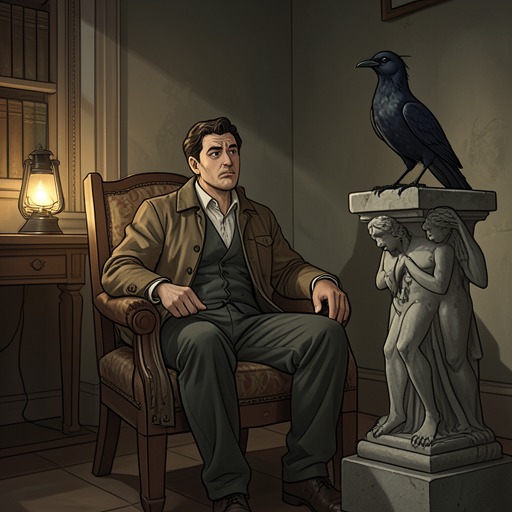
The consequence is not merely that the narrator lacks a medicine. His grief becomes attached to the chamber, the bird, and the language of repeated denial. By the ending, the Raven remains perched above the chamber door, its eyes seeming like those of a dreaming demon, while its shadow lies across the floor and the narrator’s soul is understood as caught within that shadow. Gilead therefore marks a decisive point in the poem’s religious imagination: a sacred emblem of healing is summoned, denied, and absorbed into the larger structure of permanent mourning.