Grief
The RavenGrief is the central psychological and structural force of the poem. The narrator does not merely remember Lenore’s death; he inhabits the loss so completely that every perception is drawn into it. His books cannot provide relief, the possibility of sleep is unstable, and the Raven’s repeated “Nevermore” gradually converts private sorrow into an apparently final judgment about memory, consolation, and reunion.
Definition and Emotional Source
The narrator’s grief is explicitly attached to “the lost Lenore,” whom he identifies as a rare and radiant maiden named by Angels. The loss has both personal and idealized dimensions: Lenore is not described through ordinary biographical detail, but as a luminous absence whose value is intensified by death. Her name is set against the promise of “evermore,” making remembrance itself a form of continued presence while also emphasizing that she is no longer physically available.
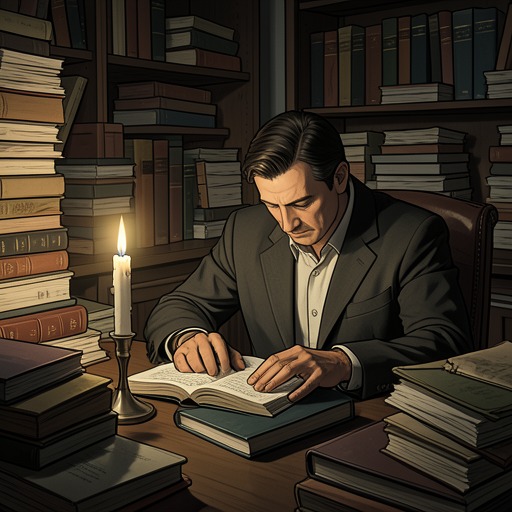
The sorrow is already active before the supernatural encounter begins. While pondering over forgotten lore, the narrator is weak, weary, and nearly asleep; he has eagerly wished for the Morrow because he has unsuccessfully sought from his books some cessation of sorrow. Reading is therefore not presented as detached study. It is an attempted remedy, a deliberate effort to redirect consciousness away from Lenore, yet the effort fails. The books cannot loosen the emotional attachment to the dead, and the night becomes a period in which grief is prolonged rather than relieved.
Grief in the Chamber
The chamber gives the narrator’s sorrow a confined physical setting. As he nods toward sleep, a gentle tapping sounds at the chamber door. He first reduces the disturbance to an ordinary visitor and mutters that it is “Only this and nothing more.” The phrase is a defensive act: by naming the sound as insignificant, he tries to keep the external world within manageable limits.
That explanation does not hold its emotional force for long. The tapping returns to his attention, and he repeats that it must be some late visitor seeking entrance. The repetition reveals how grief alters perception. An ordinary sound becomes charged with expectation, while the narrator’s effort to reassure himself exposes the fear that reassurance cannot contain. The chamber door functions as a boundary between inward sorrow and whatever might interrupt it, but the repeated knocking makes that boundary unstable.
The narrator’s grief also heightens his susceptibility to terror. The silken rustling of the purple curtains fills him with unfamiliar fears, and his beating heart must be calmed through repeated speech. The scene therefore moves from sorrow to apprehension without leaving the emotional field of mourning: because Lenore is absent, any suggestion of arrival can appear both hopeful and threatening. The desire for a visitor and the dread of what may enter coexist in the same enclosed space.
Failed Consolation and Repetition
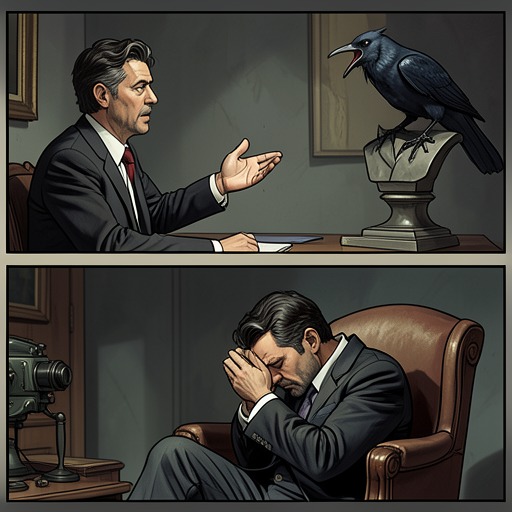
When the Raven answers “Nevermore,” the word acquires force through its relation to the narrator’s existing grief. At first, the answer seems to have little meaning or relevance, but its very emptiness allows the narrator to project increasingly painful questions onto it. The repeated response becomes less a piece of information than a verbal mechanism through which loss is revisited. Each recurrence narrows the possible future until consolation appears linguistically impossible.
The narrator directly imagines relief through Nepenthe. He calls upon the possibility that Angels have sent respite from his memories of Lenore and urges the drink of forgetfulness as though grief might be treated by removing its object from consciousness. Yet this proposed cure is not fulfilled. The Raven again answers “Nevermore,” and the rejected remedy makes the sorrow more explicit: the narrator wants not simply to understand the loss but to escape the memory that keeps Lenore present.
The poem’s repetitions thus chart a movement from attempted distraction to compulsive return. The tapping is repeated, the explanation that there is “nothing more” is repeated, Lenore’s name is repeated, and “Nevermore” becomes the answer that gathers all these earlier patterns into one refrain. The structure makes grief feel less like a single reaction than an inescapable circuit. Every effort to settle the mind produces another return to the same wound.
Denied Reunion
The most consequential question shaped by grief concerns reunion after death. The narrator asks whether, in distant Aidenn, his sorrow-laden soul will clasp the sainted maiden named Lenore. The imagined meeting places Lenore within a sacred and remote afterlife, while the narrator’s own soul is defined by the burden it carries. Hope is therefore present, but it is fragile and conditional: it depends on a future encounter that could restore the lost relationship.
The Raven’s “Nevermore” denies that hope. The answer does not establish a reasoned theology, and the narrator has already recognized that the bird’s speech may have little inherent relevance. Nevertheless, the word becomes decisive within his grieving consciousness. It transforms an uncertain future into an apparent prohibition, cutting off the possibility of clasping Lenore again. Grief is consequently intensified by the collapse of both available forms of relief: forgetting through Nepenthe and reunion in Aidenn.
Lenore’s absence also appears in the empty domestic space of the chamber. The violet velvet lining of the cushion is associated with the thought that she shall press it “nevermore.” A particular object becomes evidence of her permanent absence. The cushion is not merely described as vacant; it is imaginatively occupied by the person who can no longer return to it, so that the material room preserves the shape of the relationship while confirming its termination.
Enduring Psychological Imprisonment
By the end, grief has ceased to be an emotion the narrator can set aside and has become the condition through which the entire scene is interpreted. He commands the Raven to remove its beak from his heart and its form from his door, linking physical presence with inward pain. The bird is not only an intruder in the chamber; it has become an image of the wound that the narrator cannot dislodge.
The command fails. The Raven never flits and remains sitting above the chamber door, repeating its stationary presence as insistently as it repeats “Nevermore.” The final image gives grief a fixed spatial form: the bird occupies a position above the threshold, while the narrator remains below it in the chamber of mourning. The door that once separated the narrator from a possible visitor now supports the emblem of his confinement.
The Raven’s eyes seem like those of a demon dreaming, but the poem does not need to resolve whether the bird is supernatural in order to establish grief’s power. What matters is that the narrator’s sorrow has found an external figure that remains after every attempted explanation and every attempted cure. The ending offers no release, no accepted consolation, and no reunion. Grief survives as an enduring presence whose shadow falls across the narrator’s chamber and whose finality is spoken through the word “Nevermore.”
Narrative and Thematic Significance
Grief organizes the poem’s movement from ordinary disturbance to metaphysical despair. The initial tapping might have been dismissed as a visitor, yet the narrator’s mourning makes the event emotionally unstable; the Raven’s entrance then gives his questions a voice, and the repeated answer supplies a form to conclusions that his sorrow is already prepared to fear. The supernatural encounter is therefore also an inward drama in which grief tests, rejects, and finally dominates every possible interpretation.
The state is marked by a tension between attachment and attempted escape. The narrator seeks books, sleep, forgetfulness, and a promised afterlife, but each avenue remains tied to Lenore: the books are consulted because of her, Nepenthe is desired because of memories of her, and Aidenn matters because it might restore her. Even the wish to forget confirms the strength of the bond. The poem presents mourning not as the disappearance of love but as love continuing without an accessible object.
Through recurrence, enclosure, and denied futurity, the poem portrays grief as self-reinforcing. The narrator’s language repeatedly tries to make the disturbance small, yet each repetition enlarges its significance. By the final scene, the word that once seemed meaningless has become the governing verdict of the chamber. Grief has moved from a private sorrow for Lenore to a total condition of perception, memory, and imagined destiny.