Hope
The RavenHope is the fragile future-oriented state that the narrator invokes while mourning Lenore and seeking escape from sorrow. At first it appears as a possibility attached to tomorrow: other companions may depart, yet Hope itself seems capable of remaining. The Raven’s answer turns that possibility into a finality, making Hope central to the poem’s movement from bereavement toward psychological entrapment.
Hope in the Mourning Chamber
The narrator’s immediate condition is defined by loss. In December, he tries to find relief in books from his sorrow for Lenore, the rare and radiant maiden whom the Angels name Lenore. Hope therefore does not arise in an emotionally neutral setting; it is formed against a grief already attached to a specific beloved and to the absence that her death has created. The desire for the morrow suggests an attempt to move beyond the present night, while the books offer only an unsuccessful means of obtaining surcease from sorrow.
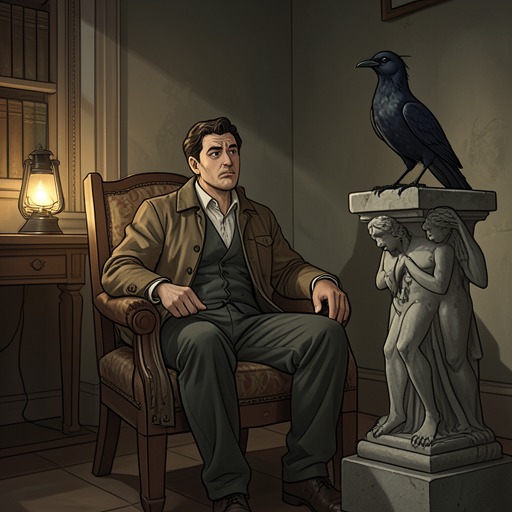
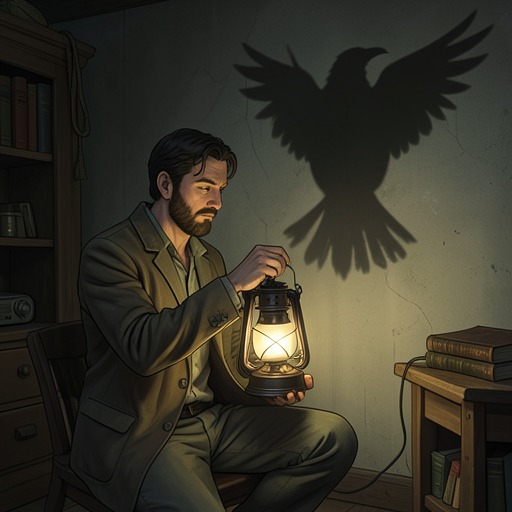
The chamber’s atmosphere makes Hope unstable before the Raven ever answers. Dying embers cast ghostly shapes upon the floor, and the uncertain rustling of the purple curtain gives the room a presence that seems both physical and spectral. Within this setting, Hope is less a secure belief than a wish projected into an uncertain future. Its force comes precisely from the narrator’s need for some future in which grief will not wholly govern consciousness.
Hope as a Future of Companionship
The narrator later links Hope to the prospect of human company. After the Raven has spoken and then fallen still, the narrator mutters that other friends have flown before and that the bird will leave him on the morrow, just as his Hopes have flown before. This formulation places Hope beside departed friends: both belong to a pattern of attachment followed by abandonment. Hope is pluralized, suggesting not one clearly defined promise but a succession of expectations that have already failed.
The expectation that the Raven will leave is consequently more than a prediction about a bird. It is an effort to preserve a future beyond the immediate encounter. If the visitor departs, the narrator may still imagine that the night will end, that solitude will change, and that the loss of Lenore will not determine every later moment. Hope survives in this imagined tomorrow only as a threatened remnant.
The Raven’s Destruction of Hope
The Raven answers the narrator’s expectation with “Nevermore.” Because the same word has already been associated with a melancholy burden learned from an unhappy master, its repetition carries an inherited pattern of negation. The bird’s answer does not explain Hope; it supplies a fixed verbal form through which the narrator’s questions and fears are forced to pass. When the narrator anticipates that the bird will leave him on the morrow, “Nevermore” denies the expected departure and, by implication, the possibility that the encounter will release him.
The answer also changes the status of Hope. What began as a future-oriented possibility becomes an object of mourning in its own right. The narrator says that his Hopes have flown before, and the Raven’s response confirms the logic of irreversible loss. Hope is not merely absent for the moment; it is placed within the same permanent register as the lost Lenore. The word’s economy is therefore devastating: a single repeated answer absorbs companionship, tomorrow, and emotional recovery into one refusal.
Hope and Lenore’s Irrevocable Absence
Hope remains inseparable from the narrator’s desire for Lenore’s return or for relief from the knowledge of her death. The contrast between the beloved’s remembered radiance and her permanent absence sharpens the state’s contradiction. The narrator can still name her, remember her, and imagine the place she might occupy, but the poem insists that she will press the velvet cushion “nevermore.” The physical cushion thus becomes a material emblem of Hope’s collapse: an intimate place remains, while the person associated with it cannot return.
The appearance of an air perfumed by an unseen censer and associated with the Seraphim briefly intensifies the possibility of supernatural consolation. Yet even this elevated atmosphere does not restore the lost beloved or establish a future in which the narrator’s grief is relieved. Hope is consequently caught between religious suggestion and verbal negation. The scene can evoke transcendence, but the Raven’s refrain keeps the desired recovery beyond reach.
Hope as Psychological Entrapment
The narrator’s treatment of Hope reveals a movement from mourning toward fixation. He seeks escape through books, projects relief onto the morrow, and tests the Raven with statements about departure and vanished friends. Each strategy attempts to make the loss temporary or intelligible. Each instead returns him to the same answer. The repetition gives grief a compulsive structure: Hope is repeatedly summoned as a possible counterforce, then repeatedly converted into evidence that nothing can be recovered.
In this pattern, Hope is not simply destroyed by an external omen; it becomes part of the narrator’s own cycle of questioning. The Raven’s “Nevermore” gains power because the narrator continues to bring increasingly painful possibilities before it. The state thus marks the poem’s decisive emotional reversal. What might have offered movement toward the future becomes the very measure of the narrator’s confinement to the past, to Lenore’s absence, and to the conviction that relief will not come.