Knocking at the chamber door
The RavenKnocking at the chamber door is the initiating disturbance in The Raven and the poem’s first sustained mechanism of suspense. Heard while the narrator is weak, weary, and nearly asleep at midnight, the tapping converts an enclosed chamber into a site of uncertain contact. What may be an ordinary visitor becomes, through repetition and the narrator’s grief, the threshold through which memory, fear, and the Raven’s “Nevermore” enter the room.
First Sound and Immediate Setting
The knocking begins while the narrator is pondering over “many a quaint and curious volume of forgotten lore.” The scene is already marked by exhaustion and inward absorption: he is “nearly napping” when the sudden tapping interrupts his reading. Its weakness and gentleness make it difficult to identify, but its very faintness increases its power. The sound is not a clear announcement by a known person; it is an acoustic disturbance that demands interpretation before it permits action.
The repeated descriptions of “tapping” and “rapping” give the event a patterned, almost musical insistence. The sound is gentle, yet it breaks the stillness of the chamber, and its recurrence makes the narrator attend to it as if it possessed intention. He initially treats it as the arrival of an ordinary visitor, muttering, “'Tis some visiter,” and then reducing the matter to “Only this and nothing more.” That conclusion attempts to contain the event by naming it as familiar and harmless, but the refrain also reveals the inadequacy of the explanation: the insistence of the sound exceeds the certainty of the words used to dismiss it.
The Door as a Threshold of Interpretation
The narrator’s first interpretation is not stable. After remembering Lenore, he hears the chamber’s curtains rustle and feels “fantastic terrors never felt before.” The external sounds therefore become entangled with a private wound. To steady his beating heart, he repeats that it is merely “Some late visiter entreating entrance at my chamber door.” The repeated phrase functions as self-command as much as description. It turns the door into a boundary between the narrator’s attempt at rational control and the imaginative terror gathering on the other side.
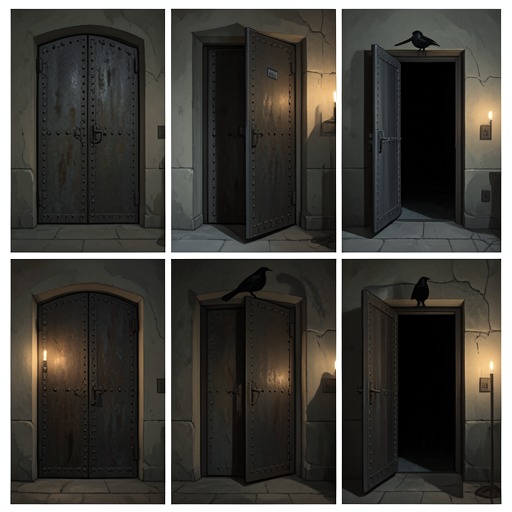
When the knocking is not confirmed immediately, uncertainty intensifies rather than disappears. The narrator acknowledges that he had been napping and that the visitor came so faintly that he was scarcely sure he had heard anything. He then opens the door wide and finds “Darkness there and nothing more.” This is the first decisive reversal in the event: the sound promises a presence, while the opened threshold reveals absence. The empty doorway does not resolve the mystery; it leaves the narrator peering into darkness, wondering, fearing, and dreaming beyond ordinary mortal experience.
The door also produces a return movement. After whispering Lenore’s name and hearing only an echo answer it, the narrator turns back into the chamber with his soul burning within him. The knocking then resumes, louder than before. Its recurrence makes the earlier dismissal impossible to sustain. The event has moved from a possible visitor at the door to a pattern that follows the narrator’s attention and emotional state. The sound’s return is not simply repetition of the same occurrence: it carries the pressure of the unanswered first encounter and raises the stakes of opening another boundary.
From Door to Window
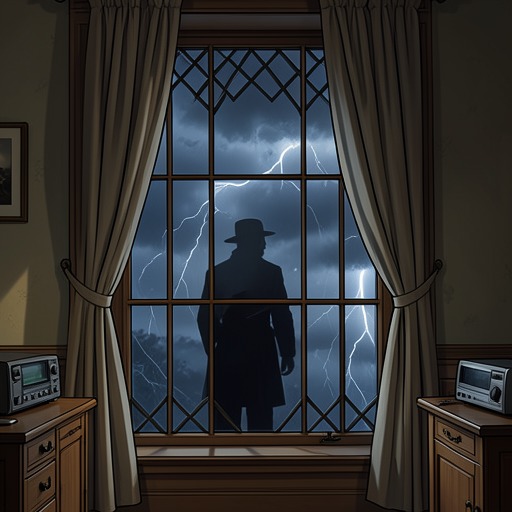
The narrator next relocates the source of the disturbance from the chamber door to the window lattice. This change preserves the basic structure of the event while altering its spatial direction. The first knocking draws him toward the entrance of the chamber; the second drives him to investigate the room’s other opening. He again proposes a natural explanation, deciding that it is the wind and nothing more, and asks that his heart remain still while he explores the mystery.
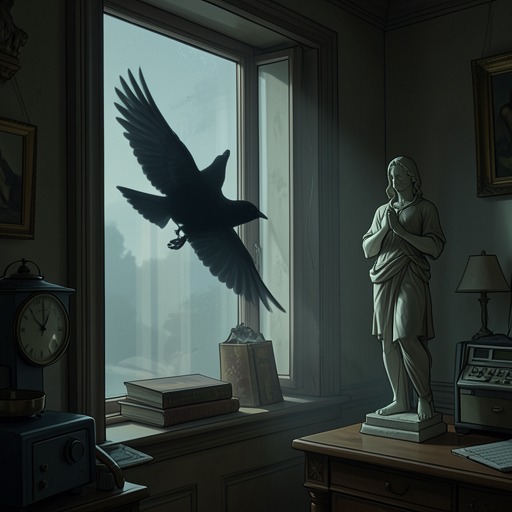
The shutter is then flung open, and the uncertainty takes visible form. A stately Raven steps inside “with many a flirt and flutter” and settles above the chamber door, on a bust of Pallas. The knocking therefore proves to have been a prelude to an entrance, though not the entrance the narrator expected. The movement from door to window reverses the anticipated route of access: the creature does not appear as a human caller requesting admission, but crosses the window boundary and occupies the chamber’s symbolic center.
The Raven’s entrance gives the earlier sound a new retrospective meaning. What began as an indistinct, almost domestic disturbance becomes the opening gesture of a supernatural-seeming encounter. Yet the bird’s behavior is presented with a striking mixture of ceremony and absurd finality. It makes no obeisance and does not pause, but perches with “mien of lord or lady” above the door. The chamber door, initially the place where an unseen visitor might stand, becomes the elevated site from which the Raven will remain present and speak.
Repetition, Answer, and Psychological Return
The sound of knocking is structurally linked to the Raven’s repeated answer. After the bird has taken its position, the narrator asks for its lordly name on the Night’s Plutonian shore, and the Raven answers, “Nevermore.” The response has little apparent relevance to the question at first, but it establishes the poem’s governing pattern: an uncertain prompt receives a fixed answer, just as the narrator’s repeated explanations receive increasingly disturbing evidence.
The relation between tapping and “Nevermore” is one of escalation. The tapping is an external sign whose meaning the narrator tries to determine; the Raven’s answer is an explicit verbal sign whose meaning expands as the narrator supplies more painful questions. In both cases, repetition creates significance through return. “Only this and nothing more” first serves as a denial of consequence, whereas “Nevermore” eventually becomes the final form of consequence itself. The earlier knocking thus prepares the poem’s logic of compulsive inquiry: each recurrence invites another attempt to master uncertainty, and each attempt deepens the narrator’s entrapment.
The event also creates a contrast between motion and permanence. The knocking is intermittent, faint, and mobile, leading the narrator from reading to the door, from the door back into the chamber, and from the chamber to the window. The Raven, by contrast, becomes fixed. It remains perched above the door, and in the ending it is “never flitting, still is sitting, still is sitting” on the pallid bust of Pallas. The transient sound has produced an enduring presence. What seemed at first to be a brief interruption has become the stable condition of the room.
Consequences and Final Significance
The immediate consequence of the knocking is that the narrator abandons passive reading and enters an investigation governed by fear. Opening the door reveals darkness; returning to the chamber brings a louder repetition; opening the shutter releases the Raven. Each threshold crossing appears to promise knowledge, but each produces a more troubling form of uncertainty. The action therefore externalizes the narrator’s movement from grief into obsessive interpretation without granting him an exit from either.
By the final confrontation, the language of the door and the language of inner suffering have fused. The narrator commands the bird to leave and asks it to take its form from the door, while also demanding that its beak be taken from his heart. The physical location of the Raven and the imagined location of pain become interchangeable. The bird remains where the knocking first directed attention, and its shadow lies across the floor. The narrator’s soul is consequently figured as caught within that shadow, with the final “Nevermore” denying release.
Knocking at the chamber door is therefore more than a plot trigger. It is the poem’s first enacted return of the unresolved past: a sound that arrives without explanation, disappears when confronted, and comes back with greater force. Through the door, the window, the Raven’s fixed perch, and the shadow that remains beneath him, the event turns architectural boundaries into psychological ones. The knock opens the narrative, but it never opens a path out of grief; instead, it inaugurates the recurrence by which the narrator’s loneliness becomes permanent.