Lenore
The RavenLenore is the lost beloved at the center of the narrator’s grief, although she never appears directly in the chamber scene. Her absence gives the poem its emotional premise and governs its movement from private mourning to supernatural-seeming despair. The narrator’s repeated attempts to name, recover, forget, or imagine her make Lenore less a participant in present action than the figure around whom every present sensation and question is organized.
Identity and Absence
Lenore is identified through a series of exalted descriptions rather than through biography or physical action. She is the “rare and radiant maiden” whom the Angels name Lenore, and she is also described as nameless in the world of the living forevermore. These formulations place her simultaneously within intimate memory and a sacred register: she is personally lost to the narrator, yet imagined as belonging to a realm beyond ordinary human naming. The contrast between her radiant designation and her namelessness expresses the violence of absence. Her identity remains vivid in the narrator’s mind even as death has removed her from earthly social presence.
The poem therefore gives Lenore a distinctive double status. She is not merely a dead person mentioned in passing, because the narrator’s entire consciousness is measured against her loss; yet she is not developed through scenes, speech, or independent choices. Her importance arises from the intensity of the surviving speaker’s attachment. The phrase “lost Lenore” makes loss inseparable from the name itself, so that remembering her also reopens the wound that remembrance cannot heal.
The Loss and the Narrator’s Mourning
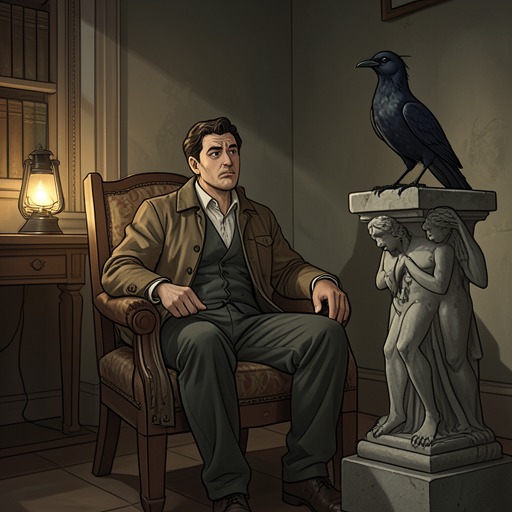
At the opening of the chamber episode, the narrator is already exhausted and immersed in sorrow. He wishes for the morrow and has vainly sought relief from his books, but intellectual diversion cannot provide “surcease of sorrow”—sorrow specifically identified as grief for Lenore. The knocking at the chamber door initially receives an ordinary explanation: the narrator tells himself that it is a visitor seeking entrance and that it is “nothing more.” This effort to contain the disturbance within familiar causes occurs against the pressure of grief, which has made the surrounding night unusually vulnerable to fear.
The relation between Lenore’s death and the narrator’s perceptions is consequently causal rather than decorative. The tapping, the chamber door, and the narrator’s repeated explanations become occasions for mourning to surface. He repeats that a visitor is requesting entrance in an effort to steady his beating heart, but the repetition does not settle the scene. Instead, it shows a mind trying to impose a harmless pattern on an experience already charged by bereavement. Lenore’s absence turns an uncertain sound into a possible summons from beyond the limits of ordinary consolation.
Memory, Forgetfulness, and the Failed Remedy
Lenore is associated not only with pain but also with the narrator’s desire to escape pain. When the atmosphere seems to grow denser and the presence of the Seraphim suggests a supernatural agency, the narrator imagines that God has sent respite and a means of forgetting. He urges The Raven to offer nepenthe so that the memory of Lenore might be relinquished. The request reveals the contradiction at the heart of his mourning: he wants relief from the memory, but the memory is also the surviving form of his bond with her.
The demand for forgetfulness is answered by The Raven’s repeated “Nevermore.” That response does not establish a factual account of Lenore’s fate or provide an alternative history; it functions as an absolute refusal of recovery through erasure. Forgetting cannot be secured, and the beloved cannot be restored by any imagined medicine. The narrator’s appeal to nepenthe therefore intensifies rather than resolves Lenore’s presence. Each attempt to remove her from consciousness confirms how completely she occupies it.
Lenore and the Hope of Aidenn
The narrator’s most explicit question about Lenore concerns a future reunion. He asks whether, within the distant Aidenn, his sorrow-laden soul will clasp the sainted maiden whom the Angels name Lenore. The wording transforms private bereavement into a religious and eschatological problem. Lenore is imagined as sainted and radiant, while the narrator speaks from a soul burdened by sorrow; the desired reunion would therefore cross not only the boundary between separation and companionship but also the boundary between earthly life and the afterlife.
The Raven again answers “Nevermore.” In context, the answer destroys the narrator’s attempt to convert memory into hope. The question had opened a possible future in which Lenore might be recovered through sacred reunion; the reply closes that future with the same word that has already denied forgetfulness. Lenore thus becomes the measure of the poem’s failed consolations. Neither books, ordinary explanations, imagined nepenthe, nor the prospect of Aidenn can give the narrator an assured path back to her.
Narrative and Thematic Significance
Lenore’s role is created through recurrence. Her name returns when the narrator recalls his sorrow, when he seeks nepenthe, and when he asks about the sainted maiden in Aidenn. Each return changes the pressure around the name: first it identifies the source of grief, then the object from which he wants release, and finally the beloved whose possible afterlife reunion he desperately tests. The repeated name keeps the lost woman at the center of the poem while the answers of The Raven progressively narrow the narrator’s emotional world.
Because Lenore never speaks, the poem offers no independent confirmation of the narrator’s idealized portrait or of the precise circumstances of her death. What the reader can know directly is the structure of her remembrance: she is rare, radiant, lost, sainted, and permanently unavailable to the speaker. Her absence is thus both the poem’s wound and its organizing principle. By the ending, The Raven remains seated above the chamber door and continues to answer “Nevermore,” leaving the narrator trapped beneath an image of irreversible finality. Lenore is not restored, forgotten, or replaced; she survives as the name around which grief becomes permanent.