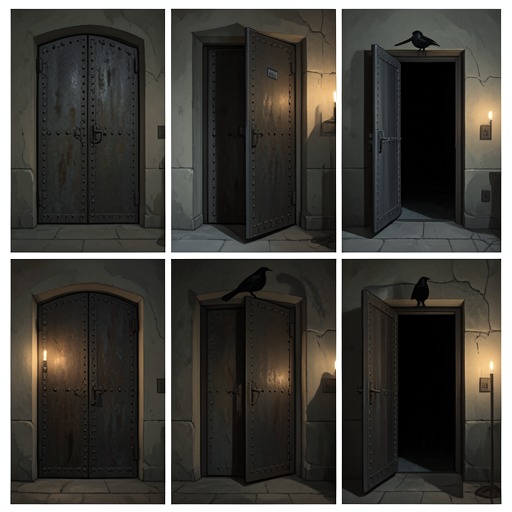
Lenore’s Death
The RavenLenore’s Death is the unseen catastrophe at the center of the narrator’s experience. The poem never stages the death directly; instead, it presents its aftermath through remembrance, deprivation, and repeated attempts to discover whether any earthly or supernatural consolation remains possible. Lenore’s absence turns the chamber into a site of mourning, while every hope of forgetting, reunion, or healing is answered by The Raven’s fixed refusal.
Identity and Narrative Presentation
Lenore’s Death is introduced through the narrator’s effort to outlast the night and reach the Morrow. He has sought relief from sorrow in his books, but that effort has failed because his reading cannot displace the lost Lenore from his mind. The loss is attached not merely to a beloved individual but to an idealized figure: Lenore is remembered as a rare and radiant maiden whom the Angels name, and she is described as nameless in the present world forevermore. The language therefore joins personal bereavement to sacred distance, making her death both an intimate wound and a separation that ordinary memory cannot repair.
The event remains deliberately indirect. No cause, date, or physical circumstances of the death are supplied. What the poem makes certain is its consequence: the narrator lives in the continuing presence of an absence. His recollection returns to Lenore while he waits in a bleak December chamber, and the dying embers that cast ghostly forms across the floor give the setting an external shape corresponding to his mourning. The death is thus narrated as an emotional and perceptual condition rather than as a completed past episode.
Grief and the Search for Relief
The narrator’s first response to Lenore’s Death is an unsuccessful attempt to obtain surcease from sorrow through books. His eagerness for the Morrow suggests a desire to pass beyond the immediate night, yet the anticipated morning offers no demonstrated cure. The more he tries to organize his pain through reading and recollection, the more clearly the loss remains the governing fact of his consciousness.
That pattern intensifies when the narrator imagines that Lenore’s place will never again be occupied. The velvet lining of the cushion is associated with the missing woman’s impossible return: she shall press it nevermore. A material object becomes a measure of irreversible absence. The cushion remains, but the person whose body might have given it meaning does not; the unchanged room therefore preserves the loss rather than softening it.
The narrator then imagines a supernatural remedy. The air seems denser and perfumed, as though an unseen censer were being swung by Seraphim whose footsteps sound upon the floor. He interprets this vision as a possible gift of respite and Nepenthe, asking whether divine powers have sent forgetfulness from memories of Lenore. Yet even this imagined intervention does not release him. The appeal to forget the lost Lenore is immediately met by The Raven’s answer, “Nevermore,” turning the hope of relief into another confirmation that the grief cannot be escaped.
Questions of Healing and Reunion
Lenore’s Death drives the narrator beyond personal recollection toward questions framed in religious and mythic language. He asks whether there is balm in Gilead, invoking the possibility of a healing substance or spiritual remedy. The question is not presented as detached theology: it is a desperate plea from a soul trying to determine whether suffering has any available cure. The Raven’s repeated answer, “Nevermore,” refuses to grant that possibility.
The final form of the narrator’s hope is reunion after death. He asks whether, within distant Aidenn, he will clasp the sainted maiden whom the Angels name Lenore. The image gives the loss a possible future resolution: separation might end in a sacred meeting beyond the present world. But The Raven again answers, “Nevermore.” This reply does more than deny a single prediction. It closes the imagined routes by which Lenore’s Death might become bearable—forgetfulness, healing, and eventual reunion—and leaves the narrator facing loss without a consoling conclusion.
Consequences and Lasting Presence
The consequences of Lenore’s Death are made visible through the relationship between the narrator and The Raven. The bird’s arrival interrupts the narrator’s mourning, but it does not replace Lenore as the central subject of his thought. Instead, every question directed toward the visitor circles back to her absence. The Raven becomes the instrument through which the narrator’s possibilities are tested, and each repeated answer fixes the loss more firmly in place.
At the end, The Raven remains seated above the chamber door, while its eyes have the appearance of a demon dreaming and its shadow stretches across the floor. The image gives Lenore’s Death a final spatial and psychological form. The bird’s immobility suggests that the verdict cannot be moved, and the shadow becomes the visible boundary within which the narrator’s soul remains caught. The absent Lenore is therefore still the decisive presence in the room: her death determines the questions, the failed remedies, the imagined afterlife, and the narrator’s continuing confinement to grief.
Narrative Significance
As an event, Lenore’s Death functions less as a point in the past than as a wound continually reactivated by language. The poem withholds the original scene and instead makes mourning itself the action. Repetition supplies the structure: the narrator remembers, proposes relief, imagines transcendence, and receives the same refusal. Through this pattern, the death becomes inseparable from the form of the poem, because each return to Lenore renews the emotional crisis rather than resolving it.
The event also sustains an unresolved tension between natural and supernatural interpretation. The narrator encounters a bird that enters with solemn authority, calls it an ancient wanderer from a Nightly shore, and later addresses it as a prophet, an evil thing, or a possible devil. Yet whether The Raven possesses genuine knowledge or merely reflects the narrator’s own expectations is never settled by the supplied scenes. What remains certain is the psychological effect: Lenore’s Death has made the narrator receptive to any sign that might answer his grief, while the answer he receives transforms bereavement into a permanent sentence.