Loneliness
The RavenLoneliness is the central emotional state in the narrator’s encounter with The Raven. It begins as grief for Lenore, appears in the narrator’s solitary attempts to read and calm himself, and culminates in the Raven’s fixed presence above the chamber door. What first seems like private isolation becomes an oppressive condition that the visitor exposes, repeats, and ultimately refuses to relieve.
Origins in Loss
The narrator’s loneliness is rooted in the death of Lenore. He has turned to books in the hope of finding surcease from sorrow, but reading cannot release him from his mourning for the lost Lenore, described as a rare and radiant maiden whom the Angels name Lenore. Her absence is not presented as a completed past event; it remains active in the narrator’s consciousness, occupying the room even before the Raven arrives. The attempt to await the Morrow therefore carries little genuine expectation. He wishes for the coming day while already recognizing that neither time nor reading can remove the loss.
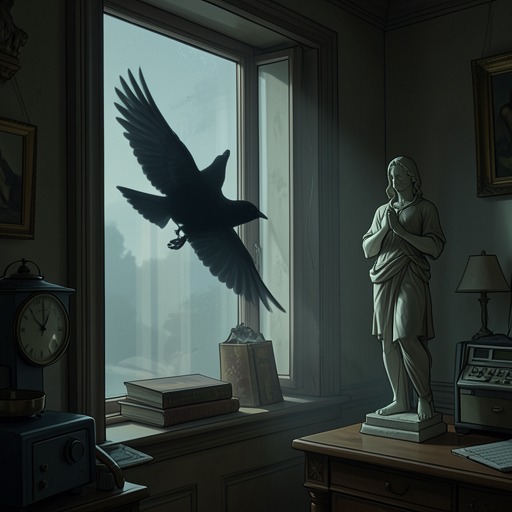
The chamber gives this grief a physical enclosure. In December, dying embers cast ghostly forms upon the floor, while the uncertain rustling of the purple curtains fills the narrator with terrors he has never experienced before. The setting does not merely contain his sorrow; it translates solitude into unstable sounds, shadows, and imagined presences. His loneliness is consequently both emotional and perceptual: deprived of Lenore, he becomes vulnerable to every movement in the surrounding darkness.
Solitary Attempts at Control
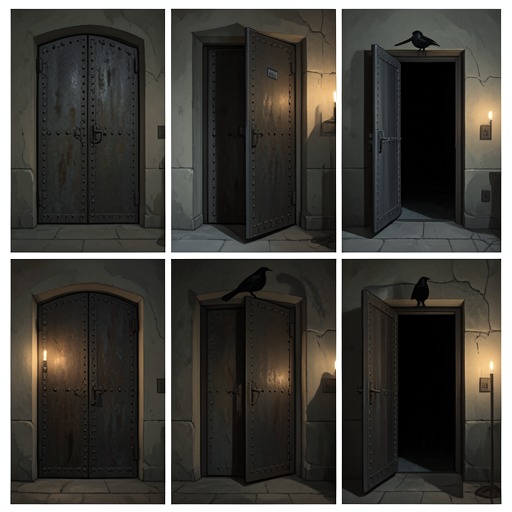
Before the Raven appears, the narrator tries to manage his isolation through repetition and explanation. To quiet the beating of his heart, he repeats that the visitor at the chamber door is merely a late visitor and nothing more. This self-reassurance temporarily gives the unknown a familiar human shape, as though a visitor could restore ordinary social contact. When his soul grows stronger, he hesitates no longer, opens the door, and apologizes for having been napping and for answering the knocking so gently.
The gesture toward the door is therefore also a gesture away from loneliness, but it produces no human companionship. The chamber door opens onto darkness rather than a person. The narrator’s effort to establish contact fails at its first threshold, leaving him alone with the absence he had tried to explain. His repeated assurances become an early form of the poem’s larger pattern: language is used to contain fear, yet repetition gradually makes the feared condition more definite.
The Raven as Solitary Presence
The Raven enters through the window as a stately bird from an ancient past and perches above the chamber door, on a bust of Pallas. It makes no obeisance, does not pause, and offers no ordinary companionship. Its silence and composure distinguish it from the narrator, whose loneliness is marked by agitation, questioning, and emotional fluctuation. Yet the bird’s arrival briefly makes the narrator smile. The grave and stern decorum of its countenance gives his sad fancy a momentary diversion, showing that loneliness can make even an ominous stranger preferable to complete absence.
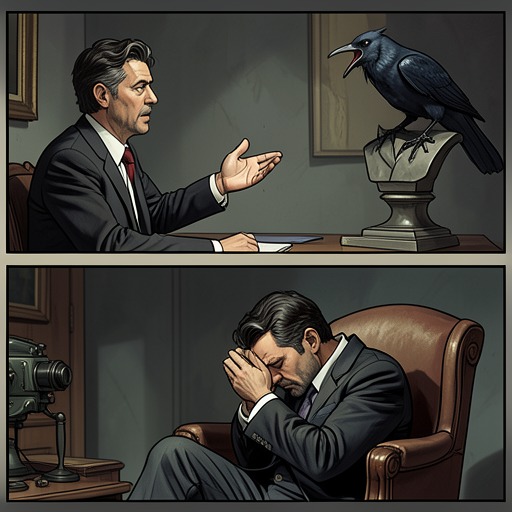
That diversion quickly turns into a new and more disturbing relation. The narrator tries to name the bird and asks for its lordly name on the Night’s Plutonian shore. The Raven answers only, "Nevermore." The narrator marvels that such an ungainly fowl can speak so plainly, although the answer initially seems to have little meaning or relevance. The bird’s apparent capacity for discourse promises connection, but its speech remains restricted to one word. It is present without becoming communicatively available.
The Raven’s loneliness is emphasized by its own stillness. Sitting alone on the bust, it speaks only that single word, as if its soul were poured into it, and then makes no further utterance or movement. This produces a stark contrast between physical proximity and emotional distance. The narrator is no longer alone in the chamber, but he remains isolated from the visitor’s intentions, history, and possible sympathy. The presence that interrupts solitude thus becomes an instrument through which solitude is made more acute.
Loneliness Recast as Imprisonment
As the encounter proceeds, the narrator’s loneliness becomes inseparable from the memory of Lenore. The imagined possibility that Lenore might ever press the violet velvet cushion is denied by the word "Nevermore." The cushion, illuminated by the lamp, becomes an object of absent intimacy: it is prepared for a presence that will not return. The Raven does not need to explain Lenore’s death directly; its repeated answer turns the room’s furnishings into reminders of irreversible absence.
The narrator then seeks forgetfulness rather than companionship. He asks for nepenthe, the drink of oblivion, and connects that desire explicitly with the lost Lenore. The unseen censer and the foot-falls of the Seraphim make the air seem denser and suggest a supernatural possibility of relief, but the Raven again answers, "Nevermore." The hope of escaping grief through forgetfulness is therefore rejected just as the hope of recovering Lenore has been rejected. Loneliness is no longer simply the condition of missing another person; it is the inability to detach from the memory of that person.
The Unbroken Ending
The narrator eventually commands the Raven to return to the tempest and the Night’s Plutonian shore. He demands that it leave no black plume as a token of the lie its soul has spoken, preserve his loneliness unbroken, and remove both its beak from his heart and its form from above the door. These commands reveal a contradiction at the center of his isolation. He wants the visitor gone because its presence invades him, yet he describes the desired state as loneliness itself. He seeks not renewed social life but the restoration of a solitude that existed before the Raven and was already saturated with Lenore’s absence.
The Raven refuses. It remains perched above the chamber door, never flitting and still sitting on the pallid bust of Pallas. Its repeated stillness converts the temporary visit into an enduring occupation of the room. The bird’s eyes seem like those of a demon dreaming, while the lamp throws its shadow onto the floor. The final image makes loneliness spatial and visual: the narrator’s soul lies within the shadow, and the shadow remains attached to the Raven’s presence. The condition that began as mourning ends as entrapment, with no promise that either the bird or the grief will depart.