Melancholy
The RavenMelancholy is the governing emotional state of The Raven, arising from the narrator’s grief for Lenore and becoming a condition of psychological entrapment. It first appears as an attempt to obtain relief through reading, then spreads through the chamber’s sounds and shadows, and ultimately becomes inseparable from the Raven’s presence. The poem’s repetitions give that sorrow a structure: what begins as a private wish for forgetfulness ends as a seemingly permanent captivity to loss.
Origin in Loss
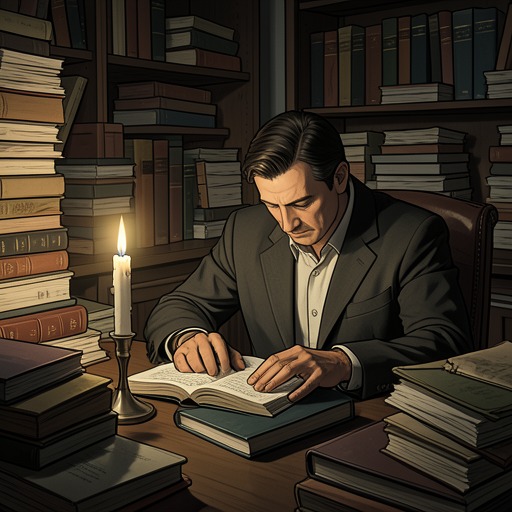
Melancholy is introduced through the narrator’s effort to escape sorrow rather than confront it. At midnight, while he is “weak and weary,” he reads “many a quaint and curious volume of forgotten lore,” hoping that books will provide distance from his pain. His wish for the morrow is explicitly connected to his search for relief from “sorrow—sorrow for the lost Lenore.” Lenore is remembered as a “rare and radiant maiden,” while the statement that the angels name her and that she is “Nameless here for evermore” places her absence between earthly loss and a more remote, inaccessible realm.
The narrator’s reading therefore functions less as recovery than as a failed attempt to suspend memory. The books offer knowledge and distraction, but they cannot remove the lost person who organizes his emotional life. Melancholy persists because the object of grief remains continually present in thought even though Lenore is physically absent. The emotional condition is not a passing sadness; it is a form of attachment that cannot be withdrawn from the dead.
Sound, Solitude, and Anticipation
The chamber turns melancholy into an atmosphere of nervous expectation. The narrator is nearly asleep when a tapping suddenly interrupts him, and the sound is described as gentle rapping at the chamber door. He initially reduces it to “Only this and nothing more,” trying to contain the disturbance through a rational explanation. He later repeats that the visitor is merely seeking entrance, again declaring that it is “This it is and nothing more.” These repeated conclusions reveal an attempt to control fear by naming it as insignificant.
That attempt fails because the chamber’s sensory details continually reactivate unease. The “silken sad uncertain rustling” of the purple curtains fills the narrator with terrors he has never felt before. The uncertain movement of fabric, the tapping beyond the door, and the nocturnal setting make ordinary objects seem charged with threat. Melancholy thus operates alongside fear: grief makes the narrator vulnerable to ambiguous signs, while the signs give his grief a physical environment in which it can reverberate.
Repetition and the Burden of “Nevermore”
The Raven’s answer transforms melancholy from an inward condition into an external, recurring voice. When the narrator asks for the bird’s name on the Night’s Plutonian shore, the Raven replies, “Nevermore.” The answer initially appears to have little meaning or relevance, yet its very irrelevance makes it available for the narrator’s projections. The bird’s single word becomes a blank verbal instrument onto which the narrator attaches increasingly painful questions.
The poem links the Raven’s response to a previous history of sorrow. The narrator imagines that the word was learned from an unhappy master whom Disaster pursued until the dirges of his Hope carried the burden “Of 'Never—nevermore.'” This imagined explanation gives the utterance an origin in repeated disappointment. Hope has already been converted into a dirge, and the Raven’s answer renews that conversion in the present chamber.
The recurrence of tapping, doors, and verbal formulas gives melancholy a compulsive form. Each return seems at first to promise clarification or closure, but instead it deepens the original wound. The phrase “Nevermore” moves from an apparently mechanical reply to a verdict on consolation itself. Repetition does not exhaust sorrow; it makes sorrow more authoritative each time it returns.
From Grief to Permanent Entrapment
Melancholy reaches its most severe expression when the narrator imagines whether Lenore will ever press the velvet lining of the cushion. The answer is “She shall press, ah, nevermore!” The focus shifts from the dead woman’s general absence to the loss of ordinary future contact: Lenore will never occupy a particular place, perform a simple physical action, or re-enter the narrator’s immediate world. This concrete imagined absence gives the grief fresh force.
The atmosphere then becomes associated with supernatural consolation and its denial. The air seems denser and perfumed, as though Seraphim move through the chamber, but the suggestion of heavenly intervention does not release the narrator from melancholy. Instead, the possibility of spiritual comfort is overtaken by the same final answer. The hope of relief is not merely absent; it is repeatedly confronted and refused.
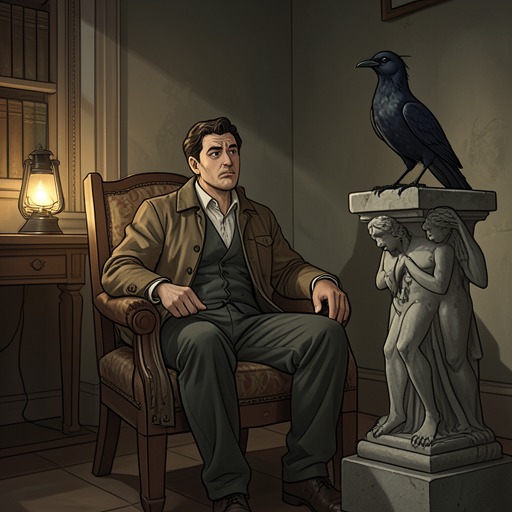
By the end, the Raven remains “never flitting,” sitting above the chamber door on the pallid bust of Pallas. Its fixed position mirrors the narrator’s fixed sorrow. The bird’s eyes seem like those of a dreaming demon, while its continued presence makes the chamber a permanent site of emotional captivity. Melancholy has ceased to be only the narrator’s response to Lenore’s loss: it has become the condition under which he must continue to live, with the Raven and its answer perpetually occupying the threshold of the room.
Narrative and Formal Significance
Melancholy governs both the poem’s subject matter and its movement. The narrator repeatedly seeks to reduce disturbance to “nothing more,” yet every repetition enlarges the emotional meaning of what he is trying to dismiss. Tapping becomes visitation; visitation becomes the Raven; the Raven becomes the voice of irreversible loss. The poem’s acoustic pattern therefore enacts the mind’s inability to leave grief behind.
The state also blurs the boundary between external event and inner projection. The Raven is physically present on the bust, but its words acquire significance through the narrator’s questions and expectations. Melancholy makes the bird’s limited speech seem like a response to the deepest questions of love, death, and reunion. In this way, sorrow does not simply color the narrative; it determines how every sign is interpreted.
The final image gives the condition its decisive form. The Raven remains above the door, and the narrator remains beneath its shadow, while the answer “Nevermore” seals the failure of both forgetfulness and hope. Melancholy is consequently presented as grief that has become repetitive, self-confirming, and resistant to release.