Opening the chamber door
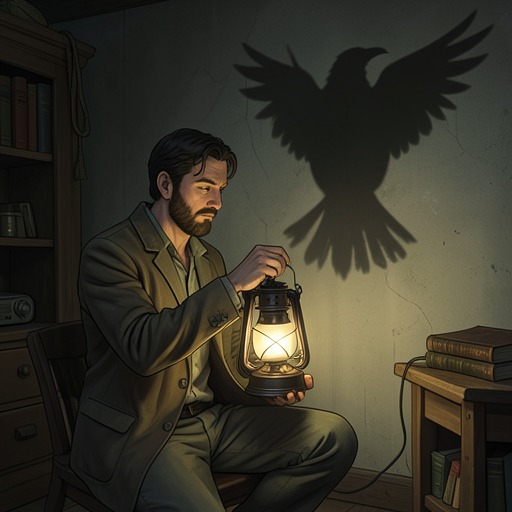
The RavenOpening the chamber door is the first decisive crossing between the narrator’s troubled interior and the unknown outside. It transforms a faint disturbance into a scene of expectation, then replaces the hoped-for visitor with darkness, silence, and the echoed name of Lenore. Because the action produces no immediate answer, it does not resolve the narrator’s fear; it gives that fear a larger space in which to return.
Causes and Emotional Background
The opening is prepared by repeated tapping at the chamber door while the narrator is weak, weary, and nearly asleep. He initially explains the sound as an ordinary visitor and tries to reduce it to “Only this and nothing more.” The repetition is already defensive: by naming the noise as harmless, he attempts to control an event that he cannot see. His wish for the morrow and his search through books for relief from sorrow over lost Lenore establish that the door is approached not from calm curiosity but from a mind burdened by bereavement.
The atmosphere intensifies the uncertainty. It is midnight in bleak December, and the dying embers cast ghostlike forms across the floor. The rustling of the purple curtains has filled the narrator with unfamiliar terrors, so the knocking becomes part of a wider field of indistinct movement. He repeats that the sound must come from a visitor seeking entrance, but the insistence reveals how much effort is required to make that explanation hold.
The Decision to Open
The narrator’s movement toward the door is marked by hesitation followed by a sudden strengthening of resolve. He declares that his soul has grown stronger and that he is hesitating no longer; he then addresses the unseen presence courteously, asking forgiveness because he had been napping and may have heard the tapping only faintly. This formal politeness treats the unknown as a social caller and preserves the possibility that the disturbance belongs to the ordinary world.
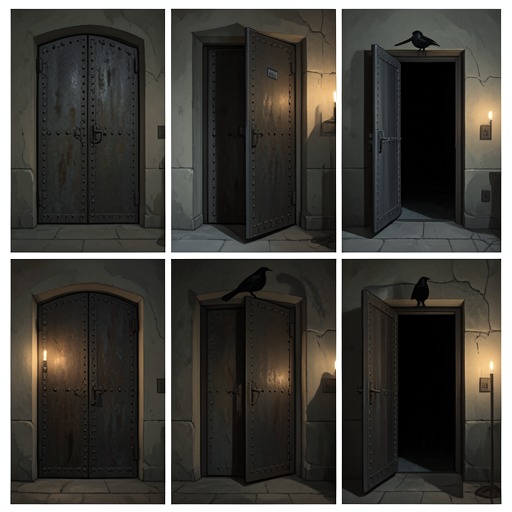
The decisive gesture follows: he opens the door wide. The action is expansive rather than cautious, but its result is radically empty. Instead of revealing a person standing at the threshold, the doorway presents “Darkness there and nothing more.” The door therefore fails as a boundary through which reassurance can arrive. It opens the chamber to an exterior that offers no visible agent, while leaving the narrator exposed to the very uncertainty he had hoped to master.
Darkness, Voice, and Echo
After opening the door, the narrator does not immediately retreat into certainty. He peers deeply into the darkness and remains there for a long time, wondering, fearing, doubting, and dreaming. The sequence makes perception unstable: he looks outward, but the scene gives him no object on which to fix his interpretation. The silence is unbroken, and the stillness gives no sign that anyone has been admitted or has withdrawn.
In that vacancy, the only spoken word is the whispered name “Lenore?” The name turns the threshold scene inward. The absent visitor is suddenly associated with the lost Lenore, and the narrator’s grief supplies the emotional identity that the darkness refuses to disclose. An echo answers “Lenore!” but the answer is merely a repetition produced by the empty space, not the return of the dead woman. The sound therefore resembles contact while proving its impossibility: the narrator hears the name again, but receives neither explanation nor presence.
Consequences and Reversal
The door-opening scene establishes a pattern in which each attempt to interpret the disturbance produces a deeper mystery. The narrator first calls the sound ordinary, then opens the door to test that explanation; the result is not confirmation but an absence that intensifies his questioning. His expectation of a late visitor gives way to the possibility that the event is connected with Lenore, yet the echo offers no evidence that she has returned. The action thus enlarges grief rather than relieving it.
The threshold also prepares the later reversal from unseen sound to visible apparition. Once the opened door has yielded only darkness, another disturbance can be displaced toward the window. The narrative subsequently identifies the wind as an explanation before the Raven enters, but the earlier opening has already taught the narrator—and the reader—that ordinary explanations may be fragile. The door is the first failed attempt to contain the uncanny; its emptiness becomes the condition for the next intrusion.
Narrative Significance
As an action, Opening the chamber door is less a solution than a failed act of knowledge. The narrator crosses a physical boundary expecting to discover an external cause, but encounters a void that reflects his psychological condition: he is surrounded by objects and sounds yet remains alone with sorrow for Lenore. The scene’s repeated language of tapping, the chamber door, and “nothing more” gives the action a compulsive structure, as though each verbal attempt to close the matter forces the question to recur.
The contrast between the narrator’s growing courage and the doorway’s absolute blankness makes the moment especially important. Courage permits the opening, but courage cannot make the darkness legible. The scene joins spatial movement to mourning: the door opens outward, while the whispered name draws the narration back toward the absent Lenore. In that tension between outward investigation and inward loss, the action becomes the poem’s first major threshold into sustained supernatural and psychological uncertainty.