The Raven’s entrance
The RavenThe Raven’s entrance is the poem’s decisive movement from anxious expectation to supernatural-seeming presence. After the narrator has opened the chamber door and found only darkness, the renewed tapping redirects his attention to the window. When he opens the shutter, a stately Raven flies into the room, crosses the boundary between outside and inside without hesitation, and perches above the chamber door on a bust of Pallas. That controlled, almost ceremonial arrival converts an unseen disturbance into the central figure of the narrator’s grief, questioning, and eventual despair.
Causes and Background
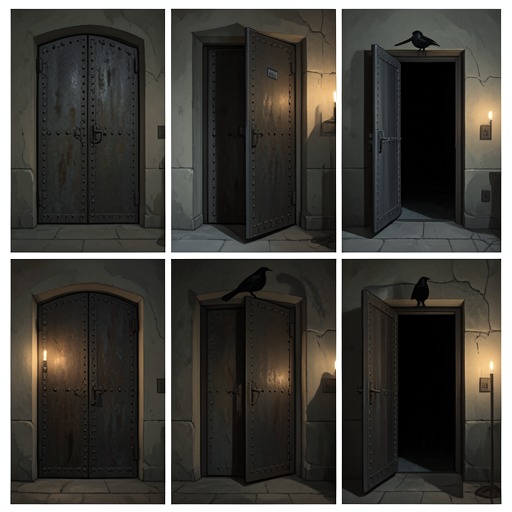
The entrance follows a sequence of failed explanations and escalating emotional pressure. In the bleak December setting, the narrator has been seeking relief from sorrow for the lost Lenore, but his books have offered no surcease. The first sound at the chamber door intensifies his fear; he repeats that it must be a late visitor and insists that it is “nothing more.” He then gathers enough courage to open the door, only to encounter darkness and emptiness. His prolonged uncertainty leaves the room charged with imagined possibilities before the second tapping provides a new, more specific direction.
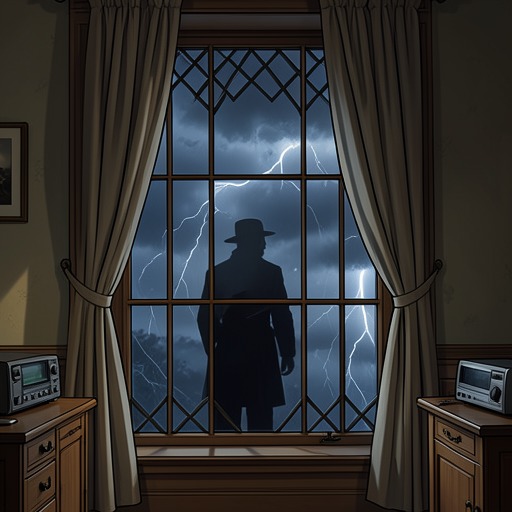
The narrator initially treats this second sound as an ordinary disturbance at the window lattice. He tells himself that it is surely the wind, while also claiming that investigating the mystery will allow his heart to become still. The decision to open the shutter is therefore both an act of inquiry and an attempt at emotional regulation. Earlier, he had repeated reassuring explanations, opened the door, and examined the darkness; now he repeats the pattern at the window. Each attempt to reduce uncertainty instead creates a new opening through which uncertainty can enter.
What Happens
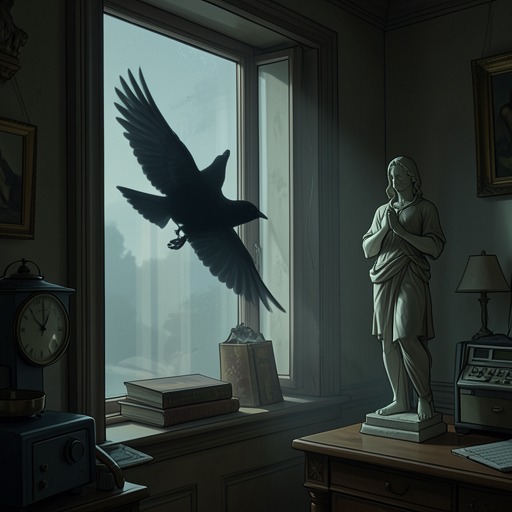
The narrator flings open the shutter, and the Raven steps inside with “many a flirt and flutter.” Its movement is neither a timid intrusion nor a chaotic attack. It enters with the formal bearing of a dignified visitor and makes no obeisance, pause, or delay. The bird’s composure contrasts sharply with the narrator’s hesitation, fear, and elaborate self-questioning. The crossing of the window boundary gives the Raven an agency that the earlier sounds did not possess: what had been imagined as wind or a visitor is now a visible creature occupying the room.
The Raven immediately claims a precise position in the chamber. It perches above the door, on a bust of Pallas, and remains there. The placement joins several symbolic and spatial oppositions: the bird comes from the darkness outside but takes up residence within the private chamber; it is an animal, yet its bearing appears aristocratic; it sits above the doorway, a point of passage, while the bust of Pallas invokes wisdom and rational authority. The entrance thus does more than introduce a character. It reorganizes the room around a new vertical and visual center, with the Raven elevated over the narrator’s threshold.
The narrator’s first response is unexpectedly close to amusement. The ebony bird beguiles his sad fancy into smiling because of the grave and stern decorum of its countenance. This brief change does not erase his sorrow; it momentarily reframes the bird as an absurdly formal visitor. Yet the smile quickly becomes an invitation to interpret. Addressing the creature as a “Ghastly grim and ancient Raven,” he wonders whether it comes from the Nightly shore and asks for its lordly name on the Night’s Plutonian shore. The question gives the bird an imagined history and a quasi-human identity before the bird supplies any explanation of its own.
The answer, “Nevermore,” is the entrance’s second decisive shock. The narrator marvels that the ungainly fowl can discourse so plainly, even though the answer initially seems to have little meaning or relevance. The bird’s speech is therefore introduced as both intelligible and unexplained. Its single word does not clarify its origin, purpose, or knowledge, but it establishes the verbal mechanism that will dominate the encounter. The Raven’s arrival changes the problem from identifying a noise to interpreting a voice.
Immediate Consequences
The entrance binds the Raven to the narrator’s emotional and imaginative world. Before the shutter opens, the narrator’s attention moves between the lost Lenore, the darkness beyond the door, and the uncertain sounds surrounding him. Once the bird occupies the chamber, those scattered fears acquire a single form. The Raven becomes a medium through which the narrator directs questions about sorrow, memory, spiritual relief, and the possibility of reunion, while the repeated answer continually turns those questions toward finality.
The bird’s refusal to acknowledge the narrator through an obeisance or pause also establishes an unusual power relation. The human occupant of the chamber opens the window, but the creature determines the terms of the encounter once it enters. It does not explain itself, seek permission, or depart. Its stillness is more commanding than frantic movement would have been: the Raven’s fixed posture makes the narrator’s increasingly agitated interpretations appear unstable beside the bird’s consistent presence.
That presence ultimately outlasts the moment of entrance. The Raven is later described as never flitting and as still sitting on the pallid bust of Pallas above the chamber door. Its eyes seem like those of a demon dreaming, and the lamp-light throws its shadow onto the floor. The spatial arrangement established at the entrance therefore becomes permanent within the poem’s ending: the bird remains above the door, while the narrator’s soul remains caught beneath the shadow. The threshold that first admitted the Raven becomes the site from which its oppressive permanence is measured.
Narrative Significance
As an event, The Raven’s entrance marks the transformation of grief into an externalized encounter. The narrator has already disclosed that he is mourning Lenore, and his attempts to manage that mourning through books, repetition, explanation, and investigation have failed. The Raven does not create the sorrow, but its entrance gives the sorrow a body, a perch, a gaze, and a voice. The event’s horror arises from this combination of material exactness and interpretive uncertainty: the creature is plainly present, yet its meaning remains open to the narrator’s increasingly desperate projections.
The entrance also creates a sustained tension between animality and subjecthood. The Raven is called an ebony bird and an ungainly fowl, but it is simultaneously presented as stately, lordly, articulate, and capable of provoking wonder. When the narrator later addresses it as a “thing of evil” and asks whether it is a prophet, a Tempter, or a bird driven ashore by a tempest, the range of names records his effort to decide what kind of being has entered his room. The creature is never reduced to one stable explanation. It remains recognizably nonhuman while challenging the narrator with language that seems to possess intention.
The entrance is consequently both a physical action and a structural reversal. The narrator expects the opening of the window to reveal the cause of a sound and restore control through knowledge. Instead, the result is the arrival of a presence that cannot be dismissed as wind and cannot be mastered through questioning. The movement from closed chamber to opened shutter, from unseen tapping to visible bird, and from imagined visitor to speaking Raven gives the poem its central dramatic pattern: every effort to secure certainty opens onto a deeper form of uncertainty, while the apparently simple answer “Nevermore” turns the visitor’s arrival into the beginning of an irrevocable descent.