The Raven’s refusal to leave
The RavenThe Raven’s refusal to leave is the action that gives the encounter its irreversible ending. After entering the chamber and answering the narrator’s questions with “Nevermore,” the bird does not depart when commanded. Instead, it remains above the door, converting a strange visitor into a fixed presence whose shadow governs the narrator’s future. The refusal is therefore not merely physical; it makes grief appear permanent and leaves the narrator unable to escape the emotional world organized around Lenore’s death.
The Raven’s Arrival and Initial Presence
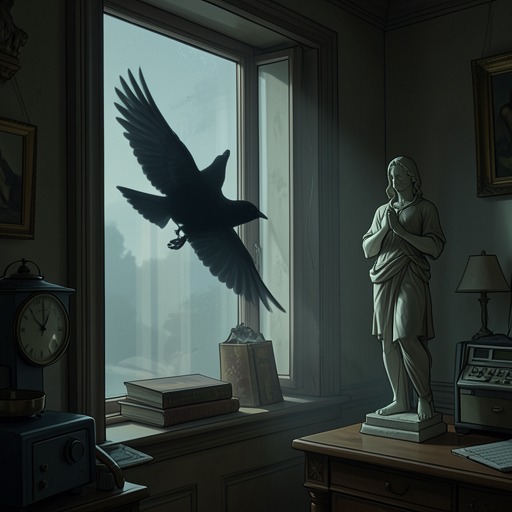
The bird first appears when the narrator opens the shutter and sees “a stately Raven of the saintly days of yore.” It enters without offering the least obeisance and, with the manner of a lord or lady, perches above the chamber door on a bust of Pallas. This placement establishes the posture that will define its refusal to leave: the Raven is elevated, still, and apparently self-possessed, while the narrator remains below it, attempting to interpret what has entered his private room.
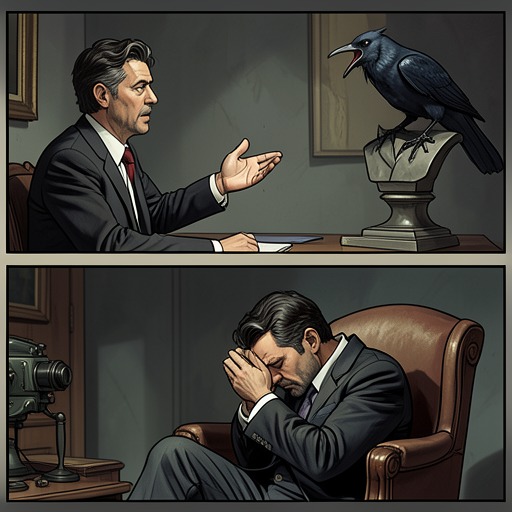
The narrator initially treats the Raven as an uncanny but potentially manageable visitor. The bird’s grave and stern expression briefly beguiles his sad fancy into smiling, and he attempts to make sense of its ability to speak. He asks for its name on the Night’s Plutonian shore and receives the answer “Nevermore.” Although the reply seems to have little meaning or relevance at first, the narrator’s wonder establishes the Raven as more than a silent animal. It becomes a voice-bearing presence whose repeated answer will progressively acquire emotional force.
Refusal as a Final Act
The Raven’s refusal becomes fully significant after the narrator’s attempts to assign it a supernatural identity. He addresses it as a “Prophet,” calls it a thing of evil, and considers whether it is a bird or devil, whether sent by a Tempter or tossed ashore by a tempest. These alternatives show the narrator trying to place responsibility for the apparition outside ordinary experience. Yet none of his interpretations produces control over it. The Raven remains present, and its single answer continues to resist the narrator’s effort to turn the encounter into a solvable mystery.
The bird’s permanence also follows the narrator’s desperate appeal for relief. He imagines that the angels have sent respite and nepenthe, the forgetting potion, so that he might escape his memories of Lenore. The request gives the Raven’s refusal its deepest consequence: “Nevermore” denies not only a factual possibility but the narrator’s hope that sorrow can be chemically, spiritually, or verbally erased. When the narrator later demands that the bird take its beak from his heart and its form from the door, the same answer closes the exchange. The Raven will neither relinquish its place nor permit the narrator to separate its presence from his pain.
The Final Vigil Above the Door
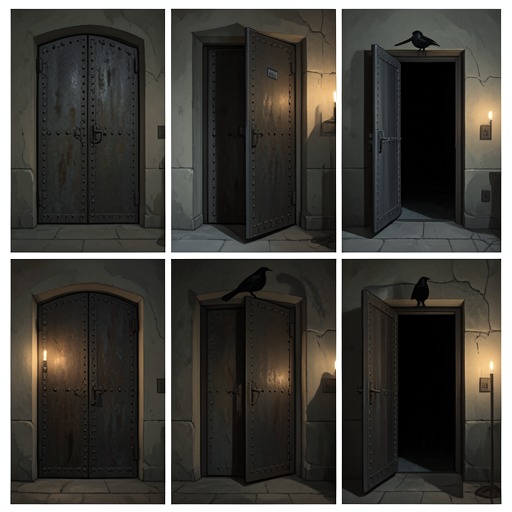
At the poem’s close, the Raven is “never flitting” and remains “still sitting” on the pallid bust of Pallas above the chamber door. The repetition makes immobility feel active and oppressive. The bird does not need to attack, fly, or speak at length; its continued occupation of the threshold is enough to hold the room and its inhabitant in suspension. The door, which earlier marked the uncertain boundary between the chamber and the outside, becomes the site of an enduring imprisonment.
The Raven’s eyes have the appearance of a demon that is dreaming, while the lamp-light throws its shadow across the floor. This image preserves the tension between animal presence and supernatural suggestion that has marked the encounter from its entrance. The bird remains materially perched on the bust, yet its shadow expands its significance beyond its body. The final vigil thus joins stillness, darkness, and watchfulness: the Raven appears fixed in place, but its effect reaches into the narrator’s soul.
Consequences for the Narrator
The refusal to leave prevents the narrator from returning to the uncertainty that preceded the visitation. Before the knocking, he was already weak and weary, reading forgotten lore while seeking relief from sorrow for Lenore. He repeatedly tried to regulate his fear by explaining the sounds at the chamber door as a visitor, by repeating that they meant “nothing more,” and by moving from hesitation to deliberate inspection. The Raven defeats each temporary reassurance. Its continued presence becomes the final form of the pattern that began with tapping and self-comforting repetition.
The consequence is stated in the poem’s last movement: the narrator’s soul remains within the shadow lying on the floor and shall be lifted “nevermore.” The Raven’s refusal therefore fixes the narrator’s emotional condition as decisively as it fixes the bird’s body above the door. Whether the Raven is understood as an actual supernatural messenger, an ominous animal whose answer acquires meaning through the narrator’s questioning, or an embodiment of grief, its final action has the same narrative result: the narrator cannot recover Lenore, cannot obtain forgetfulness, and cannot make the visitor leave.
Narrative Significance
As the poem’s closing action, The Raven’s refusal to leave transforms recurrence into destiny. The bird has already been named a wandering creature from a distant shore, yet the ending denies further movement; the traveler becomes permanently stationary. Its repeated “Nevermore” likewise shifts from an apparently meaningless learned response into the governing word of the narrator’s experience. The refusal is the physical counterpart of that word: both impose finality, and both turn a momentary encounter into an unending condition.
The action also completes the Raven’s unstable status. It is introduced as a bird, treated as an ancient and possibly prophetic being, associated with evil, and finally seen through a demonic image. The text never resolves whether the creature possesses supernatural intention, but the ending no longer requires such resolution. Its silence, posture, and shadow exert authority because the narrator’s grief has made its presence conclusive. The Raven remains above the door, and the narrator remains beneath its shadow; that spatial arrangement is the poem’s final picture of sorrow made permanent.