The Raven’s repeated answer of “Nevermore”
The RavenThe Raven’s repeated answer of “Nevermore” is the poem’s central verbal action and its most powerful mechanism of escalation. Spoken by The Raven after the narrator asks for its name, the word first appears to be a meaningless learned response; through repetition, however, it becomes an apparently final answer to increasingly intimate questions about companionship, relief from grief, divine consolation, and reunion with Lenore. The refrain converts a fixed sound into a changing psychological force, until the narrator can hear in it not merely a bird’s utterance but the confirmation of permanent loss.
First Utterance and Apparent Meaning
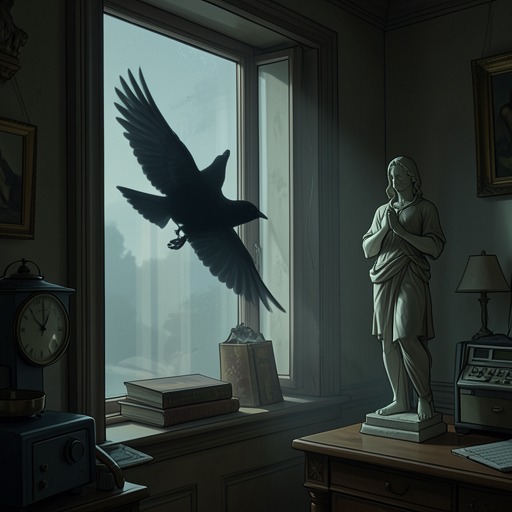
The exchange begins after the narrator opens the shutter and The Raven enters, a stately bird from the saintly days of yore. The narrator addresses it as a ghastly, grim, and ancient Raven and asks for its lordly name on the Night’s Plutonian shore. The bird answers, “Nevermore.” The reply is startling because the narrator has asked for a name, while the answer supplies a negation rather than an identity. Its grammatical mismatch makes the word seem both absurd and ominous.
The narrator initially treats the utterance as an acquired verbal habit rather than as deliberate prophecy. He marvels that the ungainly fowl can discourse so plainly, yet recognizes that the answer has little meaning or relevancy in the immediate exchange. He reasons that no living human being has ever seen a bird or beast perched above a chamber door with such a name as “Nevermore.” This explanation temporarily protects ordinary causality: the word may be the whole of the bird’s stock and store, learned from an unhappy master who repeated it in misfortune.
Repetition as a Changing Reply
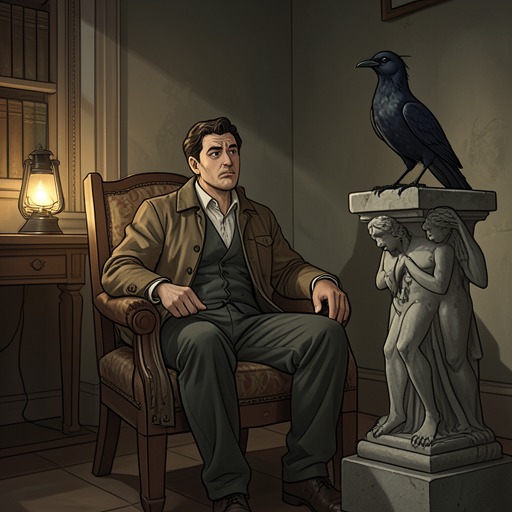
The Raven then sits lonely on the sculptured bust above the chamber door and speaks only that one word, as if its soul had been poured into it. The bird does not elaborate, gesture, or flutter; its stillness gives the answer a ritual quality. When the narrator murmurs that other friends have flown before and that on the morrow his hopes will leave him as well, The Raven again says “Nevermore.” The same sound now attaches itself to abandonment and to the anticipated extinction of hope.
The narrator’s response shows the refrain working through association rather than explanation. The bird’s answer may still be mechanically repeated, but the narrator supplies the expanding meanings. He imagines that the bird learned the word from a miserable master whose dirges made it carry the burden of “Never—nevermore.” The phrase therefore becomes a verbal form for irreversible departure. Its force comes from recurrence: each repetition preserves the previous pain while opening the next question to a darker interpretation.
The narrator attempts to manage this effect by giving the bird’s utterance an innocent cause, but The Raven’s presence continues to beguile his sad soul into smiling. He wheels a cushioned seat before the bird, bust, and door, sinks upon the velvet, and begins linking fancy unto fancy to determine what the ominous bird means in croaking “Nevermore.” The word has ceased to be a mere answer and has become an interpretive object. The narrator’s effort to decode it deepens the exchange, even though The Raven contributes no new syllable and the bird’s fiery eyes intensify the pressure of its silence.
From Consolation to Prophecy
The refrain becomes most destructive when the narrator asks about relief from the memories of Lenore. He invokes respite and nepenthe, the forgetfulness that might release him from sorrow, and urges the bird to drink that kindness and forget the lost Lenore. The Raven answers “Nevermore.” In this context, the word denies not only recovery but the possibility that grief can be chemically, spiritually, or imaginatively escaped. A plea for temporary forgetfulness is transformed into a verdict of permanent remembrance.
The narrator then recasts the bird as a “Prophet,” a thing of evil, whether bird or devil, and asks whether it was sent by a Tempter or cast ashore by a tempest. The question allows two competing accounts of The Raven: it may be an agent bearing supernatural knowledge, or merely a creature violently displaced by natural forces. Yet the repeated answer refuses to distinguish between those possibilities. The word’s certainty exceeds the evidence available to the narrator, compressing open questions about origin and agency into one unqualified negation.
The appeal for balm in Gilead raises the stakes from personal memory to spiritual healing. The narrator asks whether any remedy exists for his desolation, but The Raven again says “Nevermore.” The answer makes the bird’s refrain seem to deny the availability of sacred consolation itself. Because the narrator has already named the bird a prophet, the repetition can be received as an oracle; because the bird remains an animal with only one apparent word, it can also be understood as the narrator’s own grief forcing a single conclusion upon every inquiry.
The Final Question and Permanent Loss
The narrator’s last major question concerns Lenore directly. He asks whether he will clasp the sainted maiden whom the angels name Lenore, and repeats the image of the rare and radiant maiden. The Raven answers “Nevermore.” The refrain now reaches the precise object that has governed the poem from its opening meditation on sorrow: not simply the loss of hope, not merely the absence of healing, but the impossibility of reunion with Lenore.
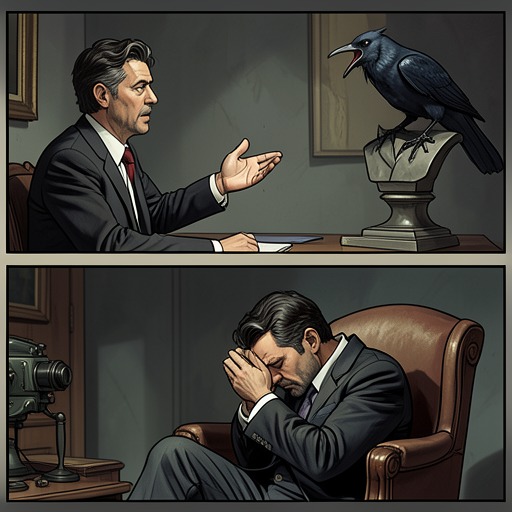
The narrator treats this answer as a sign of parting and rises into a command. He orders the bird or fiend to return to the tempest and the Night’s Plutonian shore, to leave his loneliness unbroken, and to take its beak from his heart and its form from above the door. The command attempts to reverse the relation of questioning: the narrator no longer seeks knowledge but tries to exercise authority. The Raven answers “Nevermore” once more, turning the attempted expulsion into another failure.
Enduring Consequences
The Raven never flits away. It remains sitting on the pallid bust of Pallas above the chamber door, while its eyes seem like those of a demon dreaming. The final occurrence of the refrain is inseparable from this fixed posture: the word persists because the bird persists. Lamp-light casts The Raven’s shadow across the floor, and the narrator’s soul is described as rising from the shadow that floats there. The repeated answer thus culminates not in clarification but in enclosure, as the bird, its shadow, and the word occupy the chamber as enduring signs of grief.
The refrain’s decisive significance lies in its movement from external sound to internal sentence. At first, “Nevermore” appears irrelevant to the narrator’s question and may be only a bird’s limited stock of speech. With each recurrence, the narrator supplies a more painful subject for it: friends, hopes, forgotten memories, spiritual balm, and Lenore herself. The Raven does not visibly develop or explain its meaning; the narrator’s changing questions do. Repetition therefore dramatizes a mind seeking certainty while repeatedly converting uncertainty into despair. By the ending, “Nevermore” has become the verbal shape of irreversible loss and the sound through which The Raven’s refusal to leave becomes permanent.