Adventurer’s Guild
The Reincarnated Demon King's Host Just Wants to Live in Peace, But the Hero Won't Leave Him AloneThe Adventurer’s Guild is the organized framework through which adventurers are expected to respond to danger, recruit assistance, and maintain local protection. Its importance becomes clearest when communities face threats beyond ordinary civilian capacity: the Guild is expected to provide magical support against ghosts, can be asked to assign additional personnel to overburdened posts, and offers official recognition to people entering adventuring work. In Leafel, its local branch also becomes a structure of continuity after the death of Glefald, turning a personal loss into an institutional vacancy that must be filled.
Nature and Responsibilities
The Guild appears as a practical service organization rather than a distant ceremonial authority. Its members are associated with monster extermination, patrols, and the investigation or containment of supernatural dangers. When the traveling party approaches a town surrounded by makeshift fencing during a season when ghosts are common, Avery observes that the local Adventurer’s Guild should have at least one magic user available. The remark establishes a basic expectation: a functioning post is not merely a gathering place for fighters, but should include someone capable of addressing magical threats.
That expectation is sharply contrasted with the town’s apparent unpreparedness. The barriers are temporary, the farms and houses are dark, and armed figures wait without lanterns or sun crystals. The Guild’s presumed duty to provide magical assistance therefore becomes part of the scene’s tension. Its absence, insufficiency, or delayed response leaves ordinary people exposed to dangers that cannot be handled by conventional defenses alone.
Local Posts and Crisis Response
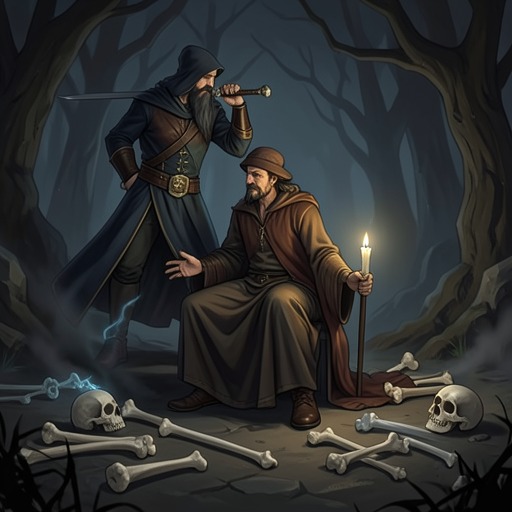
The Guild’s local responsibilities include responding to threats that grow out of neglected places. During the investigation of the town’s ghost crisis, the party discovers a moss-covered well whose wooden cover and winch have rotted away. The stone structure remains intact, while a distant voice seems to call and scream from within or beyond it. The neglected well functions as both a physical source of danger and evidence of a failure to identify and eliminate a supernatural threat before it becomes catastrophic.
The danger is eventually revealed as a nested ghost. When its corpse-like form burns away, a silvery figure of a young boy appears above the blackened remains, asking to be taken home. The incident demonstrates why the Guild needs more than ordinary armed personnel: the solution requires specialized knowledge, magic, a fire-based weapon prepared with runes, and a healer able to address the surviving spirit. The Guild’s relevance lies not only in fighting monsters but in creating, or ideally coordinating, the expertise needed to distinguish a haunting from a physical attack and to resolve both aspects of the crisis.
The local witch, Ala, admits that she should have sensed the nested ghost and destroyed the well earlier. Wicker responds that she should request one or two partners from the Adventurer’s Guild, because no single person can be expected to handle everything alone. Theo supports the recommendation, noting that he has help in Leafel and that Garris would rest more easily with additional assistance. The exchange presents Guild membership as a mechanism for distributing responsibility: it can turn isolated practitioners into a team and convert private exhaustion into a recognized staffing problem.
Recruitment, Registration, and Succession
The Guild also provides an official route into adventuring. After returning to Leafel, Wicker announces an intention to register with the Adventurer’s Guild and take over as head of the Guild post there. Their declaration is both a personal decision and an answer to a communal need. The settlement has lost Glefald, whose service had helped protect the village, and the local adventurer party is relieved that someone is finally prepared to assume his work.
Wicker’s application for membership and their request to lead the Leafel post are approved during the first week after the party’s return. Luc’s recommendation probably helps, illustrating the Guild’s relationship to established heroic status: official standing and personal reputation can reinforce one another. Even so, Wicker’s appointment is not presented as a mere honor. It carries the practical burden of replacing Glefald’s role and maintaining the post’s operations after a period of danger and bereavement.
The response to Wicker’s appointment is mixed in a revealing way. The Leafel adventurer party is grateful to have a successor, but it takes time to adjust to the chaotic halfling. The Guild therefore depends on personal compatibility as well as formal authority. Registration gives Wicker legitimacy, while daily cooperation with existing adventurers determines whether that legitimacy can become effective leadership.
Community Protection and Continuity
The Guild’s work extends beyond a single emergency. Luc offers to assist with patrols and monster extermination once the renovations to his and Theo’s home are complete, and he commissions a new sword from Jep for that purpose. The Hero’s sword remains propped in the bedroom, gathering cobwebs, so the new weapon marks a shift from legendary identity toward local service. Through the Guild’s post, Luc can continue protecting Leafel without returning to the larger heroic conflict that once defined him.
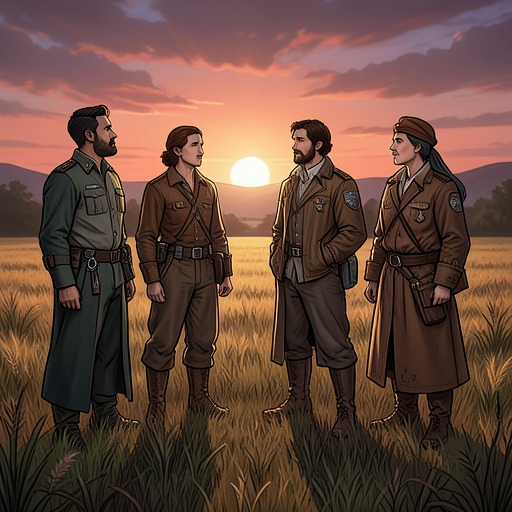
This arrangement gives the organization a role in transforming heroic power into civic responsibility. The traveling party returns to Leafel in winter as it begins to soften into spring, and the community gathers at the Watchtower to receive them. The Guild is part of the settlement’s wider defensive life, alongside the Watchtower, patrols, and local adventurers. Its value is therefore measured not only by dramatic victories but by whether people can live, work, and prepare for the next season with reliable protection nearby.
Significance in the Wider Social Order
The Adventurer’s Guild stands between individual courage and collective survival. The evidence repeatedly shows that exceptional people can solve immediate crises, but it also shows the limits of relying on exceptional people alone. Ala cannot be expected to manage every supernatural danger herself; a town facing ghosts needs a magic user; Leafel needs a replacement for Glefald; and Wicker’s appointment converts informal capability into a stable office.
The Guild also embodies a second-chance structure. Its registration process allows Wicker, a chaotic halfling with unusual abilities, to enter an official role, while its posts offer communities a way to rebuild after death, neglect, or inadequate preparation. In this sense, the organization is less an abstract bureaucracy than a repeated promise that protection can be renewed: a vanished specialist can be replaced, a solitary practitioner can gain partners, and a settlement threatened by the supernatural can become part of a larger network rather than face the darkness alone.