Ala
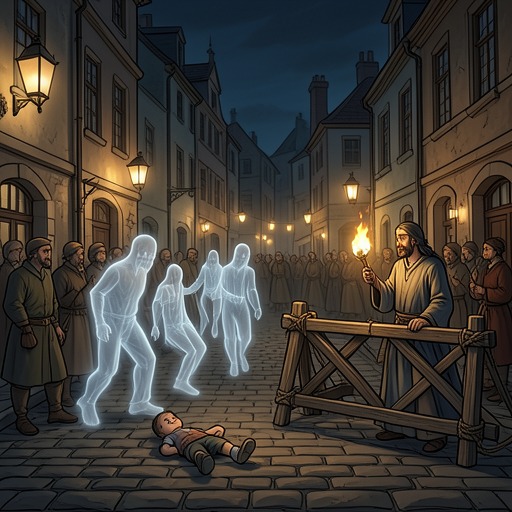
The Reincarnated Demon King's Host Just Wants to Live in Peace, But the Hero Won't Leave Him AloneAla is the witch of Ashenhave and one of the first victims whose condition reveals the full danger of the ghosts haunting the town. She was touched while saving a child on the first night of the attacks, and her near-death state makes her both a casualty of the crisis and a figure who embodies the local community’s dependence on limited, overburdened protection.
Identity and Role
Ala is identified as Ashenhave’s town witch, a local practitioner responsible for defending the settlement against supernatural danger. Her position gives her specialized knowledge and an important protective function, but it does not make her invulnerable. When Theo finds her among the afflicted, she has already been suffering longer than the others because she exposed herself to the ghosts while rescuing a child. Her role therefore rests on service rather than authority alone: she protects the town, accepts personal danger, and pays for that protection with her own health.
The evidence also places Ala within a small and strained defensive network. Garris, the town’s chief, and Everett, a guard, remain beside Theo during the night of treatment, while the wider response depends on adventurers and the party’s division of responsibilities. Wicker later tells Ala that she should request one or two partners from the Adventurer’s Guild, explicitly recognizing that a single witch cannot be expected to handle every threat alone. Her vulnerability is thus connected not to a lack of commitment, but to an inadequate support structure.
The Ghost Attack and Near Death
Ala is the longest-touched victim when Theo begins examining the survivors. The afflicted lie in a dark room with exposed skin that has turned grey and blue, their lips, eyelids, and nostrils appearing almost frostbitten. Their condition shows that the ghost-touch is not merely frightening or symbolic: it produces a visible bodily deterioration that worsens with time. Ala is singled out because she is nearly gone, making her case the immediate medical emergency among the victims.
Theo responds by scanning her chest with healing magic and ordering the barren fireplace to be lit. Warmth can stave off the touch, so the treatment requires environmental care as well as magical intervention. This detail gives Ala’s rescue a practical dimension: survival depends on keeping the victims warm, monitoring their symptoms, and supporting the healer’s work rather than treating magic as an effortless cure. Theo ultimately heals throughout the night. After Ala’s face regains its color, he takes a brief break to eat sandwiches and drink tea offered by Geg, then continues until the remaining victims have been treated.
Recovery and Farewell
By the time Ala visits Theo before the party leaves Ashenhave, she is still somewhat pale but visibly recovering. Her freckles are beginning to return, and her violet eyes are described as bright. She arrives in a wheeled chair pushed by Gail, a sign that the ordeal has not left her fully restored, but the changes in her face confirm that Theo’s intervention has reversed the immediate progression of the ghost’s touch.
Ala tells Theo and Luc that she will be sorry to see them go and calls the festival the liveliest she has seen in many years. Her reaction connects personal recovery with communal renewal: the town can celebrate again because the supernatural threat has been confronted, even though the memory of its cost remains close. Luc confidently promises that they will return, while Theo does not share his confidence, preserving a contrast between Luc’s cheerful assurance and Theo’s more guarded response.
Responsibility and Aftermath
Ala accepts responsibility for the haunting’s escalation, saying that she should have sensed the nested ghost and destroyed the well before the situation became so severe. Her statement shows that she understands the crisis as a failure of protection, even though the available evidence makes clear that she was also one of its victims. Wicker counters her self-reproach by suggesting that she was occupied with other concerns and should seek additional help through the Adventurer’s Guild. Theo agrees, adding that he has help in his own village and that Garris would also rest more easily with greater assistance.
This exchange gives Ala a grounded form of character development without presenting her as transformed into a different person. Her recovery does not erase the limits of her role; instead, it exposes them. She is capable enough to serve as Ashenhave’s witch, but the attack demonstrates that solitary competence cannot substitute for collective protection. The recommendation to find partners turns the aftermath into a structural lesson: preventing another disaster requires changing the conditions under which Ala works, not merely asking her to endure more.
Narrative Significance
Ala functions as a concrete measure of the ghost crisis and of Theo’s healing burden. Her near death forces immediate action, while the return of color, freckles, and brightness to her eyes provides one of the clearest visible signs that the night of healing has succeeded. Because she was touched while saving a child, her suffering also mirrors the larger moral pattern of the story, in which protection repeatedly carries a cost and care is proven through exposure to danger.
Her later gratitude broadens that private rescue into a communal bond. Theo fears that friendship alone cannot protect him if others discover what he is, yet Ala’s recovery and farewell show the kind of trust created by direct acts of care: she remembers that he came when Ashenhave needed him, and he leaves having helped restore not only her body but the town’s ability to move forward. Ala therefore stands at the intersection of supernatural horror, inadequate institutions, and reciprocal care. She is not merely a victim to be healed; she is the town’s overextended guardian, a survivor whose condition reveals the price of defending others alone, and a witness to the community Theo helps save.