Ashenhave
The Reincarnated Demon King's Host Just Wants to Live in Peace, But the Hero Won't Leave Him AloneAshenhave is a rural town encountered by the Hero’s party during the approach of winter, famous for its yearly pumpkin festival but threatened by an escalating ghost crisis. The town’s importance lies in the contrast between its ordinary seasonal life and the sudden intrusion of the dead: darkened farmhouses, barricades, wounded residents, and a haunted well turn a welcoming settlement into a place that must be defended and healed before celebration can return.
Setting and Seasonal Identity
Ashenhave is reached late in the day, when dusk is falling and the surrounding farms have already gone unnaturally dark. Temporary fencing has been erected around the town’s main section, while the windows of the farms appear like “dead eyes,” making the countryside itself seem abandoned. The Hero’s party is traveling southward and trying to avoid the worst winter storms, but Luc insists that their oath requires them to help if the town is in need. Ashenhave therefore becomes a threshold between continued travel and an imposed rescue mission.
The town is known beyond its immediate surroundings for a pumpkin festival held every year. Wicker’s map identifies the festival as a reason to visit, while Emi regards the delay as dangerous because winter weather is approaching. The disagreement captures Ashenhave’s double identity: it is both a destination associated with local custom and a settlement whose survival takes precedence over the party’s schedule.
The Ghost Crisis
The danger becomes apparent before the party enters Ashenhave. Wicker senses many ghosts nearby, and Veiv explains that the season is traditionally associated with them; the barriers around the town may have been erected to keep the dead out. Malthios also detects strange presences over a great distance, although he distinguishes them from Demons. The threat is thus supernatural but not part of the ordinary demonic conflict surrounding the party.
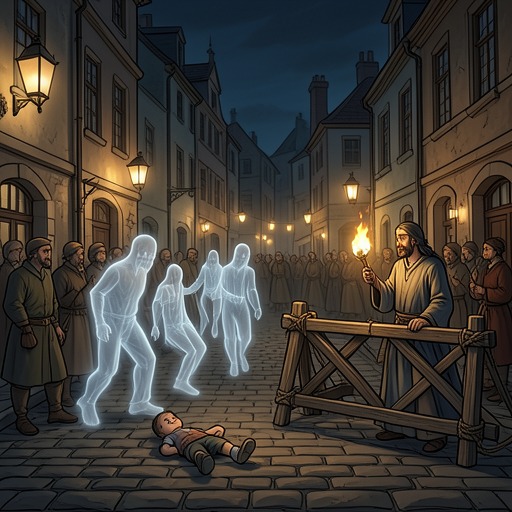
Inside the town, the attacks have already produced numerous victims. Theo spends the night healing them, restoring color to Ala the witch’s face before pausing only to eat sandwiches and drink tea provided by Geg. Garris, the town’s chief, and Everett, a guard, remain nearby while the work continues. By dawn, farmers lodging at the inn gather downstairs and watch in awe as Theo heals the last two victims; the healer is so exhausted that he stands and sways, catching himself against a wall. Ashenhave’s immediate survival depends not on a single battle but on sustained, physically costly care.
The town is eventually warded, but the protection creates a new tactical problem: the ghosts can no longer attack the buildings as before, so their next target is uncertain. Wicker divides the party according to the town’s geography and the nature of the threat. Emi and Bryony stay inside Ashenhave with Garris and his men as backup, while Veiv, Khal, Avery, and Luc defend the farmlands. Wicker, Cargo, and Theo pursue the source of the haunting, with Wicker warning that the defenders must keep the ghosts occupied while Cargo tracks the origin and Theo and Wicker destroy it.
The Abandoned Well and the Nested Ghost
Cargo leads Theo and Wicker to the edge of a small glen, where they find a moss-covered well. Its wooden winch and cover have rotted away, though the stone structure remains intact. From deep within it comes a distant, echoing voice that sounds like someone calling and screaming. The well is not merely a landmark; it is the physical center of the haunting and a buried passage into the town’s unresolved dead.
The supernatural threat takes the form of a nested corpse, a creature already pacing through the glen when the party arrives. Wicker attacks with a lantern filled with oil, hurling it at the creature before igniting a torch marked with fire-spell runes. The flames catch on the corpse’s rotten flesh and fur, and repeated swipes consume the creature until it is barely a skeleton. The confrontation gives Ashenhave a concrete source for its danger and turns the party’s investigation into an act of purification.
When the beast collapses, the danger does not end immediately. A silvery glow rises through the orange fire and Theo’s green magic, revealing the clearer figure of a boy above the blackened remains. The ghost pleads to be taken home, repeating that someone had promised to do so. Theo answers by offering help and extending his arms, treating the apparition not simply as an enemy but as a lost child whose destruction requires release. The encounter distinguishes the violent nested corpse from the human presence trapped within it.
Defense, Ritual, and Restoration
Ashenhave’s defenses depend on cooperation among local people and the visiting party. Garris and his men support the town’s interior protection, while members of the Hero’s party guard the farms and prevent the ghosts from shifting the crisis into the surrounding countryside. The arrangement makes the settlement’s geography part of its survival: town, farmland, forest, and the well each demand a different response.
Three days after the crisis, Ashenhave holds its annual pumpkin festival. Attendance is larger than usual because rumors have spread that the Hero’s party will be present, and the visitors are treated as guests of honor. The town is covered with dried cornstalks, sunflowers, orange mums, gourds, and carved pumpkins illuminated by candles after nightfall. In the square, an altar allows people to light candles and leave offerings for deities or departed loved ones, while leather masks and the heavy scent of spices shape the festival’s atmosphere.
The celebration does more than mark the season. Its offerings acknowledge both divine powers and the dead, giving communal form to the same anxieties that earlier produced fear of the ghosts. Ashenhave’s movement from dark farms and emergency fencing to candles, masks, food, and public gathering shows a community reclaiming its ordinary calendar after the dead have been properly confronted. The town’s rituals do not erase mortality; they place it within a shared social order.