Broken Blade
The Reincarnated Demon King's Host Just Wants to Live in Peace, But the Hero Won't Leave Him AloneThe Broken Blade is Leafel’s busiest tavern and one of the clearest social centers in the village. Under Imani and Dale’s care, it functions not merely as a place to eat and drink but as a domestic refuge for Theo, a meeting place for the Hero’s party, and ultimately a communal stage where private suffering is transformed into shared history.
Setting and Ownership
The Broken Blade is described as the busiest spot in Leafel in the evening, contrasting with Fox Tales, where villagers gather during the day. Its common room is therefore part of the village’s daily rhythm: a public interior where work gives way to food, conversation, and companionship. The tavern’s warmth is reinforced by Dale’s cooking and by the familiarity of the space, which remains emotionally legible to Theo even after long absences.
Imani, the innkeeper, is a large woman with dark skin, wild curls often controlled by a headscarf, and violet eyes. Dale, her dwarf husband, serves as the cook. Their hospitality is personal rather than merely commercial. When Theo first came to Leafel, he stayed at the tavern for several weeks before buying his shop. Imani and Dale reserved a corner table by the kitchen door so he could hide from the crowd, while Dale taught him to cook better and Imani asked about his day and listened carefully to his brief answers.
A Refuge for Theo
Theo avoids the Broken Blade precisely because its owners have treated him as their child. In only a few weeks, they gave him more love and affection than he felt he had received from his actual parents throughout his life. The tavern thus carries a double charge for him: it is a crowded public place he finds difficult, but it is also a home-like space whose tenderness makes emotional distance impossible.
When illness leaves Theo dizzy, weak, and unable to prepare food, he walks into the nearly empty tavern at midday. Imani immediately notices that he is unwell and asks whether he is all right. The scene turns the tavern’s hospitality into practical care: Theo does not arrive as a customer seeking comfort, but as someone whose body can no longer manage alone, and the tavern receives him before he can conceal his condition.
Dale continues that care by bringing Theo dinner, once again preparing his favorite breaded and fried steak with herby baby potatoes. Theo and Luc eat the meal on the floor of the potion-room kitchen by the fire, recalling the first night Luc arrived on Theo’s doorstep. The food links the Broken Blade’s care to Theo’s developing domestic life, while Dale’s repeated knowledge of his favorite meal makes affection concrete rather than abstract.
Gathering Place for the Hero’s Party
The Broken Blade also serves as a meeting place for the Hero’s party. Theo finds himself seated there with most of the party, between Luc and the masked Wicker, sipping apple ale while Avery and Emi glare at him. Veiv is upstairs keeping Khal company, and Luc explains that the two are a couple who have been together since before joining the Hero’s party. Cargo, the pig, eats a bowl of special-scraps stew on the floor beside the table. The crowded arrangement makes the tavern a social threshold where strained alliances, established romances, and ordinary domestic habits coexist.
The party’s presence does not erase Theo’s unease, but it places him inside a group rather than outside it. Wicker arrives early on another visit, sits beside Theo, rests their head on his shoulder, and tells him they will miss him. Imani’s fresh scones and the tavern’s familiar table frame the farewell with food and physical closeness. The Broken Blade gives separation a setting in which affection can be expressed plainly, even when Theo remains uncomfortable receiving it.
After the Hero’s party departs, Theo keeps his promise to eat at the Broken Blade once a week. Imani and Dale serve his favorite dish, ask about his day, listen to what he has to say, and share news of their own. These recurring dinners provide a pattern of connection during Luc’s absence and while Theo continues checking on Glefald. Theo eventually stops comparing Imani and Dale with his biological parents because the comparison is pointless: their repeated attention demonstrates what real parental care looks like in practice.
Reunion and Communal Storytelling
When the party returns, Dale openly offers the Broken Blade as a place to host them, saying that it is time for the village to hear everything about Theo. Theo accepts while leaning against Luc, and the tavern becomes the site where his private story is brought before the people who care about him. The invitation changes the building from a refuge for one guarded healer into a public forum for collective recognition.
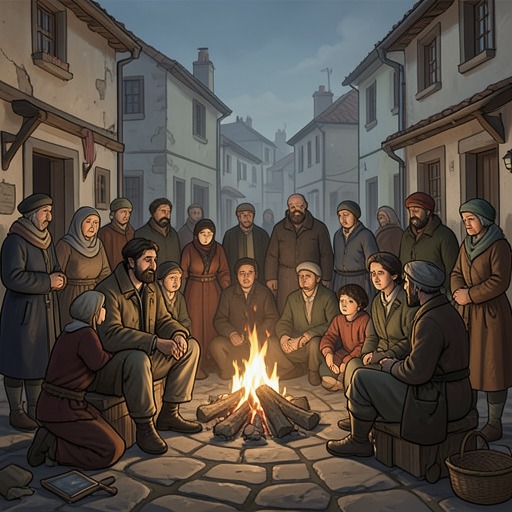
The entire village manages to fit into the tavern’s common room. There is extensive eating and laughter, with Theo and the returning party at the center. Dale’s familiar cooking acts as a balm for Theo, while the gathered people make the room emotionally overwhelming. Whenever the pressure rises, Theo can reach for Luc’s hand; Luc threads their fingers together and smiles. The tavern’s communal scale is balanced by this intimate gesture, allowing public celebration to remain connected to private reassurance.
Theo tells his story first, seated on the bar top so he can look across the eager faces. Speaking is difficult, but Luc remains beside him and Malthios encourages him. Wicker then recounts the party’s most recent adventure in the quest to slay the Demon Lords, with the others supplying additional details. Their account includes the bandit ambush, the fight with the dire wolves, the encounter with ghosts, and the final battle with the demons. Theo leaves out what happened when Tyraz captured him, and the tavern’s storytelling therefore contains both disclosure and deliberate silence: the community can share the adventure without forcing every trauma into public speech.
Symbolic and Narrative Significance
The Broken Blade repeatedly converts ordinary material care into belonging. Bread, scones, apple ale, stew, and familiar cooked meals are not incidental details; they are the means by which Imani and Dale recognize Theo, sustain him when he is ill, and maintain a relationship across absence. The tavern’s kitchen door, its corner table, its common room, and its shared floor all support different degrees of refuge, from hiding privately to standing at the center of the whole village.
Its role develops alongside Theo’s emotional arc. At first, the Broken Blade is a place he avoids because its owners’ affection exposes the deprivation of his earlier life. Later, it becomes a dependable weekly connection, then a setting for farewell, and finally the gathering place for a homecoming celebration. The change is not that the tavern becomes kinder; its care is consistent from the beginning. The change is that Theo increasingly permits himself to inhabit that care.
In this way, the Broken Blade stands for the chosen family that Leafel offers Theo. It shelters him when he is sick, feeds him when he cannot cook, receives the Hero’s party in moments of uncertainty, and gives the village a shared language for the dangers its people have survived. By the end of the documented scenes, the tavern is both public house and emotional hearth: a place where adventure is retold, pain can remain partly private, and returning home becomes something the whole community can witness.