Demon Fortress
The Reincarnated Demon King's Host Just Wants to Live in Peace, But the Hero Won't Leave Him AloneDemon Fortress is the military heart of the surviving demon threat and the decisive setting for the final confrontation between the Hero’s party, Tyraz, and Malthios. Concealed somewhere in a mountain range and defended by Demonkin, Novices, and a magical prison, it turns the party’s journey into a movement from uncertain pursuit to open battle. Its destruction after Tyraz’s death marks the collapse of the demons’ organized stronghold and gives physical form to Malthios’s declaration that the demons’ era has ended.
Definition and Strategic Place
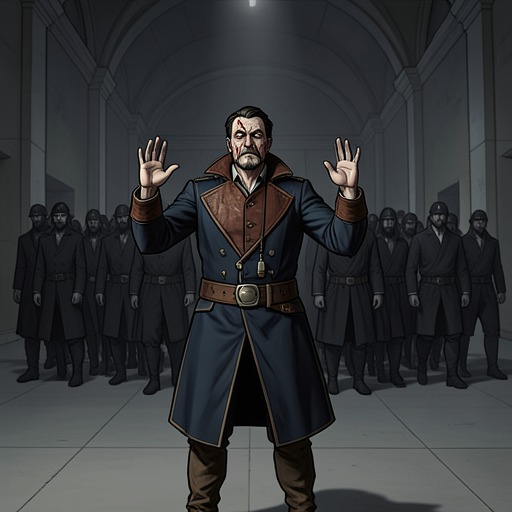
Demon Fortress is the fortress where Tyraz has gathered his forces after the defeat of Malthios. Even though Malthios had previously been defeated, remnants of the Demon King’s army continued to operate across the land under the remaining Demon Lords, and the fortress represented the concentrated military danger posed by that surviving order. The Hero’s party therefore treats it not as an incidental dungeon but as the place where the enemy’s leadership and forces can be confronted together.
Its exact position is initially unknown. The party possesses only a rough map drawn by one of Eliza’s party, indicating the mountain range in which Tyraz and his gathered forces are believed to be located. The map gives the group a direction but not a reliable destination, so their approach combines incomplete geographic knowledge with Malthios’s internal insight. Theo relays what Malthios knows while attempting not to arouse suspicion, making the fortress both a physical objective and a dangerous repository of knowledge that must be concealed within Theo’s shared body.
Approach and Defensive Power
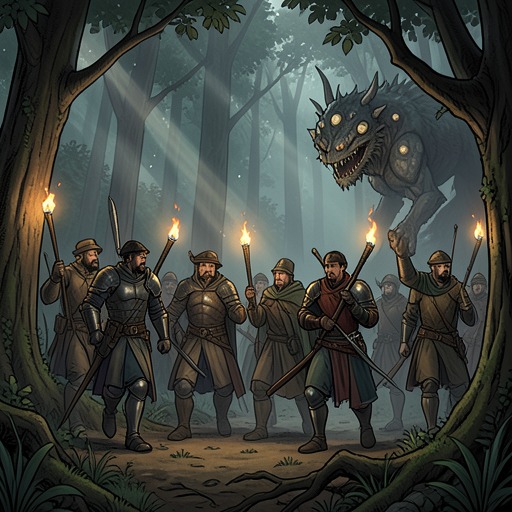
The party expects that secrecy will fail before arrival. Avery states that the demons will sense them, and even spells cast by Avery and Veiv to mask Luc’s magic cannot conceal the scent of a Hero. This makes the approach to Demon Fortress a strategic contest the party cannot win through invisibility. Their plan is deliberately loose because the terrain and the enemy’s response remain uncertain, yet the decision to proceed reflects the scale of the danger: waiting would allow Tyraz to detect them under conditions more favorable to the fortress’s defenders.
The fortress also functions as a threshold guarded by exclusion and fear. In another movement of the journey, a voice refuses the travelers entry to a settlement until they prove that they can survive a night in the open, while Wicker explains that people fear ghosts, especially when the dead have been wronged. Although that exchange does not take place inside Demon Fortress, it establishes the wider world of guarded spaces through which the party travels: entry is conditional, danger is made invisible until it chooses to appear, and claims of identity must be tested against endurance. Demon Fortress is the most extreme version of that spatial logic, a place whose occupants do not merely deny entrance but actively imprison those who penetrate its defenses.
The Assault and the Courtyard Battle
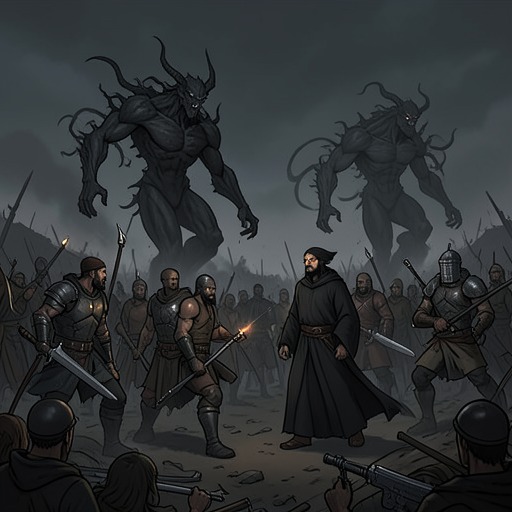
The fortress courtyard becomes a battlefield rather than a concealed interior refuge. By the time the scene is observed, many Demonkin and Novices are already dead, their bodies dissolving into shadows, while the remaining defenders attempt to subdue the Hero’s party. The scale of the clash is therefore established through both combat and aftermath: the fortress has released a mass of low-ranking forces, but those forces cannot contain the intruders.
Luc is at the center of the battle, fighting a demon whose physical mass rivals Khal’s and who carries a giant broadsword. Luc’s sword flashes like red lightning, and his power makes him appear almost feral. Theo has never seen him fight with such complete abandonment of caution and humanity; every swing is directed toward killing. Malthios recognizes the danger in that transformation and warns that Tyraz may win if Luc continues to fight in that state. The courtyard thus places two forms of power in direct tension: the Hero’s strength is formidable, but rage and loss of control threaten to turn it against the person wielding it.
The party’s objective is not simply to survive the assault. They must reach Tyraz and break the structure that has gathered the remaining demons around him. The fortress concentrates the conflict between the Heroic duty to purge demons and the personal bonds that complicate that duty. Theo is both healer and concealed host of Malthios; Luc is both the Hero confronting the enemy and the person whose violence Theo fears. Within the fortress, those identities cannot remain safely separated.
Tyraz’s Death and the Collapse of the Fortress
Tyraz’s death produces an immediate reversal in the fortress’s power. The magical circle that has kept the Hero’s party prisoner vanishes, freeing the captives and changing the battle from an escape from confinement into a withdrawal from a defeated stronghold. Wicker presses a cloth to Luc’s side while Veiv and Emi appear to cast a revival spell, showing that victory has carried a severe physical cost even though the party survives.
Malthios lands beside the wounded group after taking the crown and carries them away through shadow magic. When the shadows clear, the party is standing in the forest again, separated from the fortress and initially startled by the sudden displacement. The retreat is not a conventional march from a conquered castle; it is an abrupt extraction made possible by Malthios, whose presence remains both the source of the party’s deepest danger and the means of its escape.
The destruction follows almost immediately. A distant explosion tears through the silent night, and a column of blue flame rises from Demon Fortress into the sky. Malthios experiences the event as the lifting of a weight from his shoulders and announces that the demons have ended. The statement is more sweeping than the evidence of a single explosion can literally establish, but the scene gives it structural force: with Tyraz dead, the prison gone, and the fortress burning, the organized center of the remaining demon resistance has been removed.
Narrative Significance
Demon Fortress embodies the book’s recurring connection between space and identity. The capital’s palace is divided between royal life and the training of magic users, while Theo’s shop in Leafel is a self-built home. Demon Fortress is the opposite of that intimate refuge: it is an enemy-made structure whose purpose is military concentration, captivity, and the preservation of demon power. Moving toward it forces the Hero’s party out of planning rooms and uncertain roads into a space where every allegiance becomes visible through action.
Its destruction also completes a cycle begun when the capital’s walls awakened Malthios’s urge to destroy. In the capital, Theo feels Malthios vibrating inside him because the former Demon King is forced to stand within the city he once wished to ruin without acting on that impulse. At Demon Fortress, by contrast, Malthios is finally able to act, but his power is directed against the demon stronghold rather than against the human capital. The same destructive capacity that once threatened the world becomes the instrument that ends Tyraz’s order and saves the party.
For that reason, Demon Fortress is more than a battlefield or a geographical destination. It is the location where imprisonment becomes release, concealed knowledge becomes operational advantage, and the former Demon King’s relationship to destruction changes meaning. The fortress begins as the unknown mountain stronghold of a surviving enemy and ends as a burning relic viewed from the forest, a visible sign that the old demon hierarchy has lost its central seat of power.