Demon King’s Host
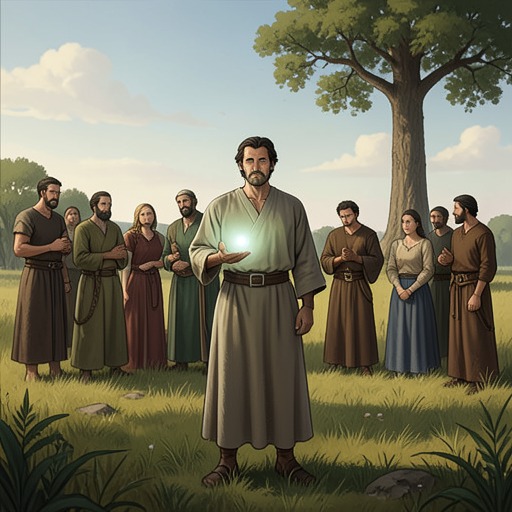
The Reincarnated Demon King's Host Just Wants to Live in Peace, But the Hero Won't Leave Him AloneDemon King’s Host is the supernatural and political condition created when Malthios transfers his soul into Theo’s body. Theo is not simply possessed: he remains a distinct person with his own will, while Malthios survives within him as a second soul whose magic and occasional control depend on the host’s consent or loss of control. The condition makes Theo both a healer and a potential incarnation of the enemy that Algeya has feared for centuries, placing his relationships, freedom, and life under the authority of institutions that define him as a threat.
Origin and Dual-Soul Structure
The condition begins with Malthios’s defeat by Eliza, a Hero who was born and, with her companions, defeated the Demon King after he had nearly conquered Algeya. A rumor held that Malthios cast a spell before dying, transporting his soul into another body so that he could survive and eventually resume his reign over Demonkind. Theo discovers by about the age of three that the voice he hears belongs to Malthios, making Theo the unintended host of that survival spell.
Malthios initially treats the arrangement as a route back to power. When Theo is two and has begun walking, speaking fully, and learning to read and write, Malthios tries to set him on a path toward evil. The plan fails because Theo’s will is stronger than Malthios expects. Malthios cannot seize the body or use his magic without Theo’s consent, except during a lapse of control caused by a powerful sudden emotion such as anger or fear. Even in those moments, the host can restrain him. The central limitation of the condition is therefore reciprocal: Malthios possesses immense power, but Theo determines whether that power can enter the world.
Malthios’s first awakening is experienced as imprisonment rather than triumph. When he becomes conscious within the child, he feels as though he is floating, unable to move his limbs, surrounded by thoughts and emotions that are not his own. He sees the beams of a cottage roof as if looking through a window, and when he tries to attack the human woman leaning over him, the body responds only through a chubby hand reaching for her braid. The body is Theo’s from the beginning, and Malthios must inhabit it on Theo’s terms.
Secrecy, Bargain, and Institutional Threat
During Theo’s childhood, Malthios repeatedly tests whether the human host will obey him, but Theo remains stubborn and capable of pulling him back whenever control slips. Their relationship changes after Theo’s magic test. They make an agreement: Malthios will stop attempting to take over Theo’s mind and body, while Theo will occasionally permit Malthios to control them, provided Malthios does nothing against Theo’s wishes. That controlled access is postponed until Theo finishes his training and can travel far from the capital and the Heroes, past and present. The bargain converts an attempted possession into a constrained coexistence, although it never removes the danger of what Malthios is.
Theo’s secrecy is not ordinary embarrassment but a survival strategy. He knows that friendship will not save him if anyone discovers the truth. The danger becomes explicit when Cargo, an intelligent hog traveling with the Hero’s party, detects the smell of Demon in Theo. Cargo first assumes the scent is lingering from Khal’s wound, but it does not disappear; he identifies Theo as the unlucky person who became Malthios’s host. Cargo does not expose him, creating a sharp contrast between private recognition and public judgment. Theo nevertheless continues to see himself through the hostile language of the world around him, calling himself the enemy and the very thing the party is fighting.
The state’s treatment of Theo reveals why concealment is necessary. Because of his healing gift, authorities insist that he belongs in the Hero’s party: he is to learn from the best healer in Algeya and later train with the next Hero. On the day Theo turns sixteen, Camden tells him that guards will collect him and return him to the capital, where he will meet the young Hero and the other companions. Their task will eventually be to purge the remaining Demons and protect ordinary people. Theo’s body is thus claimed twice, first by the reincarnation spell and then by the Heroic system that intends to use his abilities for national defense.
When Luc’s life is endangered, Theo recognizes that entering a portal to help him will end his autonomy. The authorities will know who Theo is and where he lives; Camden may recognize him; the court can force him into the Hero’s party, where the truth may be discovered at any moment. Theo still goes because refusing may mean Luc’s death and replacement by another child whom the system considers expendable. The host condition therefore intensifies a broader conflict between personal choice and institutions that treat vulnerable bodies as instruments.
Manifestation and Loss of Control
The Host becomes physically visible when Malthios’s power surges through Theo. Theo’s eyes flood black and his pupils become red slits; ebony horns grow from his temples, dark red feathered wings unfold from his shoulders, and an arrow-pointed tail emerges. His canines sharpen, and the released mana feels like a jar opened inside him. Theo normally draws on only small amounts of Malthios’s power, so the complete flood is both exhilarating and terrifying. His reflection smiles without receiving a command, making the transformation a visible sign that the body is no longer entirely governed by Theo’s conscious intention.
A later reappearance strikes while Theo is dressing alone. Mana erupts through him like a bursting dam and drives him to his hands and knees as horns and wings appear again. Malthios recognizes that even his own disappearance is temporary and tells Theo that he might have been able to vanish long enough for Theo to live honestly with Luc, but that sleep cannot permanently solve their condition. The host bond cannot be dissolved by a convenient absence. Theo remains responsible for a body whose power can return without warning, while Malthios remains tied to the person whose life he once intended to appropriate.
The danger is realized during the confrontation with Nissle. Theo feels the Demon King’s power surge through him as horns and wings form, and Malthios moves their body without thinking. A clawed hand seizes Nissle by the throat and slams her into the ground; Theo feels Malthios smiling through their shared mouth while their power bears down on her. This moment demonstrates the difference between permitted use and emotional loss of control. The host condition does not make Theo morally identical to Malthios, but it places Malthios’s violence inside Theo’s physical presence and makes Theo vulnerable to being judged for actions he did not choose.
The later transformation in the courtyard carries a different moral direction. Power floods Theo again, wings unfold, horns grow, and his fingertips curl into black claws, but the outward blast sends Tyraz flying back. Malthios uses the form to protect the people around them rather than to begin a conquest. He warns that Theo is still the same man the party met and befriended, and that Theo released him to save them. The transformation remains frightening, yet its purpose complicates the old equation of demonic appearance with inevitable evil.
Disclosure, Trial, and Relationships
The truth becomes public after Theo uses his healing magic to save Luc. Once Malthios retreats, Theo’s eyes and appearance return to normal; Khal and Veiv relax, and Wicker runs forward to embrace him. Theo then kneels beside Luc and heals a wound that was fatal in its placement and empowered by Demon magic. He takes care to repair it completely, determined not to be the reason Luc carries another scar. Luc awakens, finds Theo’s face, and then sees the truth of the host. His confusion and hurt are expressed in the question, “You’re...the Demon King’s host?” The healing that saves Luc also makes concealment impossible.
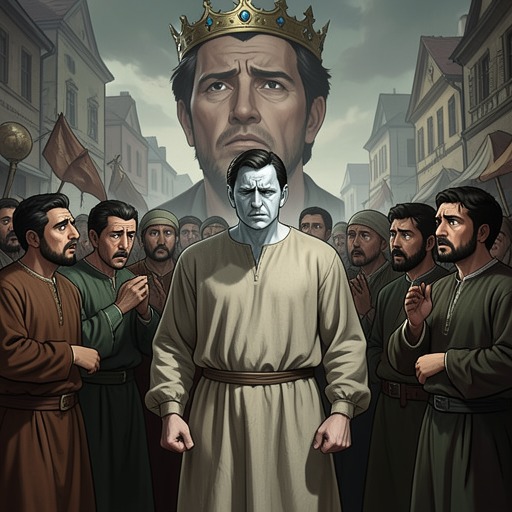
Theo is brought before the Trial of the Demon King’s Host. Mage Syvia opens the proceedings for Healer Theo Bladefoot, identified as the host of the reincarnated Demon King, Malthios. Theo does not deny the fact, but he rejects the conclusion that host and Demon King are the same person. He states that they are two separate souls in one body, with one of them in control at a time. This formulation is both a defense and a declaration of identity: Theo claims the right to be judged as Theo rather than absorbed into Malthios’s name.
The trial also exposes the limits of Theo’s legal and political agency. Syvia asks whether Malthios could be extracted, freeing Theo, while another authority insists that the choice of Theo’s fate belongs solely to Hero Luca. The proceedings therefore treat Theo’s body as a site of public emergency while assigning its ultimate fate to the Hero whose duty is to kill the Demon King. Theo’s distinction between the two souls is morally central to him, but the institutions around him are prepared to collapse that distinction.
The confrontation produces an alternative form of testimony through Leafel. A mirror portal opens onto the town square, where Micah stands at the front with his staff raised and the people of Leafel gather behind him, including Imani, Dale, Dmitri and his parents, Nib, Amaya, and Hayden. Their presence shows that Theo’s identity has not erased the bonds formed through his life as a healer and neighbor. The village answers the court’s attempt to isolate him with collective recognition, turning the host from a secret carried by one person into a truth witnessed and contested by a community.
Malthios’s own speech further revises the relationship between host and entity. He says that he regards Theo as if Theo were his own flesh and blood, explaining that most Demons do not receive the gift of a sibling but that Theo is one to him. The statement does not erase Malthios’s original attempt to control the body, nor does it make their bond uncomplicated. Instead, it marks the distance between the Demon King who sought a vessel and the being who has come to understand Theo as an irreplaceable relation.
Change and Narrative Significance
The Host begins as a concealed invasion and develops into a negotiated, unstable coexistence. Malthios enters Theo intending to use him as a route back to the throne of Demonkind; Theo responds with resistance, secrecy, and a bargain that limits Malthios’s access. Over time, Malthios becomes capable of protecting Theo and of defending Theo’s continued identity even while sharing his body. Theo, meanwhile, does not become Malthios, but he must acknowledge that Malthios’s power is part of the reality through which he survives and protects others.
The condition also creates a recurring contrast between appearance and agency. Black eyes, red pupils, horns, wings, claws, a tail, and the flood of mana make Malthios’s presence unmistakable, yet the same body can heal Luc, restrain the Demon King, protect the party, and return to its ordinary form. Conversely, Theo’s ordinary appearance does not guarantee safety: Malthios can reappear within it, and the world can condemn Theo before determining what he has chosen. The Host consequently destabilizes the simple moral categories on which the Heroic order depends.
Theo’s fear that Luc may be destined to kill him gives the condition its most intimate cost. Theo knows that he and Malthios are souls tied together and that Luc’s sworn duty is to end their lives. His love does not remove the danger; it makes the possible judgment more painful because Luc is both the person Theo chooses and the person the system may require to execute him. The host bond transforms an abstract war between Hero and Demon King into a conflict between duty, love, consent, and the demand to recognize a person inside a condemned category.
The Host’s decisive significance lies in this refusal of simplification. Theo is the Demon King’s vessel, but he is not reducible to the Demon King. Malthios is an ancient enemy, but his bond with Theo can develop toward protection and kinship. The public trial attempts to convert a shared body into a single criminal identity, while Theo, Luc, and the people of Leafel confront the harder truth: two souls can occupy one body without becoming one person, and the meaning of that body depends not only on the power inside it but on the choices made through it.