Fate
The Reincarnated Demon King's Host Just Wants to Live in Peace, But the Hero Won't Leave Him AloneFate is the story’s central tension between what appears imposed and what can still be chosen. It governs heroic duty, demonic succession, bloodline expectations, and the accidents that bring Theo and Luc together, but it never remains an unquestioned verdict. Again and again, the narrative places inherited roles beside deliberate acts of love, freedom, and companionship, until escape from Fate becomes less a flight from consequence than the creation of another future.
Fate as Inherited Duty
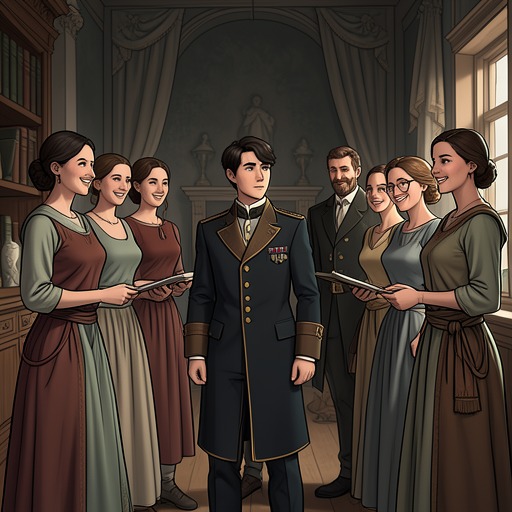
Luc’s experience first presents Fate as the practical cost of being a Hero. He explains that his earliest relationships ended or became impossible because his life was organized around departure: a squire broke off their relationship when Luc was announced to be leaving, despite Luc asking him to come along, while later romances could not survive the party’s brief stays in each town. Luc treats this instability as “the fate of the Hero,” making Fate sound less like a supernatural command than a social and professional condition that repeatedly denies permanence.
That same logic becomes more coercive in Luc’s conflict with Hero Eliza. Julius reveals that Eliza threatened to take everything from him unless he refused Luc’s invitation to join the party, because she wanted Luc to continue their bloodline and sire the next Hero. Fate here is institutionalized through family, succession, and the Hero’s inherited gift. Luc’s private love is treated as an obstacle to a public destiny, while his body and future are claimed as resources belonging to the heroic line.
Fate, Death, and Ascension
Malthios describes Fate through the violent history of his transformation into the Demon King. He did not choose the elevation in any simple sense; it happened while he was avenging fallen comrades, and the act of vengeance carried him into a power he could not separate from death. His wings, once black like his hair, became red after he killed many of his own kind to ascend. Their color functions as a permanent record of the price of authority, making Fate visible on his body as both consequence and accusation.
The demonic order therefore gives Fate a grimly material form. Demons have no royalty by birth; positions are gained through death and power, and only one worthy of that power may become Demon King. Malthios’s ascent is consequently neither a hereditary coronation nor a freely planned career. It is a position produced by violence, justified by strength, and retrospectively interpreted as destiny. His judgment that “Fate is a stupid thing” captures the contradiction: the force seems to assign meaning to events, yet the meaning is built from loss, retaliation, and choices made under pressure.
The Reversal of Inevitability
The story’s decisive reversal comes when the roles that once appeared to determine Theo and Luc’s lives lose their authority. Luc is expected to preserve the Hero’s bloodline, while Theo carries the danger and identity of the reincarnated Demon King. Their relationship joins the two most heavily burdened destinies in the narrative, but it does not reproduce the war between those roles. Instead, their attachment turns the presumed opposition between Hero and Demon King into a shared domestic future.
Luc eventually states that choosing a quiet and peaceful life with the man he loves is “the only choice I have ever made for myself.” He rejects the idea that those born with the Hero’s gift must be bound to duty and argues for a world in which they may choose their own fate. The claim is significant because it does not deny that duty exists; it distinguishes imposed obligation from chosen responsibility. Luc can lay down the Hero’s sword without ceasing to be morally serious, while remaining with Theo becomes an active commitment rather than a passive escape.
The older heroic order identifies Luc’s decision as the ending of a bloodline and the abandonment of everything he trained for. Luc answers by redefining heroism around consent, peace, and self-determination. Theo reinforces that reversal by challenging Eliza’s understanding of what makes a better Hero. Fate’s apparent victory—Luc’s lifelong conditioning toward service—thus becomes the ground for a new definition of heroic action.
Love as a Counter-Fate
The relationship between Theo and Luc does not erase the past; it gives inherited objects and histories new meanings. Luc places his father’s ring, a textured silver band with a dark sapphire, on Theo’s marriage finger. The ring is all Luc has of a father who died after saving an adventuring party from a demon attack, so its transfer links romantic commitment with family memory, sacrifice, and the heroic past. Yet the gesture also redirects that inheritance away from bloodline continuation and toward a chosen union.
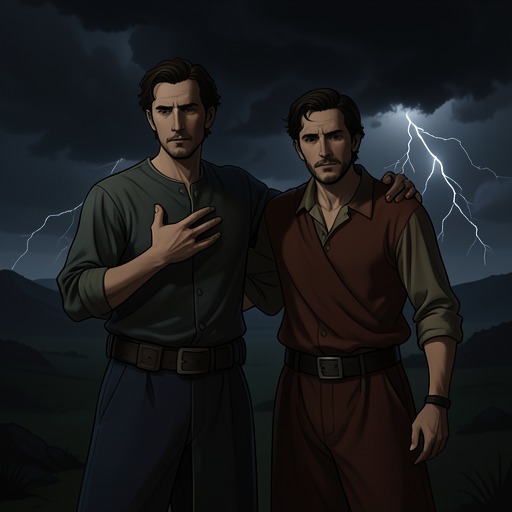
The narrative repeatedly frames their meeting as unexpected. Malthios says that Fate brought Theo to him, even though his own ascent was not his choice. This does not make Fate benevolent or orderly; it makes the connection an unforeseen opening within a history dominated by violence. The same pattern appears in Theo’s realization that seducing the Hero may have been the way to escape his fate. The thought is presented with astonishment because the solution is both intimate and absurdly contrary to the grand systems governing the world: a Demon King’s host survives not by mastering the heroic order, but by forming a bond with the person meant to oppose him.
Freedom, Return, and Second Chances
By the end, Fate is associated with return rather than mere prediction. After years of confinement to roles and enemies, Malthios stands in the doorway of the healer’s cottage looking toward Leafel and recognizes that, for the first time in thirty years or perhaps longer, he is free to do whatever he wants. His freedom is not a restoration of his former status. It is the possibility of life after Demon Kinghood, after war, and after the authority that once seemed to define him.
The final image of the Hero’s sword completes this transformation. The sword, once an object of cold fear, lies partly hidden beneath cloaks and coats, its gold and jeweled hilt webbed over by a spider. Without someone to wield it, it is only metal and gems. The contrast makes Fate’s dependence on human enactment plain: the sword’s power is not self-executing, and the role attached to it cannot continue without a person willing to bear it. Theo and Malthios no longer feel fear at its sight because the object has been separated from the destiny it once symbolized.
Luc’s decision to lay down the sword and follow Theo into ordinary village life gives the concept its final shape. Fate may bring people together, burden them with gifts, or place them inside systems created by blood and death, but it does not possess the last word. The future imagined for Theo and Luc—work, friendship, a garden, reading, sparring, and shared service in Leafel—replaces heroic succession with chosen continuity. The story’s second chance is therefore not a return to an original life; it is the freedom to build a life that the old definitions of Fate had declared impossible.