Formation of the Pentagram
The Reincarnated Demon King's Host Just Wants to Live in Peace, But the Hero Won't Leave Him AloneFormation of the Pentagram is the decisive moment when Malthios stops surviving alone and becomes part of a chosen alliance. The group emerges from an act of protection, expands through mutual recognition, and establishes the principle that power is not merely inherited or bestowed by a sponsor but can be built through people who fight for one another. Its later history is shadowed by the fact that the same alliance eventually produces Demon Lords and becomes inseparable from Malthios’s rise to Demon King.
Conditions in Demon Society
The Pentagram forms within a demon society organized according to magical hierarchy and physical strength. Demonkin occupy the lowest level, possessing little or no mana and serving mainly as common soldiers. Novices are Demonkin who have received mana from a Demon Lord sponsor; the gift gives them differing magical potential and formidable physical prowess. Demon Lords ascend after massive slaughter of innocents, gaining immense mana and wings, while the method of becoming a Demon King is known only to Demon Lords and succeeds only when the demon receiving that power is worthy of it. At the time of Malthios’s youth, no Demon King had existed for many years.
Malthios enters this system from its most precarious edge. His parents abandoned him before he was six, and he survived in a demon village by stealing food until a Demon Lord named Fulton selected the children who had survived the gift of mana and trained them as Novices. Receiving mana was among the most painful experiences of his life, and training offered safety only in a limited sense: stronger Novices despised and bullied the weaker ones. Malthios had already learned that demon society allowed the strong to prey on the helpless, and he regarded that order with hatred because it reproduced the abandonment that had nearly killed him.
The Founding Encounter
The immediate beginning of the Pentagram is Malthios’s struggle to teach himself to read in a library where he was not supposed to be. He had tried to learn during his years on the streets, but made little progress. As a Novice, he secretly returned to the library during breaks, becoming increasingly frustrated with the book before him. When he nearly threw it, a red-haired demon of about his age caught his wrist and offered help. Kamil sat beside him and placed the book across both their knees, turning instruction into the first quiet gesture of companionship in the group’s formation.
That fragile connection is tested almost immediately. A stronger Novice and his companions corner Malthios, mock him as a runt, and prepare to beat him. Before the blow lands, a small antlered demon with dark curls attacks the aggressor and sends him flying into his companions. Aym does not intervene because of an existing obligation or reward; they simply refuse to accept five against one as fair fighting. Their defense gives Malthios something he has rarely been offered: protection extended without a demand for payment.
Malthios refuses to remain a passive beneficiary of that protection. When Aym is threatened, anger raises his mana, and he reaches toward it instead of recoiling. Blue flames burst from his fists. The power is not presented as a clean escape from demon violence, since it answers brutality with the possibility of greater brutality, but it gives Malthios the means to stand beside the person who stood in front of him.
The Five Become a Unit
The group takes recognizable shape when three more Novices arrive: Kamil, the red-haired learner who first helped Malthios; Torq, a large dark-skinned demon with ram-like horns who delights in fighting; and Foras, a taller, slighter demon with damp-looking dirty-blond hair whose dry judgment balances Torq’s enthusiasm. Kamil greets Malthios as someone she has already decided will fit among them, while Torq treats the confrontation as an opportunity for combat and Foras reprimands him when his forceful friendliness unsettles Malthios.
The newcomers turn an isolated defense into collective action. Three of the hostile Novices are killed and dissolve into shadows, while the last attempts to flee and is driven against a wall by Kamil’s wind magic. The victory does not merely settle a personal quarrel. It demonstrates the practical value of the alliance: each member contributes a distinct strength, and the group can defeat opponents who would have overwhelmed an individual Novice.
Afterward, one of the smaller demons explains the group’s governing idea: they rely on one another so they can advance and become Demon Lords, because no one can hope to win without fighting for something. Malthios initially finds the claim almost impossibly simple. His disbelief reflects the world that formed him, where power has meant domination, abandonment, and the arbitrary favor of someone stronger. The others insist that strength can instead be organized around mutual dependence.
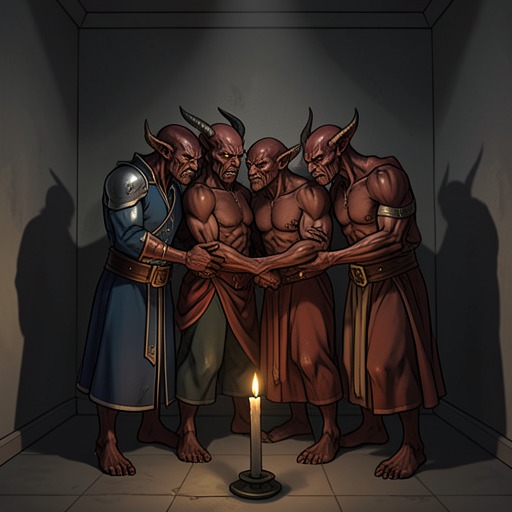
Kamil then formally presents Malthios to Aym, proudly identifying him as the one she has mentioned and asking whether he is a good fit. Aym studies him before granting the concise judgment that he has potential. Kamil answers with triumph, punches the air, and declares that the Pentagram is assembled. The name marks a transition from five individuals caught in a fight to a deliberate fellowship with a shared future.
Consequences and Later Meaning
The Pentagram gives Malthios his first durable experience of chosen family and shared purpose, but its founding also establishes the logic that will govern his later life: isolated power is vulnerable, while coordinated power can rise through an unforgiving hierarchy. The alliance is therefore both refuge and instrument. It protects its members from immediate violence, yet it also aims directly at the status of Demon Lords, a rank whose ascent is tied to slaughter and immense magical power.
The group’s founding acquires tragic force when Malthios later kills his own kind and his mana spikes as it did during his ascension to Demon Lord. His black wings open to their full length and change to dark blood red before the watching demons recognize that a new Demon King has risen. The scene turns the Pentagram’s original promise inside out: the bullied Novice who needed allies becomes the supreme figure in the hierarchy that once made him helpless.
The event also remains connected to the human life Malthios later inhabits as the Demon King’s host. Within Theo’s mind and body, Malthios is powerful but imprisoned, and Theo’s disobedience teaches him the limits of his control. Theo experiences the Demon King’s magic as terrifying yet natural, while refusing Malthios’s demands because he hates being ordered around and sees no point in obeying them. Their shared existence contrasts sharply with the Pentagram’s voluntary ideal: Malthios once sought advancement through companions who chose to stand with him, but later becomes trapped in a bond where neither host nor indwelling king can think or feel without the other knowing.
The Pentagram’s founding also casts a long shadow over later communities. In Leafel, townsfolk from many races greet Theo with waves and smiles even though he rarely speaks, rarely smiles, and dislikes physical contact. His reserve began as a defense against provoking Malthios and remains partly a precaution against having to flee again. The warmth of Leafel offers a social alternative to the demon hierarchy, just as the Pentagram once offered Malthios an alternative to solitary survival.
The group’s legacy is further refracted through Theo’s role as a healer and member of the Hero’s Party. When Khal suffers a basilisk wound, Theo cuts an X across each puncture with a hot knife and uses calm emerald magic to destroy the poison, enduring Khal’s screams because he cannot spare magic to ease the pain. Later, when the Hero’s Party prepares to depart, Theo sees Eliza and must suppress fear and rage while trying to protect Luc from the person who harmed him. These scenes echo the Pentagram’s founding question—what is strength for?—but answer it through care, restraint, and responsibility rather than conquest.
Narrative Significance
As a threshold event, the Formation of the Pentagram marks the passage from enforced survival into chosen belonging. Malthios enters the scene as a neglected child shaped by pain, a Novice whose worth is measured by magical potential. He leaves it as a recognized member of a unit whose members identify potential in him and promise advancement through mutual reliance. The ritual is informal—a book shared across two knees, a body thrown between victim and attacker, a hand on a shoulder, and Kamil’s shouted declaration—but those gestures perform the work of initiation.
The event’s central contrast is between the strong-picking-on-the-weak order Malthios despises and the collective strength the Pentagram invents for itself. Its members do not erase violence from demon society; they learn to survive and rise within it. That contradiction explains both the group’s appeal and its ominous future. The Pentagram is Malthios’s first answer to helplessness, a community founded when someone intervenes for no reason and others choose to join. It becomes the emotional and political foundation from which his later transformations—from abandoned child to Novice, Demon Lord, and finally Demon King—can be understood.