Hayden
The Reincarnated Demon King's Host Just Wants to Live in Peace, But the Hero Won't Leave Him AloneHayden is the sword master and guardian of Leafel, leader of the adventurers who defend the village from monsters and bandits. He is significant not simply because he can fight, but because his presence repeatedly tests the boundary between unwanted attention and dependable protection. Theo initially dislikes him intensely, yet Hayden’s conduct during Glefald’s illness, the village’s defense, and the final ambush gradually places him among the people whose loyalty gives Leafel its strength.
Identity and Position
Hayden is introduced as tall, broad, and heavily muscled, wearing a knight’s tunic with an arming sword at his belt. His blond hair is slightly overgrown, and he has an irritating habit of tossing his head to clear it from his bright green eyes. These details establish both his martial role and the physical confidence that makes him difficult for Theo to ignore. When he encounters Theo in a compromising state, he immediately adopts the formal authority of a local defender and challenges him over his identity and business.
As leader of Leafel’s adventurer party, Hayden occupies a practical position between ordinary villagers and the larger heroic institutions that pass through the settlement. He is responsible for anticipating danger, questioning unexpected arrivals, and keeping the village prepared for attacks. His title, Sword Master Hayden, is therefore more than a boast: it describes a public duty that repeatedly brings him into contact with threats, strangers, and Theo’s concealed life.
Conduct Toward Theo
Theo’s first sustained impression of Hayden is hostile. Hayden repeatedly hounds him to join his party, insists on accompanying him while he forages in the forest, and makes other advances that Theo regards as bordering on harassment. Theo’s dislike is so immediate that the very thought of Hayden leaves a bitter taste in his mouth, which he tries to remove by eating a blackberry. The gesture turns an abstract irritation into a physical reflex: Hayden is not merely inconvenient to Theo, but a presence Theo actively tries to push away.
The tension is complicated by attraction and embarrassment. When Hayden’s green eyes scan Theo’s partly dressed state, Theo hopes the heat in his cheeks is not visible. Hayden’s attention is intrusive from Theo’s perspective, but it is also difficult for Theo to treat as emotionally neutral. Later, after Luc has spoken to Hayden, Hayden limits their interactions to a respectful nod and a formal greeting. Theo notices the change immediately, suggesting that the earlier harassment, however unwelcome, had become a familiar part of his daily world.
When Hayden suddenly appears behind Theo in the shop, Theo reacts with startling force, slamming him against the desk before recognizing the familiar green eyes and blond hair. The encounter shows how fear surrounding Theo’s hidden identity has made ordinary contact dangerous, while Hayden’s persistence ensures that he remains one of the people most likely to cross Theo’s defenses. Even after the two have been separated by larger events, Theo admits that he misses Hayden along with Leafel, his cottage, his garden, Nib’s bookstore, and the family he has made there.
Protection, Illness, and Community
Hayden’s protective identity is most clearly demonstrated during Glefald’s final illness. While Theo’s healing extends the elf’s life beyond his original estimate, Glefald remains bedridden and eventually begins to wane. Hayden does not avoid Theo during this period, but he keeps his distance after Luc’s intervention, reducing their contact to formal courtesy. That restraint contrasts with his earlier pursuit and indicates that he can accept a boundary even when it costs him personal closeness.
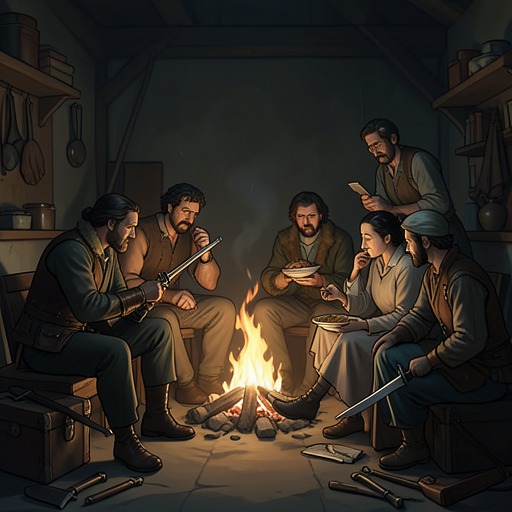
Glefald’s death reveals Hayden’s capacity for quiet endurance. Theo spends nearly an entire day and night at the Watchtower easing Glefald’s suffering. Isabelle, Micah, and Cade come and go with food and necessities, while Muffins the cat stays beside the dying elf. Hayden remains seated by the door as though standing guard, his expression more solemn than Theo had imagined possible. When Glefald dies at dawn, Hayden rises and thanks Theo for his work before going to inform the others. His role is not theatrical: he protects the dying room, recognizes the healer’s labor, and takes responsibility for carrying the news back to the community.
His loyalty extends beyond individual emergencies. When Leafel’s people appear through Micah’s mirror spell to confront the authorities holding Theo, Hayden steps forward beside Micah and bows. The village is represented by a crowd including Imani, Dale, Dmitri and his parents, Nib, Amaya, and its wider population; Hayden’s presence gives that collective resistance the formal posture of a public defense. He is not merely an adventurer who happens to live in Leafel. He is one of the figures who makes the village’s claim on Theo visible.
Humor, History, and Conflict
Hayden’s seriousness is repeatedly undercut by the narrative’s comic view of him. Theo considers him to have more muscles than thoughts, and even after Hayden suffers devastating injuries when something believed to be a golem drops a tree on him, his behavior remains recognizably Hayden’s. His ribs are broken, yet a pain potion makes him loopy and he spends the entire healing session flirting with Theo, finally passing out only when the treatment is complete. The scene turns his persistence into absurd physical comedy while also showing how readily he trusts Theo with his life.
Hayden’s bluntness can also make him tactless. After learning that something about Theo is strange, he says so with an expression of superiority until Isabelle smacks him on the back of the head. He then predictably proposes a spar, prompting Isabelle to cover her face in exasperation. His instinct is to convert uncertainty into confrontation or competition, but the repeated comic correction from others keeps that instinct from becoming simple dominance.
Despite his rough manner, Hayden has a history that explains his relationship to violence and self-defense. He recounts that his mentor beat him with a wooden practice sword until his form was correct. Hayden secretly trained with a real blade because he knew the abuse would continue after graduation. When his mentor attacked him in earnest after discovering that Hayden could defend himself, Hayden killed him in self-defense. This history gives moral weight to his otherwise casual martial identity: his mastery was formed under coercion, and his authority was won by surviving an older authority’s attempt to destroy him.
The Ambush and Hayden’s Choice
Hayden’s protective function reaches its sharpest expression when he and Malthios walk Leafel’s borders. Hayden complains about the patrol, and Malthios grits their teeth at his annoying voice, preserving the familiar friction between the sword master and the being sharing Theo’s life. Hayden then asks whether Theo or Malthios is truly concerned with the village’s safety, forcing the divided identity into the open as a practical question about responsibility.
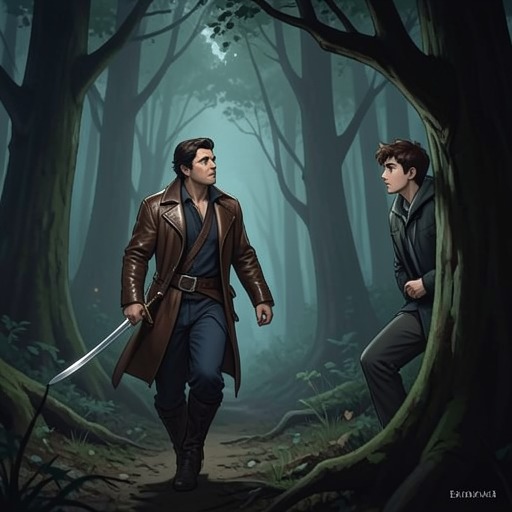
The patrol becomes an actual test when an arrow flies from the trees and clips the feathers at the edge of Malthios’s wing. Around twenty dark-clad attackers emerge, their faces covered and their weapons divided among bows, short thin blades, and mage staffs. Hayden swears, draws his sword, and faces the sudden numerical threat. Rather than retreating behind his title, he gives Malthios a direct order: Malthios must get Theo to safety while Hayden summons help. The command places Hayden between the attackers and the vulnerable village, but it also acknowledges that protecting Theo is part of protecting Leafel.
This moment clarifies the difference between Hayden’s earlier pursuit and his mature loyalty. His attention to Theo may be intrusive, clumsy, and often comic, yet when danger arrives he does not demand recognition or closeness. He directs Theo’s protector to move Theo out of harm’s way and accepts the immediate burden himself. His history of self-defense, his guardianship of Glefald’s deathbed, and his defense of the border converge in this decision.
Development and Narrative Role
Hayden’s arc is not a transformation from villain to hero. He begins as a legitimate defender whose behavior irritates Theo, and he remains blunt, flirtatious, competitive, and socially inelegant. What changes is the context in which those traits are read. At first, Hayden’s repeated advances feel like pressure against Theo’s fragile privacy. Later, his restraint after Luc’s warning, his vigil at the Watchtower, his participation in Leafel’s public defense, and his readiness to face masked attackers reveal a man capable of placing duty above desire.
For Theo, Hayden becomes part of the emotional map of home. Theo’s wish to return to Leafel includes missing him, even though the same thought once provoked disgust and the desperate avoidance of another unwanted encounter. That contradiction matters: Hayden is one of the people who makes home imperfect rather than idyllic. He is a source of irritation, embarrassment, laughter, security, and remembered belonging at once.
Hayden therefore embodies Leafel’s communal form of heroism. He is not the officially celebrated Hero, and he does not resolve the central conflict through supernatural power. He guards borders, questions strangers, watches over the dying, trains with a sword, survives injury, and stands with the villagers when Theo’s life is placed before distant authorities. His roughness makes protection look less like purity than persistence: a flawed person continuing to show up, even when the person he wants to protect would rather avoid him.