Hero Conscription System
The Reincarnated Demon King's Host Just Wants to Live in Peace, But the Hero Won't Leave Him AloneThe Hero Conscription System is the institutional framework through which Algeya claims the bodies and abilities of children marked by exceptional magic. Its decisive principle is that talent creates an obligation: a gifted child is assessed, assigned to the Hero’s party or its support structure, trained under state authority, and eventually expected to participate in purging demons and protecting ordinary people. The system therefore converts aptitude into service before the person possessing it can meaningfully consent.
Identification and Assignment
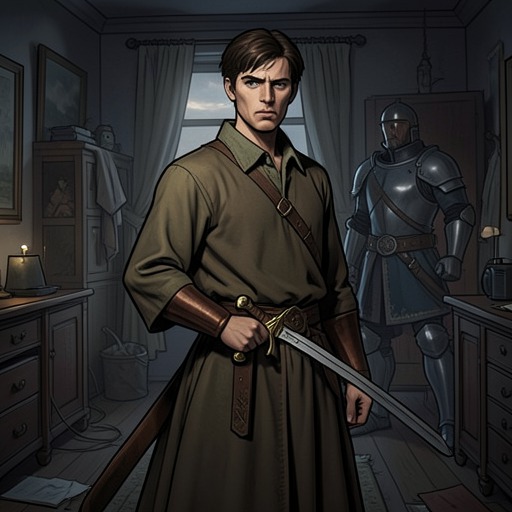
The system begins with magical evaluation. When Theo was eight, the test revealed a deep emerald-green power so intense that its glow blinded everyone present before fading. The result made him an object of immediate competition, with people clamoring to claim him as an apprentice. The court mage overrode those offers, declaring that a gift of this magnitude belonged in the Hero’s party. Theo was assigned to learn from the best healer in Algeya and later to train with the next Hero when they reached the required age.
This decision was presented as obvious rather than negotiable. The court mage’s judgment transformed a child’s unusual ability into public property, while Theo’s parents could only stand by as the anticipated private benefit of his talent disappeared. The system’s professional vocabulary of training and service concealed a transfer of authority: the state, represented by the court mage, decided what Theo’s magic was for and who had the right to direct it.
Training, Age, and Compulsory Service
Theo’s assigned instructor was Camden, the priest who had served in Eliza’s party and had been badly injured in its final battle, losing mobility in both legs. The injury also connected the system’s educational institution to its violence: Malthios told Theo that he had caused it by dropping a pillar on the priest, adding that healers were always targeted first. Training was thus not preparation for an abstract profession but preparation for a dangerous war in which healers were strategically vulnerable.
The system treated sixteen as the point at which Theo’s obligation became operational. On the day he reached that age, Camden told him that guards would arrive the following morning to escort him back to the capital. There he would meet the new young Hero and the other companions, train with them until the Hero came of age, and then assume responsibility for purging the remaining Demons and protecting common people. The timetable gave the arrangement the appearance of orderly civic administration, but Theo experienced it as the forced continuation of a life chosen for him during childhood.
The same logic applied to the Hero. Theo later condemned the system for making a five-year-old undertake a life of danger and pain before he was old enough to make his own decisions. Luc’s experience also shows that compulsory service extended beyond battlefield deployment: the Hero’s relationships, movements, and future were treated as resources belonging to the institution.
Resistance, Escape, and Enforcement
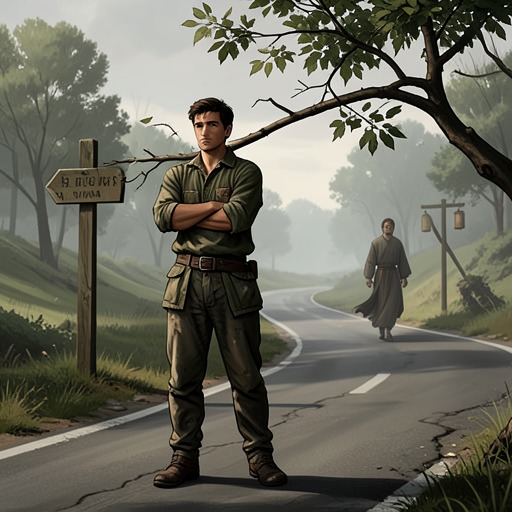
Theo resisted the system by leaving before the guards could take him back to the capital. He packed his few belongings and enough food for the road, did not leave Camden a note, and traveled for two years while earning a living through odd jobs. He and Malthios moved farther north until they found Leafel, a peaceful village that seemed beyond the reach of both Demons and Heroes. Theo’s flight was not merely an attempt to avoid danger. He explicitly identified freedom as his motive: he had never been allowed to choose either his training or the use of his magic, and he wanted to place that power somewhere it could do actual good.
The system answered refusal through surveillance, detention, and physical restraint. After Theo’s identity as Malthios’s host became known, he was held in the capital under orders from the court mage and Hero Eliza, with Magic-Dampening Handcuffs placed on him. Emi explained that the restraints were not unexpected because the authorities would not permit him to remain free. The progression from magical evaluation to compulsory training, capture, shackling, and trial reveals the system’s full institutional chain: classification defines the subject, duty justifies control, and alleged public danger suspends ordinary liberty.
The legal process likewise presumed that Theo’s protection of Malthios made him responsible for the Demon King’s presence. The trial was convened as the Trial of the Demon King’s Host, and the court sought agreement that Healer Theo was guilty for his role in protecting Malthios. Yet the proceedings also exposed the system’s concentration of authority. King Alexis stated that Theo’s fate belonged solely to Hero Luca, making a single serving Hero the final decision-maker over the accused host’s life.
Bloodline, Duty, and Private Life
The system’s demands reached into reproduction and intimate relationships. Julius told Theo that Eliza had ordered him to refuse Luc’s invitation to join the party and threatened to take everything from him if he did not let Luc go. Julius believed that Eliza wanted Luc to continue their bloodline and sire the next Hero, something that could not be achieved through either of Luc’s male relationships. The Hero’s assignment was therefore tied to a hereditary future: service was expected to reproduce itself through Luc’s body and descendants.
Luc’s earlier relationships illustrate the emotional cost of that expectation. He described a maid-in-training as his first lover and a squire who trained with him as his second long-term relationship; the squire ended their relationship when Luc’s departure was announced, despite Luc asking him to come along. Luc had several shorter relationships during stays in other towns, but regarded lasting attachment as incompatible with the fate of the Hero. The system made mobility, danger, and institutional obligation into a pattern that repeatedly interrupted private life.
Against that prescribed future, Theo and Luc formed a relationship grounded in chosen commitment. Theo promised to wait for Luc, and Luc gave him a silver ring that had belonged to his father, a member of an adventuring party who saved his companions from a Demon attack but died doing so. When Luc placed the ring on Theo’s marriage finger, the ring tightened to fit. The inherited object thus carried two competing meanings: it preserved the memory of sacrificial service, while its new placement marked a future Luc chose rather than one assigned by Eliza or the Heroic institution.
Public Challenge and Institutional Consequences
The system’s legitimacy was challenged not only by Theo’s testimony but also by the community he built in Leafel. During his trial, Micah opened a mirror spell showing Leafel’s town square, where Imani, Dale, Dmitri and his parents, Nib, Amaya, Hayden, and the people of Leafel gathered in determined support. Hayden demanded Theo’s release on behalf of the village. Their intervention refuted the assumption that Theo’s refusal made him isolated or socially dangerous: the community that benefited from his healing recognized him as a person rather than as a state asset or merely the Demon King’s host.
Camden also rejected the court’s moral judgment. He stated that he had raised Theo himself, had ample reason to hate Malthios, and nevertheless considered it wrong to blame Theo for choices made under such circumstances. His defense shifted the question from whether Theo had complied with duty to whether the institution had ever given him a genuine choice. That distinction is central to the system’s critique: coercion is not erased merely because the assigned role is described as honorable or necessary.
Luc’s decision provided the system’s most direct internal rupture. Eliza asked whether he was willing to end their bloodline and throw away everything for which he had trained. Luc answered that choosing a quiet, peaceful life with the man he loved was the only choice he had ever made for himself. He further declared that the world should become one in which those born with the Hero’s gift could choose their fate instead of being bound to duty. The statement turns personal refusal into political principle. Theo’s escape had shown that the system could be resisted from outside; Luc’s choice showed that its own designated instrument could reject its authority from within.
The Hero Conscription System consequently stands as both a practical wartime arrangement and a mechanism of dispossession. It can identify exceptional power, organize specialized training, and impose a coordinated defense against Demons, but it achieves that order by treating children as future weapons, healers as military resources, hosts as legal exceptions, and Heroes as hereditary instruments. The ending does not merely release one unwilling participant from service. Through Theo’s survival, Leafel’s collective defense, and Luc’s choice of a shared life over bloodline and duty, it imagines freedom as the condition under which gifted people may finally decide what their gifts mean.