Hero Status
The Reincarnated Demon King's Host Just Wants to Live in Peace, But the Hero Won't Leave Him AloneHero Status combines extraordinary physical power with an imposed national duty: the Hero is expected to purge demons and protect ordinary people, while the magic itself shortens the bearer’s life. The succession from Eliza to Luc makes that cost visible, and Luc’s eventual retirement turns the role’s supposed inevitability into a choice he can refuse.
Identity and Nature
The Hero’s power is expressed physically. It grants resilience, speed, strength, accelerated healing, and resistance to magic, but these abilities must be honed through training, often beginning in childhood. It is not simply a title attached to a capable fighter: Hero magic consumes the body that bears it. Heroes on record had barely survived into their twenties, and Eliza was already showing signs that her time was running out after the battle with Malthios. Her search for a successor therefore arises both from the continuing demands of the office and from the danger its power poses to its bearer.
The role joins combat ability to a public charge. When Theo was sixteen, Camden told him that guards would take him to the capital to meet a newly discovered young Hero and the other companions. They were to train together until the new Hero came of age; then responsibility for purging the remaining demons and protecting the common people would pass to them. The arrangement made Hero Status a succession, not a private calling: a child could be summoned into a national duty before choosing the life that duty would require.
Succession and Training
The prospect of a successor first reached Theo as rumor. At around fourteen, he heard that another Hero had been found to take Eliza’s place. Eliza’s approaching exhaustion made the news unsurprising, but Theo hoped never to meet the new bearer. His fear was tied to a secret: he shared his body with Malthios, and discovery could make friendship powerless to protect him. The Hero’s succession thus threatened Theo not only with a new obligation, but with exposure to the very force his hidden identity was expected to oppose.
Theo had already been prepared, without being told that his training would lead to the capital. Camden taught him healing and spoke warmly of the friendships formed within a Hero’s party, promising that Theo would one day know those bonds himself. The training also included the expectation that a healer must defend himself or protect a companion when necessary. By the time Theo was sixteen, however, he fled instead of waiting for the guards. He and Malthios spent two years traveling north, taking odd jobs before settling in Leafel, beyond the reach of Heroes and demons—or so Theo believed. His flight shows how the succession system could be experienced by its prospective participants: not as an honor freely accepted, but as a future from which escape seemed necessary.
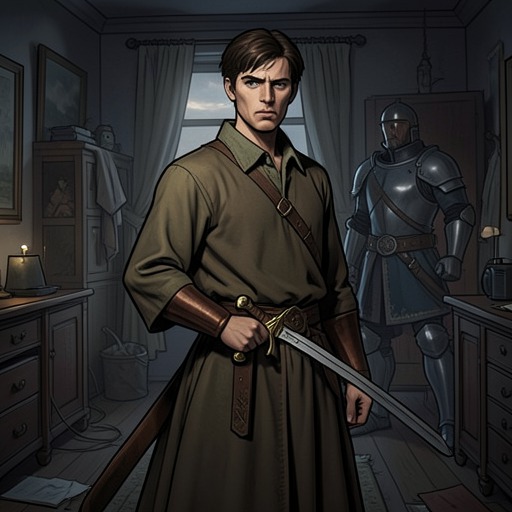
Luc, the new Hero, had been trained from the age of five, compared with Eliza’s starting age of twelve. His abilities were apparent when Theo first saw him: he was broad and physically trained, and his combat displayed speed, control, and confidence. In a duel, Luc moved as if the sword extended his arm; Theo’s instinctive study of fighting forms recognized the exceptional skill behind the performance. The sword at Luc’s side carried a different meaning for Malthios. It was Eliza’s weapon, the blade that had nearly killed him, and its presence connected the next generation of Hero Status to the previous Hero’s violence.
The Office and Its Personal Costs
Hero Status narrowed the lives of its bearers as well as shortening them. Luc described earlier relationships that could not survive the demands of his departure: a childhood romance, then a squire who ended their relationship when Luc was announced as leaving, despite Luc’s request that he come along. Later relationships formed during brief stays in towns, but none lasted. Luc understood this pattern as part of the Hero’s fate, a life in which travel and obligation repeatedly displaced the possibility of staying with someone.
The pressure extended beyond romance into the expectation of succession by blood. Julius told Theo that Eliza had ordered him to refuse Luc’s invitation to join the Hero’s party and threatened to take everything from him if he did not let Luc go. Julius believed Eliza wanted Luc to sire the next Hero and continue their bloodline, something neither he nor Julius could provide. The office was therefore bound not only to combat and sacrifice, but to an inherited future that treated Luc’s intimate life as a means of preserving the role. Eliza’s control over Luc presented that demand as an extension of duty; Luc’s later refusal would challenge both.
Luc’s Rejection of the Inheritance
When the court considered Theo guilty of protecting Malthios, Luc stood beside him rather than preserving his position in the Hero’s order. Eliza confronted Luc with the consequences as she saw them: ending their bloodline and throwing away everything he had trained his whole life to do. Luc answered by choosing a quiet, peaceful life with the man he loved and insisting that those born with the Hero’s gift should be able to choose their fate rather than remain bound to duty. His decision did not deny the sacrifices built into his training; it refused to let those sacrifices dictate every choice that followed.
The story gives that refusal concrete form through the objects associated with the Hero’s past and Luc’s future. Luc offered Theo his father’s silver ring, textured like scales and set with a dark sapphire. His father had died saving an adventuring party from a demon attack, so the ring carried a family memory shaped by the same dangerous world that had claimed generations of Heroes. Luc placed it on Theo’s marriage finger. Later, the Hero’s sword lay partly hidden beneath coats, its jeweled hilt caught in a cobweb. It no longer inspired fear in Theo or Malthios: without someone to wield it, it was only metal and gems. The change in the sword’s meaning marks the difference between an inherited symbol of violence and a life no longer organized around wielding it.
Retirement and Significance
Luc’s choice does not remove him from the world his status once required him to defend. He becomes known as the retired Hero and as Luc, the Demon Slayer, and his presence in Leafel changes the village’s exposure to danger. Malthios observes that the former Demon King living there alongside a retired Hero may draw humans and other races seeking revenge or hoping to prove themselves. In response, Malthios and Hayden walk the county boundary for hours, working to detect unknown approaches and protect the village. Retirement, then, is not a return to a world untouched by the Hero’s past; it is a different way of living with its consequences, alongside the people Luc has chosen.
Hero Status begins as a magical advantage burdened by an early death and enforced service, and its succession threatens to reproduce those costs in the next generation. Luc’s departure from that script is significant because he refuses both the duty’s claim on his future and its demand for a bloodline. By choosing Theo and a quiet life in Leafel, he makes the possibility of a different future part of the role’s ending: the gift may remain, but those born with it need not surrender their choices to it.