Hero’s Role
The Reincarnated Demon King's Host Just Wants to Live in Peace, But the Hero Won't Leave Him AloneHero’s Role is the system of magical inheritance, military training, demon-purging, and public protection that governs the Hero in Algeya. It presents the Hero as both savior and state instrument: a chosen figure whose body is trained for combat, whose companions are organized around the mission, and whose personal freedom is repeatedly subordinated to the safety of the common folk. The plot’s decisive question is whether duty requires obedience to that system, or whether a Hero can choose how, when, and for whom the duty is fulfilled.
Definition and Succession
Hero’s Role begins with exceptional magic being identified and claimed by the court. When Theo manifests an extraordinarily powerful healing gift, the court mage declares that someone with such a gift belongs in the Hero’s party. Theo is therefore sent to learn from the greatest healer in Algeya and is expected to enter training with the next Hero when that successor reaches the required age. His gift is not treated primarily as his own future; it is classified as a national resource to be placed inside the Heroic structure.
The succession system is necessary because Hero magic consumes its bearer’s body with unusual speed. Recorded Heroes have barely survived into their twenties, and Eliza is already showing signs that the power and the battle against Malthios have shortened her remaining time. The discovery of a new Hero when Theo is fourteen is therefore both a political necessity and a biological warning. The system preserves continuity by replacing one endangered body with another, while leaving the underlying life-force cost intact.
When Theo turns sixteen, the succession plan becomes immediate. Guards are scheduled to escort him to the capital, where he is to meet the young Hero and the other companions. The group will train together until the new Hero comes of age, after which the responsibility for purging the remaining demons and protecting ordinary people will be transferred to them. This language makes Hero’s Role sound orderly and inevitable, but Theo experiences it as a future being imposed on him.
Training, Appearance, and Public Authority
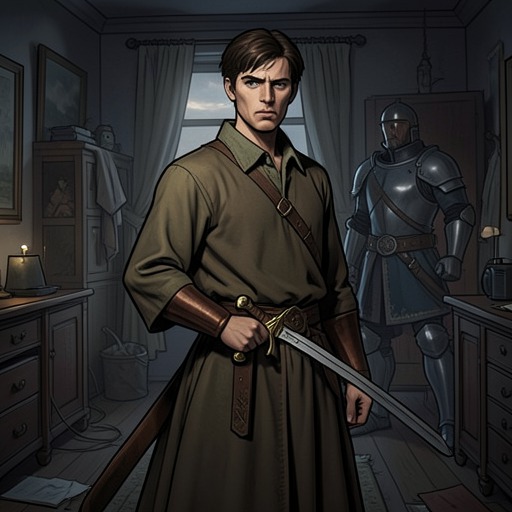
The Hero is shaped through a combination of magical power, physical conditioning, equipment, and party discipline. Luc’s trained body and the magic flowing through it make him visibly formidable when Theo first encounters him. His navy coat edged in gold, light leather armor, bracers, shoulder guard, protective body plates, and jeweled sword mark him as a public combatant as much as an individual warrior. The sword’s significance is even greater than its appearance suggests: it is Eliza’s sword, the weapon that nearly killed Malthios, and its presence makes the Hero’s inherited role physically continuous with the previous Hero’s campaign.
The Hero’s party is not simply a collection of fighters. Its members are assembled through training, political representation, adventure, and rescue. Avery and Emi train with Luc in the capital and come from high-ranking families. Bryony joins when the quest begins, volunteering to represent her kingdom in the struggle against demons. Khal and Veiv enter six months into the mission after the party helps with a demon-origin monster; Khal brings prior adventuring experience, while Veiv brings practical magic learned through pest control on her farm. Wicker joins two years after the quest starts, having saved the party from a reanimated Demon Lord commanding undead. Wicker was not formally invited but follows the group until the bond becomes real. The party thus embodies both the official machinery of Hero’s Role and the accidental human attachments that the machinery cannot fully regulate.
Hero’s Role also imposes obligations of self-preservation and care within the party. Theo identifies inadequate sleep, poor food, and untreated injuries as threats to the mission itself. He explains that Luc requires more than traveler’s rations because his physical magic depends on proper nourishment and that inadequate food leaves him weakened, with a serious risk of death against a difficult opponent. He also identifies Avery’s untreated weak lungs, Veiv’s inflamed hand joints, Bryony’s improperly healed leg injury, and Emi’s severe back and shoulder tension. As party healer, Theo defines his task not merely as repairing wounds but as keeping every member in condition to survive.
Duty Versus Personal Choice
The central tension in Hero’s Role is the conflict between public duty and private allegiance. Luc can become frighteningly impersonal when he believes the mission or a friend’s safety is threatened. When Avery is confronted, his cold rage reveals the lethal figure beneath the smiling Hero, and Theo recognizes that this same violence could be directed at him if his identity as Malthios’s host became known. Yet Luc also insists that Theo is not a stranger and defends the value of friendship against companions who seem to care only about the mission. His understanding of duty is therefore divided: he is responsible for fighting demons, but he also regards chosen bonds as part of what makes the mission worth undertaking.
Theo’s own healing practice exposes another contradiction. He is expected to keep everyone else alive, but he resists allowing anyone to care for him. When Imani finds him feverish in bed, checks his temperature, and tells him that he has pushed himself too hard, he attempts to dismiss the help and sit up. Imani responds by asking when he will let other people care for him. Theo understands that Camden, Imani, Dale, Nib, Amaya, and Luc already care about him, yet he refuses to accept that care because discovery of his secret could turn affection into rejection. Hero’s Role therefore creates an uneven economy of care: the healer is indispensable when tending others, but must learn that dependence is not a failure of duty.
The same conflict appears in Theo’s confrontation with Eliza. Eliza claims that watching over him is natural because he is her blood, but Theo answers that her sense of duty helped turn a child into a weapon. Their argument places familial responsibility, state service, and the autonomy of the child in direct opposition. Eliza accuses Theo of running away from his duty; Theo accuses her of accepting a system that weaponized him. Neither definition of duty remains morally uncomplicated once the costs to the person performing it are made visible.
The Trial and Reinterpretation of the Role
The formal trial of the Demon King’s Host reveals the punitive edge of Hero’s Role. After Theo’s identity is confirmed, the party is transported to the capital through a portal orb, and he is taken to the dungeons while the court prepares its judgment. The legal framework treats protection of Malthios as evidence of guilt, leaving little room to distinguish Theo’s own choices from the danger embodied within him. The Hero’s duty to purge demons becomes the standard against which Theo’s life is measured.
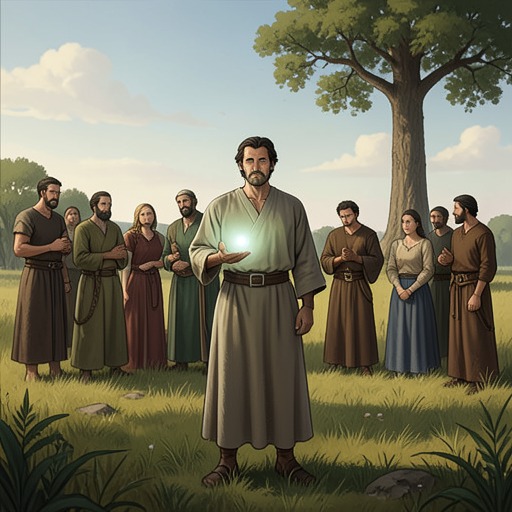
That standard is challenged when Leafel intervenes. Through a mirror spell cast by Micah, the court sees the people of Leafel gathered in the town square: Imani, Dale, Dmitri and his parents, Nib, Amaya, and the wider community, with Hayden speaking for them. They demand Theo’s release. Their appearance changes the meaning of the case because it demonstrates that Theo’s relationships are not private delusions or manipulations by Malthios; he has genuinely become part of a community that considers his life worth defending.
Malthios then states that he destroyed the Demon Fortress and everyone within it, leaving only a few lesser demons and demon-created monsters for competent adventurers to handle. He concludes that there is no longer any need for a Hero. The claim overturns the institutional premise of the role: if the organized demonic threat has been removed, the mission that legitimized the Hero’s exceptional authority may have reached its end.
Luc does not reject the duty outright. He declares that, as the Hero, it is his duty to kill the Demon King, but immediately adds that he can choose when that will happen. This decision separates obligation from automatic execution. Luc preserves the language of duty while refusing to let the court dictate its timing, creating a space in which judgment, relationship, and future safety can be considered together.
Consequences and Thematic Significance
The trial’s conclusion replaces immediate execution with differentiated responsibility. King Alexis sentences Malthios to life in prison while declaring Theo Bladefoot free of all charges. The judgment recognizes that the host and the Demon King are connected but not identical, and it rejects the assumption that Theo’s healing, community life, and resistance to domination constitute criminal allegiance. Luc’s delayed decision also prevents Hero’s Role from becoming a simple command to kill whenever a demon is identified.
The epilogue shows the role after its crisis has been domesticated. In autumn, Theo is writing labels at his shop while managing the garden harvest and gathering forest ingredients for the winter stores. Luc, now living within Theo’s ordinary world rather than standing only as a weapon of the court, distracts him and is reprimanded for misbehaving. Luc has learned gardening over the summer, though he lacks patience for it; the Hero’s reflexes and magical gift remain, but they are now placed beside shop work, seasonal labor, and shared domestic life.
This ending does not erase Hero’s Role so much as expose its limits. The role can train a body, assign a succession, organize a party, and authorize violence, but it cannot by itself sustain the relationships that make protection meaningful. The story contrasts the Hero’s public image with the less visible labor of healing, feeding, resting, gardening, and accepting care. Its final reorientation suggests that the most important transformation is not the creation of a stronger Hero, but the refusal to let heroic duty consume every other form of responsibility.