Imani
The Reincarnated Demon King's Host Just Wants to Live in Peace, But the Hero Won't Leave Him AloneImani, the tavern keeper of the Broken Blade, is Theo’s adoptive mother figure and one of the clearest embodiments of chosen family in Leafel. With her husband Dale, she offers him the sustained affection, practical care, and public loyalty that his birth family never provided. Her importance is not measured by magical power or political rank, but by the way she makes care ordinary: a reserved healer who expects to be abandoned learns, through Imani’s repeated welcome, that he can belong somewhere and be claimed as someone’s son.
Identity and Place in Leafel
Imani is described as a large, curvy woman with dark skin, wild curls usually tamed beneath a headscarf, and violet eyes. She runs the Broken Blade with Dale, her dwarf husband, who serves as the tavern’s cook. Their establishment is both a public meeting place and a private refuge within the village. When Theo first arrived in Leafel, he stayed there for several weeks before buying his shop, and Imani and Dale reserved a table for him in the corner beside the kitchen door so that he could remain apart from the crowd without being turned away.
That arrangement captures the particular intelligence of Imani’s care. Theo dislikes crowds, physical contact, and unnecessary conversation, and he rarely smiles or speaks. Imani does not treat those habits as an insult or a problem to be corrected. She gives him a place where he can hide while still being included, allowing affection to reach him without forcing him into a form of sociability he cannot yet bear.
A Parent by Choice
Imani and Dale decide almost immediately that Theo is their child. They cannot have children, though they had deeply wished for them, and Dale later explains that Theo’s arrival affected them like instinct: they recognized that he needed them before he understood the need himself. Imani gives Theo the first hug he has ever received, while Dale makes a cake specifically for his eighteenth birthday, the first birthday he has celebrated. Their love therefore becomes a direct contrast to Theo’s memory of his birth parents, whose warmth was absent and whose family name carries no comfort for him.
Theo initially responds to this welcome by withdrawing. He avoids the Broken Blade for months or even years, claiming that he dislikes the crowd, though the deeper reason is that the tavern’s owners have offered him more love and affection in a few weeks than his actual parents gave him throughout his life. His avoidance is not evidence that their care has failed. It shows how threatening genuine tenderness is to someone who has learned to survive by staying ready to flee. Imani continues to ask about his day and listen to his short, quiet answers, while Dale teaches him to cook better. Their patience makes room for a relationship that Theo cannot immediately reciprocate in conventional ways.
When Theo later returns to the tavern with most of the Hero’s party, Imani is delighted that he has come back. She and Dale still fuss over him even though he has barely offered more than a greeting for months, and they serve him his favorite meal without waiting for him to request it: thinly pounded, breaded steak fried in oil, accompanied by buttered baby potatoes seasoned with rosemary. Theo feels guilty about the distance he has maintained, but he eats the meal eagerly. Food becomes one of Imani’s most tangible forms of recognition: she remembers what he likes and provides it before he asks, turning memory into maternal attention.
Care During Theo’s Illness and Departure
Imani’s care becomes especially visible when Theo’s health collapses. After struggling to tend his garden and shop, he goes to the Broken Blade because he has no energy to prepare food. On a clear, warm day, he reaches the nearly empty tavern and leans heavily in the doorway. Imani, organizing bottles and tankards behind the bar, immediately sees that something is wrong and asks whether he is all right. Before he can recover, the world tilts and he loses consciousness.
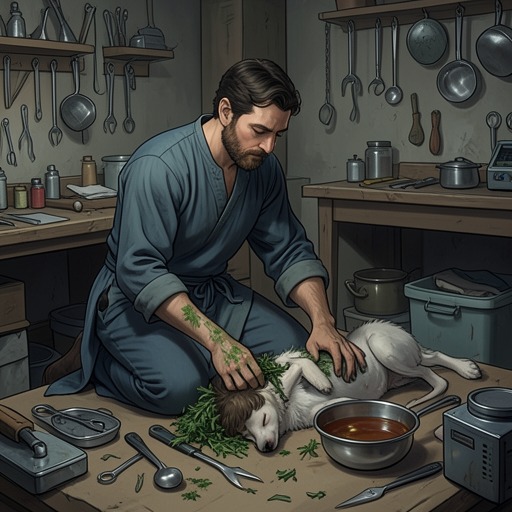
Theo wakes in his own bed wearing only his undershorts, with a cool cloth on his forehead. Imani sits beside him, removes the cloth, and brushes her fingers lightly over his face to check his temperature. She tells him that he has pushed himself too hard. Dale brings a tray, props him against pillows, and feeds him rich broth with vegetables and chicken. Imani and Dale’s response is not merely that of innkeepers serving a customer or villagers assisting a healer; it is the response of parents caring for a sick child who has tried to endure alone.
Theo recognizes the depth of this care only after receiving it. He realizes that a parent’s love is not meant to be cold and distant, and that he had not understood how much he had been deprived of warmth until Imani and Dale gave it to him through smiles, kind words, hugs, food, and persistent attention. His regret is directed at his own withdrawal, but Imani does not make him earn his way back. She continues to welcome him.
After Luc leaves Leafel, Theo promises to dine at the Broken Blade once a week. He keeps that promise. Imani and Dale are always happy to see him, serve his favorite dish, and make time during their busy evenings to hear about his day. Theo has little to report, but his life has become more connected than before, and the regular meals give that change a rhythm. He stops comparing them with his birth parents because the comparison is pointless: this, he understands, is how real parents act.
Imani also participates in Theo’s emotional life by accepting the departures that threaten to reopen his old fear of abandonment. When Bryony and Wicker arrive with permission and a portal to take him to the capital to help the gravely endangered Luc, Theo knows that going may expose his identity and end his autonomy. He also fears that he may never return. Before he leaves, Imani pulls him into a hug without hesitation, while Dale pats his back. Her embrace is joined by Amaya’s and Nib’s farewells, but Imani’s action carries the force of a mother sending a beloved child into danger while still affirming that he has a home to return to.
Public Loyalty and the Trial of the Demon King’s Host
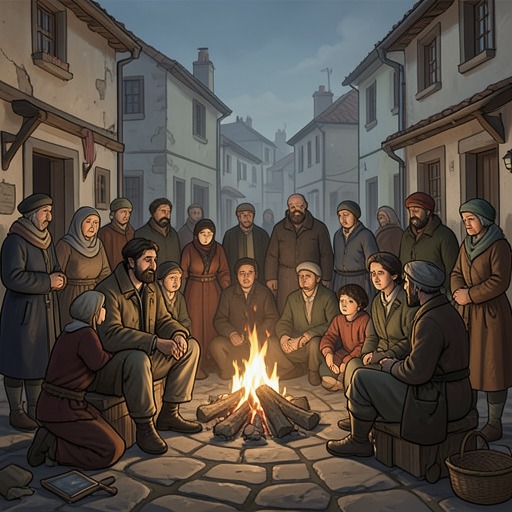
Imani’s private affection becomes public resistance when Theo is imprisoned and tried as the host of Malthios, the Demon King. The capital court treats Theo as a dangerous identity to be confined and judged. Leafel answers by appearing through a mirror portal in the courtroom, with Micah at the front and Imani, Dale, Dmitri and his parents, Nib, Amaya, Hayden, and other townsfolk gathered behind him. They demand Theo’s release despite the court mage’s accusation that they are guilty of treason as well.
Imani speaks for the community because she knows the person hidden beneath the official charge. She says that Theo arrived in Leafel lost and still only a child, believing that no one could care for him. The village welcomed him, and he repaid that welcome with love and care in his own guarded way. Her testimony does not deny the danger surrounding Malthios or erase Theo’s secret; instead, it insists that a person cannot be reduced to the most threatening fact about him. Nib emphasizes the lives Theo has saved through healing, while Hayden acknowledges his sharp tongue and stubbornness but calls him a good person. Imani’s account gives these claims their emotional foundation: she has witnessed Theo before the public crisis, during his isolation, illness, work, and gradual attachment to Leafel.
When the trial ends, Imani is among the first people to receive Theo after his release. Micah runs into him sobbing, and Imani and Dale close around him in a tight embrace. She kisses his temple and tells him that they are proud of him; Dale welcomes him home as their son. Theo, who has spent years repressing grief and resisting touch, collapses into their embrace and cries. Imani’s welcome therefore completes the movement that began with the corner table at the Broken Blade. The hidden boy who believed he must always be ready to run is publicly received as family.
Narrative Significance
Imani’s relationship with Theo rewrites the meaning of home. Theo’s fear that no amount of friendship could protect him if his nature were discovered is tested against a community that learns the truth and chooses him anyway. Imani does not protect him through force; she protects him by remembering who he is, naming the goodness of his actions, and refusing to let an institution’s accusation replace personal knowledge.
Her care also provides the novel’s strongest counterpoint to the systems surrounding the Hero’s party and the Demon King. Those systems treat people as functions: Luc is expected to continue a heroic bloodline, Theo can be judged as a host, and another child can be raised to replace a fallen Hero. Imani’s language is familial rather than functional. She sees Theo as a lost child, welcomes him as a son, feeds him when he cannot care for himself, and stands with him when association carries political risk. Through her, parenthood becomes an act of recognition rather than biology.
Imani’s significance finally lies in her constancy. She is present at the tavern when Theo needs food, beside his bed when illness defeats him, at the portal when he must leave, in the courtroom when his life is threatened, and at the end when he returns. Her repeated gestures allow Theo to revise the story he tells about himself: he is not only a fugitive, healer, or Demon King’s host. He is also Imani’s dear Theo, a son who can leave, return, and be welcomed home.