Julius
The Reincarnated Demon King's Host Just Wants to Live in Peace, But the Hero Won't Leave Him AloneJulius, also called Jul and addressed formally as Sir Julius, is a knight who trained with Luc during their youth and later became his former lover. His brief but consequential appearance turns a seemingly personal rivalry into evidence of the coercive structure surrounding the Hero’s life: Julius did not abandon Luc freely, and Luc’s intended future was shaped by demands that he continue the Hero bloodline. Julius therefore functions as both an intimate rival to Theo and a witness to the system Theo and Luc eventually reject.
Identity and Background
Julius is introduced among the knights training in the courtyard of the capital, where his physical resemblance to Hayden is noted alongside a more delicate build: he is tall and broad compared with Theo, but has a narrow waist, slender limbs, tied-back light blond hair, fair skin, and glittering green eyes. His appearance combines conventional handsomeness with prettiness, a quality that makes his controlled hostility toward Theo especially striking. He watches Theo as though he wishes him dead, yet his expression remains formally composed rather than openly aggressive.
Julius identifies himself as a knight who trained with Luc when they were younger. Luc’s own account places Julius within a sequence of relationships shaped by the Hero’s itinerant existence. Luc recalls that a squire with whom he trained ended their relationship when Luc was announced to be leaving, despite Luc asking him to come along. The squire is not named in that recollection, but Julius later confirms that he and Luc trained together and explains that he did not want to leave Luc. Together, these details establish Julius as the former squire-lover whose separation from Luc was connected to the beginning of Luc’s life as a Hero.
Return to Luc’s Life
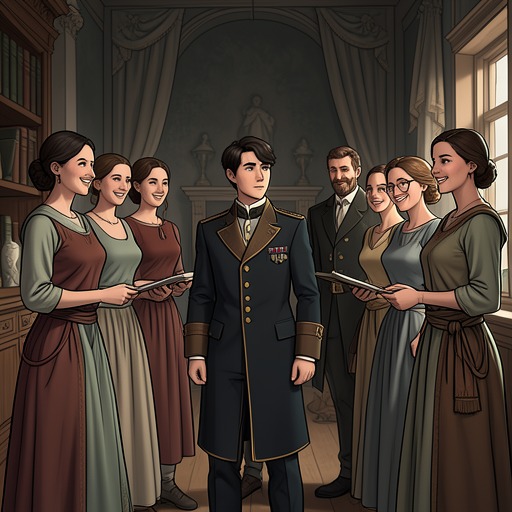
Julius reappears when Luc and Theo join the Hero’s party for training. After the party’s members greet Theo, Luc keeps an arm around Theo’s waist, and Julius’s attention becomes particularly pronounced. His stare is not merely professional scrutiny: the scene places him in direct visual and emotional opposition to the intimacy between Luc and Theo. When Julius suggests that Theo should begin with an easier opponent because the healer is out of practice, the remark carries the surface form of tactical advice but also serves as a challenge.
Luc recognizes him stiffly as Jul, and his body shifts slightly in front of Theo, a protective gesture that makes the old relationship visible before Julius explains it. Julius offers the formal introduction, “Sir Julius, nice to meet you. Luc and I trained together when we were younger.” Theo answers by questioning the assumption that he is out of practice. The exchange establishes a triangle governed by competing claims: Julius invokes shared training and past intimacy, Theo asserts present competence, and Luc physically places himself between the two men.
The confrontation becomes a duel. Julius adopts a fighting stance, but Theo notices that his balance is slightly wrong for unarmed combat and guesses that he is more accustomed to using a sword. Theo attacks without granting the pauses or recovery periods expected in conventional dueling. He deflects Julius’s movements, kicks him in the ribs, sweeps his legs, flips over him, parries his strikes, and uses his momentum against him. The fight ends with Theo on top of Julius, one knee pinning his stomach, another controlling his arm, and a hand lightly closed around his throat. Julius’s breath catches beneath Theo’s palm, but Theo releases him when Julius signals surrender and offers him a hand up.
The physical contest reverses the apparent power arrangement. Julius enters as the established knight and former lover, apparently positioned to judge the healer, but Theo’s speed and survival-oriented technique leave Julius defeated before the watching party. Julius’s reaction combines awe with unmistakable attraction, making the duel both a demonstration of Theo’s ability and an intensification of the erotic rivalry surrounding Luc. Theo then returns to Luc with sharpened confidence, while Luc’s visible desire confirms that Julius’s presence has not displaced the present relationship.
The Truth About the Separation
After the duel, Julius speaks privately to Theo and reveals the reason he did not join Luc. He explains that he was happy when Luc asked him to join the Hero’s party, but Hero Eliza ordered him to refuse. She threatened to take everything from him if he did not let Luc go. This disclosure changes Julius from a resentful former lover into someone who was forced into abandonment by the authority governing Luc’s career.
Julius also supplies a motive for Eliza’s intervention. He believes that she wanted Luc to continue the Hero bloodline and sire the next Hero, something that could not be achieved through a relationship with either Julius or Theo. His account makes Luc’s sexuality and romantic life part of a larger political calculation. The Hero is not treated simply as a person with a dangerous calling; he is treated as a hereditary resource whose intimate choices are judged according to reproductive utility.
Theo refuses to be frightened away by the warning. He states that he has no intention of letting Luc go, directly opposing the pattern Julius describes. Julius’s testimony thus becomes a hinge between past and future: his relationship with Luc was broken by a threat, whereas Theo and Luc’s relationship is defined by their determination to remain together despite the same institutional pressure.
Relationship with Luc and Theo
Julius and Luc share a history of training, courtship, and separation. Luc’s earlier description of a squire who ended their relationship when Luc was required to leave matches Julius’s later explanation, giving retrospective specificity to Luc’s past. Their reunion is emotionally restrained on the surface. Luc is stiff when he addresses Julius, and Julius maintains a polite, nearly impassive manner, but the tension beneath that restraint is exposed through his stare, his challenge to Theo, and his private confession.
Julius is also connected to Theo through rivalry rather than friendship. Theo reads his conduct as an attempt to test or undermine him, and Mal interprets the encounter through the possibility that Julius is not over Luc. Yet Julius’s warning ultimately assists Theo. By explaining Eliza’s threat, he gives Theo knowledge that strengthens rather than weakens Theo’s commitment. The former lover becomes an unwilling ally in the struggle against the Hero system’s control.
The contrast between Julius’s past and Theo’s present is sharpened by the objects associated with Luc’s relationships. Luc promises Theo that he will wait for him and places his father’s silver, scale-textured ring with a dark sapphire on Theo’s marriage finger. The ring carries the memory of a father who died saving an adventuring party from a demon attack, while the marriage gesture establishes a chosen bond that competes with inherited duty. Julius’s history represents love surrendered under coercion; Theo and Luc’s union represents an attempt to make intimacy, rather than bloodline, the basis of the future.
Role in the Wider Conflict
Julius’s significance extends beyond the courtyard and the past relationship. When Theo is later taken to the capital for the Trial of the Demon King’s Host, Julius is the knight standing before the cell, his face blank as he meets Theo’s eyes. This placement connects Julius to the machinery of judgment that threatens Theo. He is no longer merely the former lover who challenges Theo in training; he is also one of the uniformed figures through whom the court’s authority is enacted.
That institutional position creates a deliberate contrast with the choice Luc makes during the trial. Eliza asks whether Luc is willing to end their bloodline and discard everything for which he has trained his whole life. Luc answers that choosing to live peacefully with the man he loves is the only choice he has ever made for himself, and he hopes for a world in which those born with the Hero’s gift can choose their fate rather than remain bound to duty. Julius’s earlier revelation gives this declaration its human history: the threat against Julius shows what happens when that choice is denied.
Julius is therefore a rounder figure than a simple jealous rival. He first appears to embody hostility, competes with Theo physically, and remains attached to Luc, but his later disclosure reveals vulnerability, coercion, and a continuing concern for Luc’s welfare. His narrative function is not to reclaim Luc but to expose the cost of the life Luc is choosing to leave behind. Through Julius, the story shows that the Hero’s imposed future has already damaged previous relationships before Theo and Luc openly resist it.