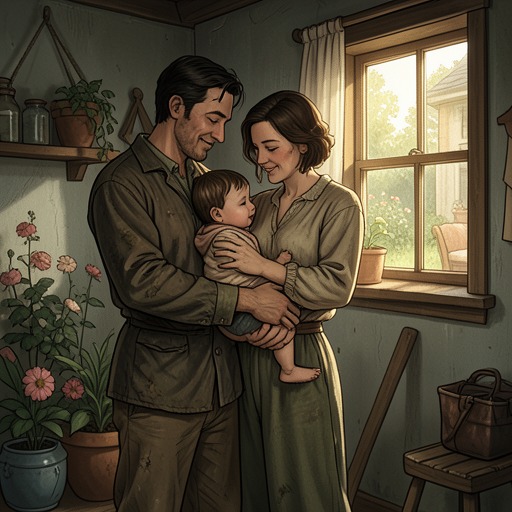
Khal and Veiv
The Reincarnated Demon King's Host Just Wants to Live in Peace, But the Hero Won't Leave Him AloneKhal and Veiv are the Hero’s party’s long-term couple, a relationship defined by mutual loyalty, practical care, and a shared desire to build a life beyond perpetual adventuring. Their bond is not incidental to the group’s history: they joined the quest together, protect one another in danger, and remain visibly connected even when illness, battle, and the party’s obligations threaten to pull everyone apart.
Formation and Shared Future
Khal was already an adventurer when he met Veiv on her farm in an outlying town resembling Leafel. Veiv used her magic chiefly for pest control rather than warfare and worked with Cargo, her trusted hog companion. The two had been discussing traveling together before eventually settling down, so their decision to join Luca’s Hero’s Party was a shared step rather than Khal’s solitary commitment to a heroic cause. Their relationship therefore begins with a tension that persists throughout the story: they are willing to enter danger together, but their imagined future includes rest, domestic stability, and a life not permanently governed by the road.
Their history also distinguishes them from the more temporary romantic attachments associated with the Hero’s role. Luca describes former lovers whose relationships were made impossible by distance, departures, or the unstable schedule of the quest. Khal and Veiv, by contrast, entered the party as an established couple and remain a unit within it. Their partnership demonstrates that the Hero’s journey does not erase every private bond, even though the institution of heroism repeatedly makes lasting intimacy difficult.
Care in Danger and Recovery
The relationship is tested most sharply when Khal is poisoned by a basilisk after saving Luca. Veiv is present during the crisis and, together with Avery, can only slow the poison’s progress, forcing the party to carry Khal to the nearest town in search of a healer. When Khal awakens, his first concern is not his own condition but Veiv’s safety. He asks where she is and whether she has been hurt, revealing that his instinct under extreme physical threat is directed toward his partner rather than toward himself.
Theo explains that Veiv and Avery managed to delay the poison while the party sought help, and that treatment removed the immediate danger. Khal still requires further healing for the remaining poison and his wounds, so recovery is presented as a process of continued care rather than a single miraculous reversal. Once Theo scans him and confirms that the injured area is normal, Khal is cleared to return to duty, with the specific advice that he maintain his water intake. Khal responds with formal gratitude to Theo and immediately tries to restore the party’s routine by declaring that the break is over and training must resume. Veiv’s relationship with him thus appears through both tenderness and disciplined practicality: she helps preserve his life, while he treats recovery as a responsibility to the group.
Place Within the Party
At the Broken Blade, Veiv remains upstairs to keep Khal company while he recovers, whereas the rest of the party gathers below with Theo. The arrangement makes their intimacy visible without turning it into spectacle: Veiv’s absence has a clear purpose, and Khal’s later return to the table is understood through her presence beside him. When he is well enough to rejoin breakfast, he eats energetically and admits that he is eager to resume training, while Veiv and the others accommodate the pause caused by his poisoning.
Their place in the group is also marked by physical familiarity. Veiv leans against Khal’s side while watching Theo and Luca confront Hayden, and the gesture places the couple together as a stable point amid the party’s volatile romantic and protective tensions. She can comment dryly on Luca’s possessiveness, while Khal remains beside her, making their partnership part of the social texture of the party rather than a private attachment detached from communal life.
The party’s meals and teasing further establish that Khal and Veiv belong to a chosen family. At the outdoor feast, everyone shares cheeses, bread, berries, and roasted chickens by hand, while conversation and laughter turn the group’s rough teasing into an expression of deep affection. Khal and Veiv are among the people through whom this family structure is made legible: their established couplehood coexists with the wider loyalty of the party, and neither aspect cancels the other.
Contrast With Heroic Duty
Khal and Veiv’s relationship gains thematic force from its contrast with the demands placed on Luca. Luca’s past lovers were separated from him by the Hero’s departures, and Hero Eliza later pressures him to preserve the heroic bloodline by fathering the next Hero. Her demand treats intimate life as an instrument of succession, while Luca’s eventual choice is to live peacefully with Theo and reject a future determined by inherited duty.
Against that pressure, Khal and Veiv represent a less institutional form of commitment. Their bond is not organized around bloodline, magical inheritance, or a command from the court. It grows from meeting, choosing to travel together, caring for one another in danger, and retaining the possibility of settling down. The couple therefore helps broaden the book’s idea of family beyond lineage and official destiny. Their shared future may be interrupted by the quest, but the relationship itself remains evidence that companionship can survive within heroic life without being reduced to a political obligation.
Khal and Veiv’s partnership consequently functions as both a personal romance and a structural anchor for the Hero’s party. Their first concern for each other during the basilisk crisis, their physical closeness during tense encounters, and their shared origin in a plan to travel and eventually settle all point toward the same principle: a heroic life is sustainable only when it leaves room for reciprocal care and a future chosen by the people who must live it.