Leafel
The Reincarnated Demon King's Host Just Wants to Live in Peace, But the Hero Won't Leave Him AloneLeafel is a small, secluded settlement whose decisive importance lies in the way it turns home from a birthplace or political territory into a chosen community. Far from the capital and rarely visited by travelers, it gives Theo a place to practice healing, conceal the danger of his identity, and form durable bonds. By the end of the story, Leafel is no longer merely the village that sheltered him: it is a living network of people who claim responsibility for one another and make Theo’s return possible.
Setting and Physical Character
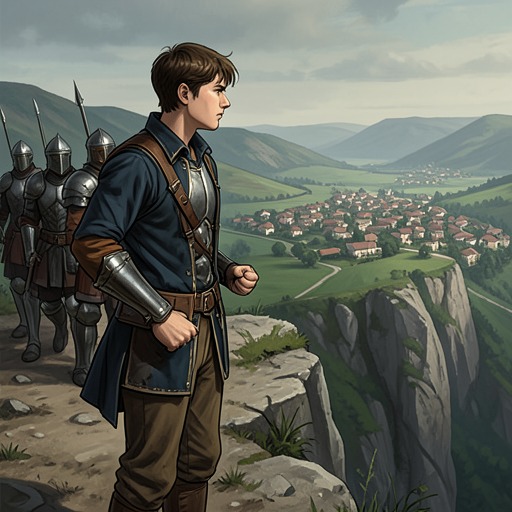
Leafel lies out of the way, with a forest pressing close to the edge of the settlement and a stream leading to a small waterfall beyond the village. The approach changes from a dirt path through the farmlands to cobblestones, marking the transition from open countryside into a contained local world. Spring weather can shift abruptly there: when Theo carries a basket toward his shop, drizzle begins and a gust makes the shop sign creak beneath the looming, dark trees.
The village is rustic enough that a newcomer might regard Theo’s property as little more than a dump, but Theo sees its history rather than its rough surface. He bought a small, rundown house on the edge of Leafel, just before the forest, after earning enough coin during his travels. He repaired it and made it into a shop, sleeping in its attic while the potion room also served as his kitchen. The building sells the products of his work as well as embodying it: alongside healing magic, Theo gathers and prepares herbs and potions for the ordinary injuries of everyday people. He describes the place as home because he built it himself, almost literally, and because it is the first home he has truly possessed.
The shop and its surrounding garden gradually become more than a workplace. The flock is kept in crates, herbs are stored inside, and the garden supplies food and materials. When Theo is away, Micah lays a heating charm over the animals. After the last frost, the household prepares the garden for planting, resumes foraging, and undertakes spring cleaning. Luc and Khal remove the back door and part of the washroom to extend the building and add a small study, while Veiv watches the shop and Wicker, Theo, Micah, and Dmitri share the work of foraging and tending the garden. Leafel’s domestic spaces therefore expand as its chosen family expands.
Community, Safety, and Belonging
Leafel’s isolation limits traffic but also helps preserve its security. The village’s small adventurer party, led by an exceptionally talented swordsman, protects residents from beasts, both monstrous and ordinary. The settlement receives occasional monsters, yet its remoteness makes it an unlikely target for bandits; even so, an adventurer-guild post exists within the county. Later, Hayden identifies himself as Sword Master Hayden and guardian of Leafel, explaining that the village should remain alert when the Hero’s party arrives because monsters have attacked before.
The village’s most visible public asset is Theo himself. As word spreads about the healer’s unusual skill, the draw of Leafel grows slightly, although few local people travel farther than the next town south. The townsfolk cannot resist praising Theo despite his requests that they stop, making him one of the two achievements about which they are most proud; the other is their adventurer-party leader. Their pride gives Theo social standing, but it also creates a danger, since recognition beyond the village could expose what he is. He knows that friendship alone would not save him if people discovered his demonic secret.
Leafel’s history of welcome extends beyond Theo. Amaya calls the village her family and values the chance to give back after its people accepted her openly. The settlement also shelters people marked by difficult pasts: Imani escaped an arranged marriage, Hayden killed an abusive mentor, and Liffey’s parents were banished in disgrace. Leafel’s response is not to demand that such people return to an approved origin, but to give those with nowhere else to go a place in which they can heal. That principle explains why the village can become a home for Theo and later offer the same possibility to Malthios.
Theo’s Home and the Village’s Bonds
Theo’s relationship with Leafel is stated with unusual finality. After Luc’s party leaves and Theo withdraws beyond the shop into the forest, he reaches a waterfall, a private space where the village’s surrounding landscape gives form to his grief. Yet when the possibility of departure arises, he insists that Leafel is his home and that he is not going anywhere. The declaration is not sentimental decoration: it establishes the village as the responsibility Theo chooses over the institutional path imposed by the Hero’s system.
That choice is tested when Luc’s life is threatened. Entering a portal would surrender Theo’s autonomy, reveal who he was and where he lived to powerful authorities, and risk forcing him back into the Hero’s party, where his identity could be discovered. Nevertheless, he leaves instructions that show how completely his life has become interwoven with Leafel. Micah is placed in charge of the shop and told to double-check everything and avoid poisoning anyone; Dmitri is assigned the garden and flock; the harvest and eggs are to go to Imani and Dale or to the Watchtower. Even during a crisis, Theo’s mind turns toward continuity of care rather than personal property.
The village also preserves memory through shared ritual. After Glefald’s death, Leafel honors his wish for an earth burial rather than the more common funeral bonfire. A tree is planted over his body so that the remains can feed new life, following an elven custom that the people of Leafel willingly adopt. Later, Micah waters Glefald’s sapling at the Watchtower. The tree thus becomes a visible link between mourning, growth, and the village’s practice of making room for customs brought by its residents.
Return, Protection, and Transformation
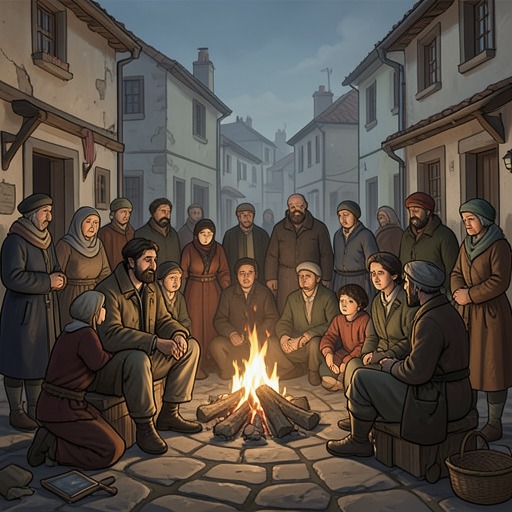
Leafel’s commitment becomes unmistakable during the trial of the Demon King’s Host. In the crowded throne room, the court, mirror-spells, Syvia, Eliza, and the Hero’s party place Theo under institutional scrutiny. A large mirror then opens onto Leafel’s town square. Micah stands at the front with his staff raised, displaying remarkable magical skill for someone of his age and level; behind him stand Imani, Dale, Dmitri and his parents, Nib, Amaya, and the people of Leafel, all facing the court with grim determination. Hayden steps beside Micah and bows. The village does not defend Theo through abstract claims about innocence. It presents the concrete fact that he belongs to people who know him and have chosen to stand with him.
When Theo returns home, Micah breaks from the crowd and runs into him, sobbing into his tunic with his arms tightly around him. The return is consequently physical and emotional at once. At the Broken Blade, Dale says that the tavern is happy to host them and that it is time for everyone to hear everything about Theo. Later, Theo and Luc walk on foot to the shop. The flock is safe, the building is not stale despite its long closure, and its familiar smells of dried herbs, almond-scented floor soap, and recently burned incense make the place recognizable before anyone explains what has been done to preserve it.
The repaired home also records Leafel’s transformation. What began as Theo’s solitary shop becomes a shared household, with Luc and Khal adding space, Veiv preparing for twins, and several companions contributing to its maintenance. The Hero’s sword, once a source of cold fear, lies partly hidden beneath cloaks and coats in a corner, its gold and jeweled hilt caught in a spider’s web. Without a wielder, it is only metal and gems. In Leafel, the object’s symbolic authority has been displaced by ordinary domestic life.
Malthios and the Meaning of Home
Leafel ultimately becomes the setting in which Malthios experiences freedom without returning to conquest. After standing in the doorway of the healer’s cottage and looking toward the road to the village, Malthios recognizes that, for the first time in thirty years or perhaps longer, he can do whatever he wants. He can land casually in the middle of town with horns, wings, and tail fully visible. Although the attention makes him awkward, passing townsfolk wave or stare in awe, and he waves back before making his way to Fox Tales.
This public visibility contrasts sharply with the secrecy and fear that once defined the village’s relationship to Theo’s hidden nature. Malthios is not immediately treated as an invading power; he is treated as a startling presence within a community that has already learned to receive people who do not fit its approved categories. His acceptance is not presented as the erasure of the past, but as a practical extension of Leafel’s central ethic: those who have nowhere else to go may be given the chance to heal.
Even Malthios’s freedom is folded into communal responsibility. Hayden makes him walk the county’s borders, a task that irritates him but that he has agreed is sensible. After several hours they are only halfway around Leafel’s boundary. Theo is restless in Malthios’s mind and eager to return to Luc, yet Malthios also recognizes the value of the patrol. The former Demon King is therefore not placed outside society as a permanent exception; he is incorporated into the work of guarding the village that has accepted him.
Leafel’s narrative significance lies in this conversion of space. The capital concentrates kingship, councils, magical training, knights, and the institutions that can command a Hero’s life. Leafel offers a smaller counter-structure built from healing, food, work, grief, protection, and mutual recognition. Its borders are defended, its dead are remembered, its houses are expanded, and its people answer a distant court with their collective presence. For Theo and Malthios alike, Leafel proves that belonging can be made through repeated care—and that a village dismissed as remote can become the strongest political and emotional force in the story.