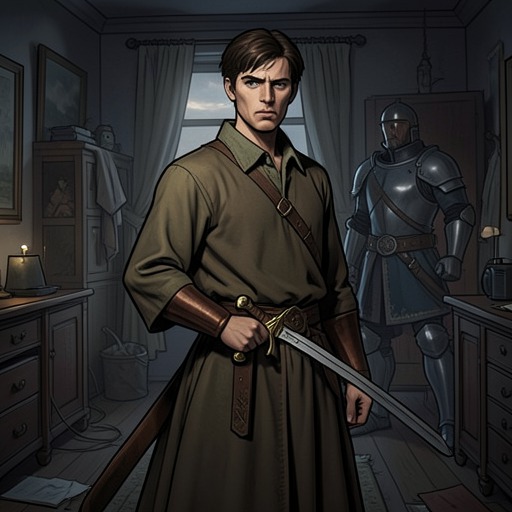
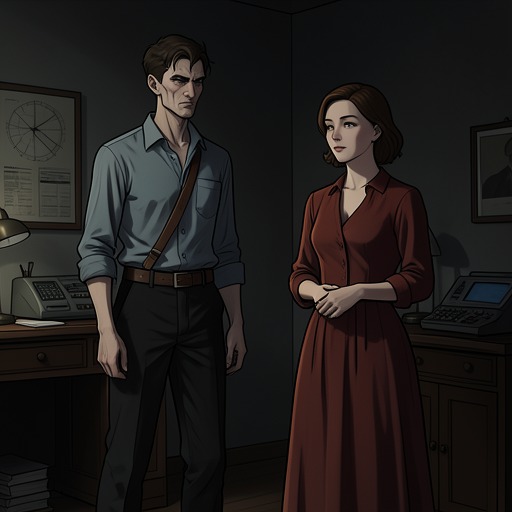
Luc and Eliza
The Reincarnated Demon King's Host Just Wants to Live in Peace, But the Hero Won't Leave Him AloneLuc and Eliza’s relationship is both familial and institutional: she is Luc’s mother’s twin, the aunt who takes him in after his mother dies, and the older Hero who shapes his entire future. What begins as rescue and tutelage becomes a conflict over whether blood, magical inheritance, and heroic duty give Eliza the right to command Luc’s life. Their final rupture matters because Luc does not merely disobey a relative; he rejects the system that treats his body and destiny as property of the Heroic line.
Family Origin and Heroic Inheritance
Luc’s mother dies when he is five. She had been a healer without magic, relying on herbs and potions, and even her skill could not save her from illness; by the time a magically gifted healer arrived, it was too late. After the death, Eliza comes for Luc. As his mother’s twin, she is his closest surviving maternal relation, but she does not simply provide a home. She takes him to the capital for testing, where it is discovered that he has inherited Hero magic as well.
That discovery determines the shape of Luc’s childhood. Eliza trains him as her prodigy, beginning when he is only five. The contrast with Eliza’s own history is revealing: she began training at twelve, while Luc is placed on the Hero’s path at an age when he has scarcely had the opportunity to choose anything for himself. His grief and dependency are therefore absorbed into a public role. Eliza’s care is inseparable from recruitment, and family protection becomes the first mechanism through which heroic obligation is imposed.
Luc later describes the cost of this life through the pattern of his romantic relationships. His first lasting partners are a maid in training and a squire who trained with him; the squire ends their relationship when Luc is announced as the Hero and refuses to leave the capital-bound mission with him. Later affairs in towns last only as long as the party’s visits. Luc calls this the fate of the Hero, a fate Eliza helps preserve by making departure, attachment, and ordinary domestic continuity difficult.
Training, Comparison, and Divergent Heroism
Eliza and Luc share the physical basis of Hero magic: resilience, speed, strength, rapid healing, and resistance to magic, all abilities developed through training. Yet their methods and temperaments differ. When Luc fights Hayden, Malthios judges Luc superior to Eliza, describing him as bolder, more fearless, and almost reckless. Eliza is formidable, but she is associated with disciplined mission-focus; Luc fights with his heart, which makes him stronger while also making attachment a vulnerability.
This difference exposes the deeper tension between them. Eliza treats the Hero’s role as a command that outranks private feeling, while Luc’s strength is intensified rather than diminished by his capacity to love. The relationship thus contains a reversed inheritance: Luc receives Eliza’s training and the Heroic gift, but he does not accept her understanding of what those gifts require. He becomes her successor in power while becoming her opponent in principle.
Eliza’s influence also extends through the way others are permitted to approach Luc. Julius tells Theo that he loved Luc and was happy when Luc invited him to join the party, but Eliza ordered him to refuse. She threatened to take everything from him if he did not let Luc go. Julius believes Eliza wanted Luc to continue their bloodline and sire the next Hero, something that could not be achieved with either Julius or Luc’s other male partners. In this account, Eliza’s family concern is inseparable from reproductive planning: Luc is valued not only as her nephew or companion, but as a vessel for hereditary succession.
Control, Bloodline, and Conflict
The bloodline demand becomes explicit when Eliza confronts Luc after he returns to Theo. She sees his choice of a life with a man not as a private relationship but as the abandonment of the future she trained him to produce. Her question is framed around the end of their bloodline and the waste of everything Luc has been taught to accomplish. The conflict is therefore not simply aunt against nephew, nor even mentor against former pupil. It is a contest between two definitions of continuity.
Eliza’s continuity is biological, institutional, and linear: the Hero trains, serves, produces the next Hero, and passes the burden onward. Luc’s alternative is relational and chosen. His earlier relationships already show how the Heroic vocation interrupts ordinary intimacy, but his bond with Theo gives him a future that is not organized around temporary stops, military service, or reproduction. The silver ring Luc gives Theo belonged to his father, who died saving an adventuring party from a demon attack. By placing that inherited object on Theo’s marriage finger, Luc redirects family memory away from the continuation Eliza demands and toward a partnership he actively chooses.
Luc’s struggle with Eliza also parallels Theo’s struggle with Malthios. Theo is the Demon King’s host, sharing mind and body with Malthios under conditions in which neither can escape the other: Malthios is imprisoned within Theo, while every thought and feeling is mutually accessible. Malthios attempts coercion through threats and insults, but Theo’s refusal to obey frustrates him. Luc recognizes a similar danger in the control imposed by heroic institutions. When Luc tells Theo that returning to the Hero’s party means being dragged back against his will, he understands that his own duty has made him an agent of coercion, even if he does not wish to be.
Break and Rejection of the Old Order
The decisive break occurs when Luc publicly answers Eliza’s demand that he sacrifice his chosen life for the bloodline. He does not deny his training, his power, or the history they share. Instead, he identifies his decision to live peacefully with Theo as the only choice he has ever made for himself. He further imagines a world in which those born with the Hero’s gift can choose their fate rather than remain bound to duty.
Theo then declares Luc a better Hero than Eliza, a judgment that transforms the family dispute into an ethical verdict. Eliza has preserved the heroic institution through control, sacrifice, and the attempted management of Luc’s relationships. Luc inherits the same power but refuses to reproduce the same structure. His heroism consists not in extending the bloodline at any cost, but in defending the possibility that a gifted person may choose love, rest, and an ordinary shared future.
Their relationship therefore ends in estrangement rather than reconciliation. Eliza remains rigid and dismissive, calling Luc naive, while Luc stands beside Theo and commits himself to a life outside her design. The nephew does not escape his aunt by erasing their bond; he escapes by separating inheritance from obedience. Eliza gave him the power and training that made him a Hero, but Luc’s final act of maturity is to decide what that power is for.