Luc’s Poisoning and Recovery
The Reincarnated Demon King's Host Just Wants to Live in Peace, But the Hero Won't Leave Him AloneLuc’s Poisoning and Recovery is a rescue event in which Luc’s life becomes the immediate price of Theo’s concealed identity. A demon’s attack leaves Luc unconscious with a deadly fever, and Theo must travel to the capital, where his identity as the Demon King’s host may be recognized, because Luc is not expendable to him even if the authorities treat Heroes as replaceable. The episode turns a medical emergency into a decisive test of love, duty, secrecy, and self-sacrifice.
Causes and Background
The crisis occurs nearly three weeks after the Hero’s party has departed for the capital. Theo has begun to bear Luc’s absence more easily because he believes the journey is relatively safe, but Micah and Dmitri arrive at his door wide-eyed and out of breath, revealing that the expected danger has already found Luc. A demon struck Luc in the face with an unknown substance just before the party reached the capital. Luc is not waking, has developed a deadly fever, and has not responded to anything the capital mages have attempted.
The circumstances echo an earlier medical crisis in Leafel, when a companion had been bitten by venomous demon spawn and the townspeople sent for Theo because they believed he worked miracles. The repeated demand for Theo’s healing establishes both his public role as Healer Theo and the burden attached to it: when ordinary healing fails, other people’s survival is placed in his hands. Luc’s poisoning raises that burden to its most personal form, because the patient is not merely a member of the Hero’s party but the person whose absence has already wounded Theo.
The Attack and the Race to the Capital
Bryony and Wicker explain that the attacker was small, roughly Wicker’s height, with the lower face hidden behind a scarf and what appeared to be a single horn in the center of the forehead. Mal immediately identifies the assailant as Nissle, described as one of the most dangerous assassins after Luvel and as someone whose poison concoctions are deadly. This recognition changes the emergency from an unknown illness into a targeted demonic attack with very little time remaining. Mal can name measures that might ease the effects, but no certain cure; Theo will have to force his healing magic against the poison itself.
The journey through the portal is therefore also a threshold into exposure. Theo understands that once he steps into the capital, his autonomy will be gone: people in power will know who he is and where he lives, and Camden will recognize him even if the court mage does not. He expects to be forced back into his place in the Hero’s party, where the truth about him could be discovered. Yet refusing to go would mean allowing Luc to die while the authorities simply raised another child to replace him. Theo’s decision is immediate and absolute because Luc is expendable to the system, but not to Theo.
Theo’s Healing of Luc
At the capital, Eliza initially stands between Theo and the bed, while Camden asks her to trust him and accept that Theo can heal Luca. Once Eliza moves aside, Theo sees Luc clearly and rushes to him. Luc’s skin has lost its normal glow, his face is ashen beneath the fever, his dark hair is stuck to his forehead, and his eyes move restlessly beneath their lids. His cheek feels cold to Theo, and Mal estimates that only a couple of hours remain.
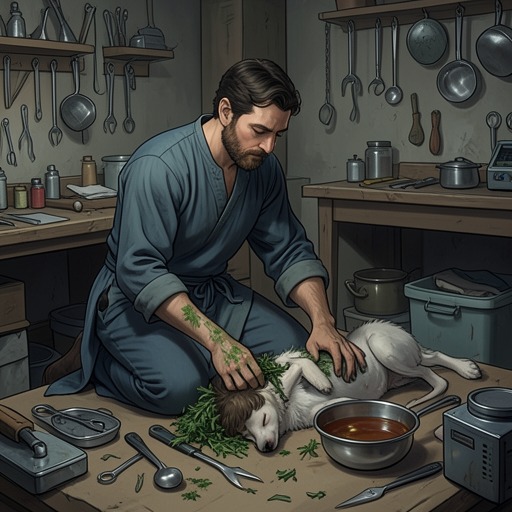
Theo begins the healing with Wicker and Cargo encouraging him, while simultaneously removing the limit on Mal’s mana and allowing its full force to flood through him. The room fills with green light. Mal warns him not to shift forms, but Theo refuses to moderate the attempt as long as Luc is safe. The healing becomes an act of sustained concentration rather than a single miraculous gesture: Theo remains fixed on Luc while the poison works through his body, ignores the aches caused by holding his position, endures a dry throat and gathering sweat, and relies on Mal to remind him to breathe so that he does not lose himself in the magic.
The value at stake shifts visibly during the treatment. At the beginning, Luc’s life is sliding toward death while Theo’s secrecy and autonomy remain intact. During the spell, Theo spends his own strength to reverse that movement. Color returns to Luc’s skin, his breathing eases, and the restless motion beneath his closed eyes stops. Theo continues until the final magical scan finds no trace of poison. The cure is therefore defined not merely by Luc’s survival but by the complete cleansing of the toxin, achieved only after Theo refuses to leave even a small remnant behind.
Collapse and Immediate Consequences
The moment the scan comes up clean, relief and exhaustion overwhelm Theo. He releases a sound like a dry sob and collapses onto the bed beside Luc, with Luc’s face as the last thing he sees before darkness takes him. His collapse gives the recovery its cost: Theo saves Luc, but the act consumes his energy and mana so thoroughly that he cannot remain conscious afterward. The scene makes healing resemble combat, with Theo’s body serving as the battlefield and his own endurance functioning as the final resource.
Luc’s recovery also exposes the limitations of the capital’s established powers. The capital mages cannot help him, while Theo, whose identity must remain hidden, succeeds through a dangerous combination of personal skill and Mal’s unrestricted mana. The rescue consequently strengthens Theo’s position as a healer while increasing the danger surrounding him. His ability to save Luc is proof of his value, but it is also evidence that could draw attention to what he is.
Narrative Significance
The poisoning is structured as a rescue plot, but its deeper conflict is between institutional duty and chosen attachment. The Hero’s party can imagine replacing Luc with another child; Theo rejects that logic by treating Luc as singular and irreplaceable. His choice is not framed as abstract heroism. It is made under the knowledge that saving Luc may return Theo to the Hero’s party and place the truth of his demonic nature within reach of the court.
The episode also develops the story’s recurring pattern of selective disclosure and threatened identity. Theo knows that friendship alone cannot save him if anyone discovers what he is, yet Luc’s danger makes concealment impossible as a practical priority. The poisoning does not resolve that secret; instead, it forces Theo to act in a way that makes the secret increasingly precarious. His healing therefore produces a double result: Luc returns from the edge of death, while Theo moves closer to the political and personal consequences of being known as the Demon King’s host.
The event’s final image holds those outcomes together. Luc’s face is restored to life, and Theo loses consciousness beside him. Love succeeds, but only through exhaustion, exposure, and the willingness to spend everything available in a body already divided by Mal’s presence. The recovery is thus both a medical victory and a turning point in Theo’s understanding of what he will risk for Luc.